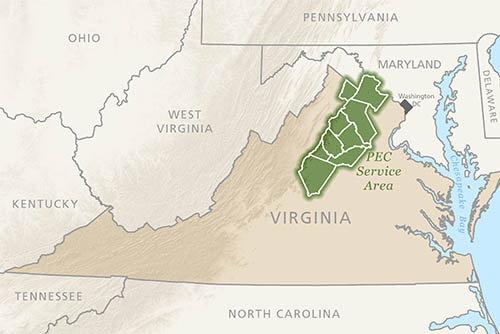
 PEC focuses on nine counties and one city in the northern Piedmont of Virginia: Albemarle, Charlottesville, Clarke, Culpeper, Fauquier, Greene, Loudoun, Madison, Orange, and Rappahannock.
The General Assembly and Governor let us down. Now the SCC must act to protect residents from rising electricity costs.
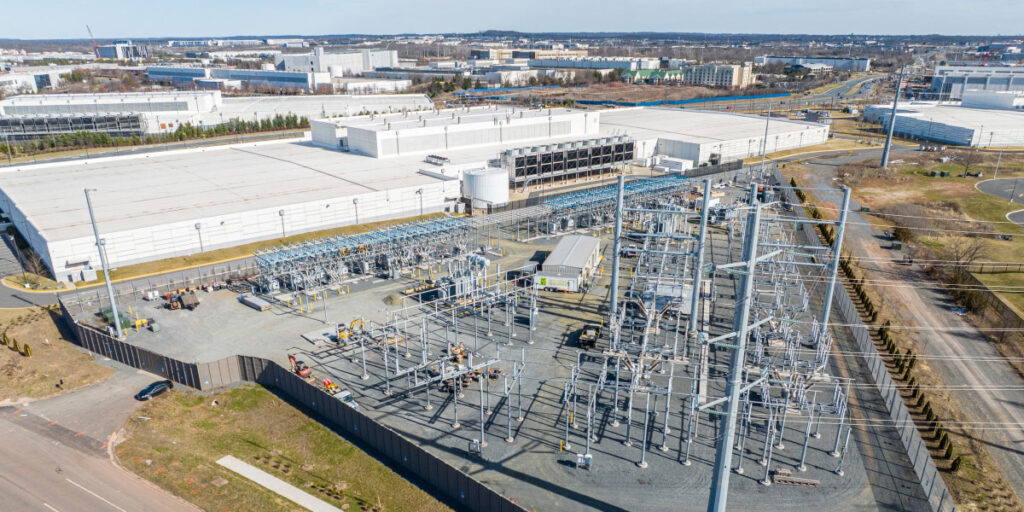
Despite poll after poll showing bipartisan statewide opposition to uncontrolled data center growth, along with accumulating evidence of direct and indirect impacts on air, water, noise, property rights and utility rates, the General Assembly has once again kicked the can down the road and put data centers ahead of the people of Virginia.
On Monday, the General Assembly announced a budget compromise that keeps Virginia’s ~$2 billion annual sales tax exemption for data centers intact. Instead of eliminating that tax break, legislators created a new “electricity consumption tax” that amounts to less than one-third of the state’s tax giveaway. The budget also directs the Department of Environmental Quality (DEQ) to study noise and water issues. Frankly, these are token gestures that do not address the scale of the crisis facing Virginia and do nothing to protect the people and environment. We appreciate the Senate’s effort to press for accountability, but Virginians deserved more.
Here’s what’s important to understand: Because the legislature failed to pause unconstrained data center growth or pass meaningful reform, Virginians are left fighting the impacts piecemeal – at the local level, in state agency permitting, and at the State Corporation Commission (SCC).
These decisions — on local data center approvals, state permits for gas turbines and water withdrawals, and SCC cases on transmission lines and ratemaking — are the remaining avenues of defense for communities, our environment and our electric bills. Every one of them matters, and public engagement at each level makes a real difference. Right now, the most urgent opportunity is at the SCC level to ensure residential customers are not continuing to subsidize the industry’s energy and transmission infrastructure through our electric bills.

Tell the SCC: Make Data Centers Pay for Their Own Infrastructure
Rising electric bills aren’t a mystery — transmission infrastructure is a major culprit, even if the costs are buried in the numbers across multiple lines on your bill. As Virginia prepares to build hundreds of new substations and thousands of miles of transmission lines to serve data centers, those costs will compound significantly — potentially adding hundreds of dollars a year to what average Virginians pay now. How those costs get allocated by the SCC will determine whether that burden falls on data centers or on you.
The SCC is currently considering Rider T1, Case No. PUR-2026-00056, an annual transmission rate case that determines how the cost of new transmission infrastructure gets divided among customer classes — residential, small business, data centers and other classes.
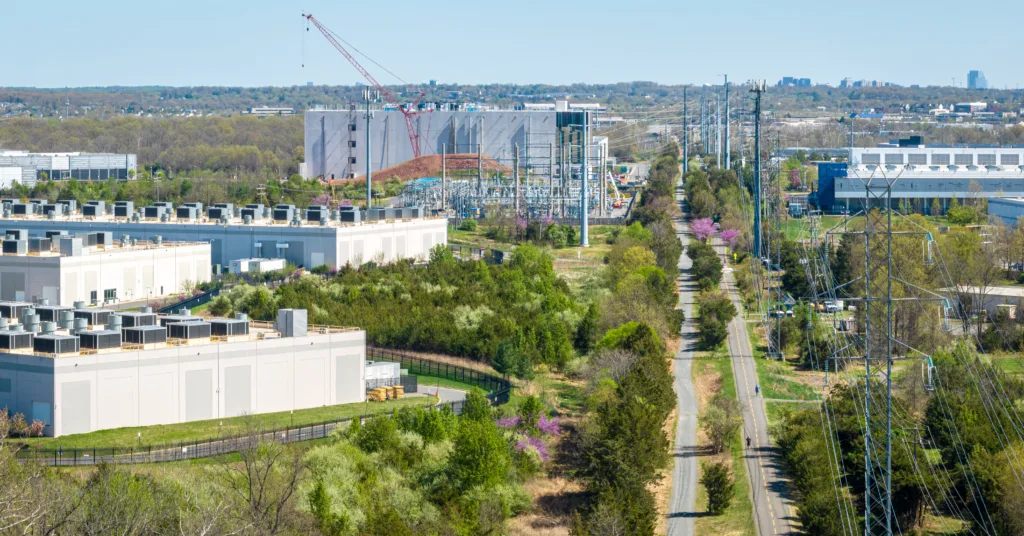
This is a high-stakes case. Dominion Energy reports that it has requests for more than 70 gigawatts (GW) of power from data centers, requiring about 233 new substations. The cost of those substations alone is estimated at $6 billion to $12 billion — and that’s before counting thousands of miles of new transmission lines that will add billions of dollars more.
Working with expert witness Greg Abbott (former Deputy Director of Public Utility Regulation for the Virginia State Corporation Commission), PEC filed testimony in this case urging the SCC to adopt a “but for” standard: but for data center demand, we wouldn’t need to build the vast majority of the transmission infrastructure being proposed – so data centers should pay for it. This “but for” approach is already being applied in Pennsylvania, and it’s the right standard for Virginia. Now it’s time to weigh in.
Add Your Voice by July 9
Your comment doesn’t need to be long or technical. The SCC wants to hear authentic comments from Dominion retail customers and Virginia residents. Tell them:
– You want data centers to pay for the infrastructure they require
– You don’t want those costs passed onto residential ratepayers
– If you’ve faced rising electric bills, seen transmission lines proposed near your home, or live near data center development — share that
– And if rising electricity bills are going to be a hardship, tell them how
How to Weigh In
Comments are accepted on the SCC’s website. Select PUR-2026-00056 and enter your comments.
Public comments will be accepted through July 9. The evidentiary hearing is July 14 and a final order is expected by August 1.
Why This Matters Even After the Budget Disappointment
The electricity consumption tax the General Assembly passed as part of the budget compromise does nothing to address what will appear on your electric bill if the SCC fails to act. A consumption tax on data centers is not the same as requiring data centers to pay for the substations and transmission lines built specifically to serve them. Those infrastructure costs are what will hit residential ratepayers — and they are enormous.
SCC staff have signaled that they recognize the scale of what’s coming and have also recommended changes in how these costs should be allocated. The commissioners need to hear from you though to ensure a fair cost allocation gets across the finish line.
PEC is engaged in multiple cases at the SCC right now including one on Dominion’s process for connecting data centers to the grid where we discovered that Dominion had 70GWs of data center delivery point requests in the pipeline and a timeline for new data center power requests that exceeds 15 years. Read below for more details on what’s at stake and why a pause is urgently needed.
Despite the General Assembly and governor failing to meet the moment with real data center reform, your advocacy is working. The debate happening in Richmond now wasn’t happening two years ago, but it’s now front and center because thousands of Virginians like you kept pushing, kept speaking out, kept standing up. Elected officials are feeling more and more pressure, and the window for real reform is opening.
Thank you for continuing to fight for better outcomes in your communities and across Virginia.
Julie Bolthouse
Director of Land use
[email protected]

Large Load Connection Case – A Peak Into Dominion’s Black Box
PEC has been highlighting since 2023 the crisis by contract, the process in which our utilities agree to private contracts to provide data center customers with unlimited amounts of power on unreasonable timelines. No one has really seen into the black box of Dominion Energy’s procedures, implementation plans, or timelines for providing what now has reached 51GWs of contracted capacity, despite the fact that these contracts are committing all ratepayers to massive expansions of the electric grid in the form of substations, transmission lines, and new power plants.
During the recent SCC Large Load Connection case, PUR-2026-00011, though, we got a peek into that black box and what we saw alarmed all parties including the data center developers. The costs are higher than imagined and timelines are longer than expected.
The current grid peak for the entirety of Dominion’s customers is about 25GW, so the 51GWs of data center electric contracts they’ve committed to providing would triple the grid’s current peak demand. However, during this case Dominion announced that there are actually over 70GWs of delivery point requests to serve data centers in the pipeline necessitating approximately 233 substations which would largely be connected to new 230-kilovolt (kV) transmission lines. This, in addition to larger 500kV and 765kV transmission and substations needed to move large amounts of power throughout the state and from adjacent states, easily will add up to thousands of miles of new transmission lines.
We also know from recent reports put out by PJM (the electric grid operator for the mid-atlantic region) that they are struggling to manage the energy market which is where our utilities purchase power from. PJM explained they have “transitioned from an era of managing surplus to an era of managing scarcity – one that is projected to persist for a decade or more, because new generation simply cannot be built fast enough to offset the combined effect of retiring supply and surging demand.”
In this case PEC advocated for data center customers to demonstrate stronger commitments in terms of collateral and enhanced site control, and to provide more transparency to localities and the public about location and timelines of energy commitments.
With so much demand in the queue and wait times increasing drastically, commitments are important because they can help discourage speculative developments from entering and moving forward in the queue. These projects are integrated into load forecasts and transmission line planning which means costs are incurred well before their delivery point or substation is built.
Possibly even more shocking than the 70GWs in the pipeline was the revelation that Dominion had committed to 27GWs of load with in-service dates before 2032. To provide that amount of power would require around 5GWs a year for the next five and half years. This is a shockingly high commitment when the utility has only been able to bring on 1-2GWs of data center load per year over the last several years of growth, largely from increasing import of power from other states.
In a new “era of scarcity” in the energy market, and with the growing backlash against transmission lines and gas plants in the state, it remains unclear how Dominion Energy possibly plans to bring on line 5GWs (the equivalent of 5 nuclear reactors or 5 average sized gas plants) every year for the next five years. We know that this load is not expected to come online all at once but instead be ramped up over time but it would seem that the compounding effect of 5GW connected per year for five years consecutively would eventually catch up with the utility.
After that 27GWs though, they have the remaining 43GWs in the 70GW pipeline that Dominion needs to coordinate provision of power for. Their proposal is to utilize a new “batching” process that would move forward approximately 10 delivery points or substations of about 2-3GWs annually.
Google expressed concern about this in their testimony stating, “At the Company’s current processing rate of one batch per year [10 substations; 2-3GWs], a project in a later batch could face a 15-year wait just for the commencement of a transmission study, with additional years required for infrastructure build-out.”
The crisis-by-contract that the utility and the industry have continued to ignore has now reached connection delays over 15 years and is committing Virginia to hundreds of substations, thousands of miles of new transmission lines, dozens of new power plants, and potentially much higher electric bills if these costs are not properly allocated to the data center industry.
The case has not been fully decided yet but PEC had a huge win in the interim order with the SCC demanding Dominion submit a new proposal that incorporates into their process:
- Enhanced site control
- Meaningful surety requirement at the initial queue entry that escalates as the project progresses
- Public database of interconnection requests, on an anonymized basis
- Estimated study timelines
- And requirement for company to file future material revisions for review and approval
Protecting Virginians from stranded costs
Despite the bottleneck of energy generation and transmission and the impossible timeline, data center companies continue to seek land use approvals in Virginia. The likely reason is that they believe that if they are allowed to keep building the physical shells, the sheer economic weight of the tech industry will eventually force utilities like Dominion (NextEra/Dominion) and state regulators to find a solution to the power crisis, no matter how destructive and costly it is to communities. This could mean eliminating critical air quality protections, streamlining reviews, fast tracking power plants and transmission lines, and increasing dependence on emergency measures such as utilization of 202(c) orders to keep polluting plants running and use of backup diesel generators at data centers to reduce pressure on the grid during extreme weather events. [see our blog post Times Up: The Costs of the Data Center Tax Break in Virginia Far Outweigh the Benefits]
It is irresponsible for the state to continue to allow unconstrained data center development in Virginia. Until we can get our legislators to take strong holistic action though we must address each component of this crisis where it is playing out. The opportunity before us currently is getting the transmission rate structure set to more fairly allocate these costs to the data center industry.
I know we’ve asked you to write decision makers a lot but the tide is turning. Testimony of SCC staff indicates that they recognize the scale of the load growth coming, the cost that will be incurred, and the need to adjust the allocation so it doesn’t fall onto residential customers. They need your support, your personal stories and pleas to the SCC Commissioners to get a better allocation methodology across the finish line though.
Thank you for your continued support and engagement on this important issue. Feel free to contact me with any questions.