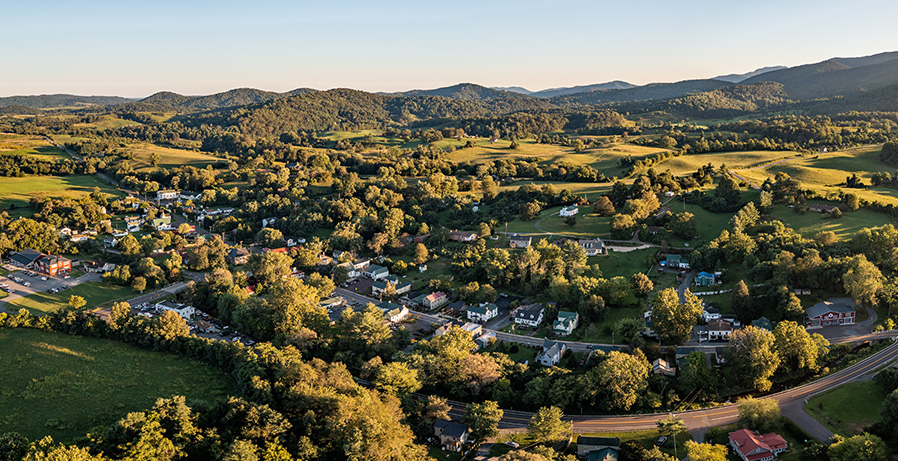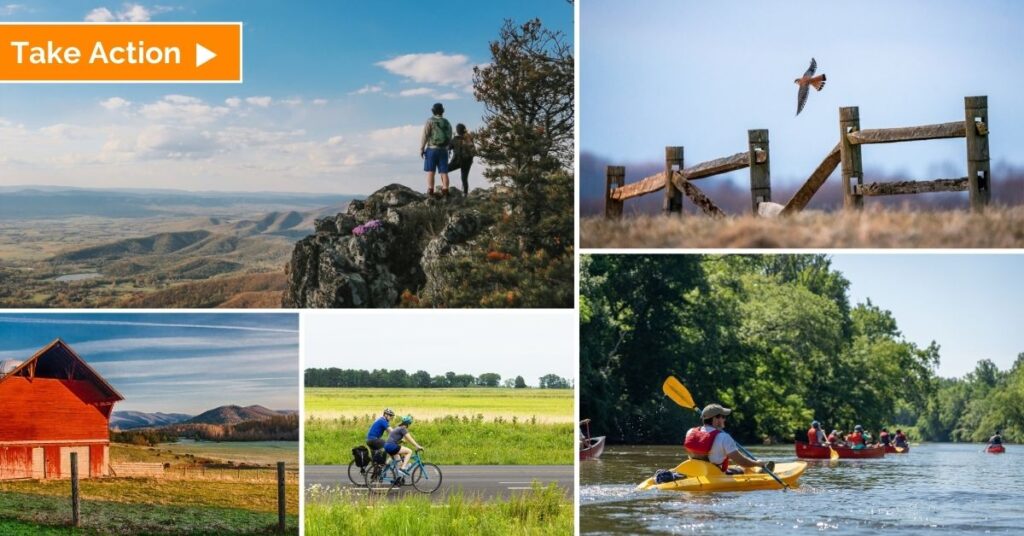

It was fantastic to have such an engaged crowd at our recent Conservation Funding Workshop and Social at Powers Farm & Brewery in Midland!
Our Work
Safeguarding the landscapes, communities and heritage of the Piedmont by involving citizens in public policy and land conservation. Learn more about our work by browsing the subject areas below and find out how to get involved!
Loudoun County Fall Updates
Read on for Loudoun updates on data center, agrivoltaics, transportation, rural zoning, and water issues, as well as opportunities to weigh in on important issues impacting your community!
The Value of Solar Report
Committed to advancing Virginia’s clean energy future, PEC commissioned Dunsky Energy + Climate Advisors to study and calculate the actual value of distributed solar generation to every Virginian — factoring in the range of benefits that utilities do not acknowledge when they are proposing big cuts to net metering values.
Learn more about our findings on the Value of Solar landing page.
Dominion Petition to Reduce Net Metering Benefits Threatens Future of Distributed Energy
Public comment opportunity in late 2025 and early 2026
In May 2025, Dominion Energy petitioned the Virginia State Corporation Commission (SCC) to make regulatory changes to “net metering,” a billing arrangement whereby owners of rooftop and other small-scale solar receive a 1:1 credit for the excess energy their systems generate and send back to the grid. This is the fundamental structure that makes solar economically viable and financially accessible to homeowners, farmers and small businesses. However, because it loses profits from distributed energy, Dominion wants to cut that net metering value and severely undermine the benefit and practicality of all distributed generation — all at a time when we are importing more energy than any other state and are projected to need an additional 40-50 gigawatts to accommodate data center growth. Dominion’s case before the State Corporation Commission later this year and in early 2026 will provide an important opportunity to provide public comment. PEC is an intervenor in this case, posing questions and offering additional information that can be used in the SCC’s decision making. We encourage you to submit comments in support of the current net metering rate structure.
For more information about the Value of Solar report or PEC’s energy work, contact Ashish Kapoor at [email protected].
Net Metering Fight, Value of Solar Report and PEC’s Agrivoltaics Project
Read on to learn more about our recently completed, first-of-its-kind in Virginia, agrivoltaics project at PEC’s Community Farm; the results of a PEC-commissioned study on the true value of smaller-scale solar; our efforts to ensure rooftop solar owners and other behind-the-meter solar users are able to maintain electricity bill savings in the face of a challenge by Dominion; and our upcoming efforts, both during the General Assembly and year-round, to increase distributed generation energy (i.e. solar on rooftops, parking lots, small-scale agrivoltaics, etc.) in Virginia.
Farming the Sun: How Agrivoltaics Can Help Solve Virginia’s Energy Crisis
Virginia needs energy solutions that work with communities, not against them. Agrivoltaics does exactly that—it gives farmers additional revenue to help them keep their land, produces clean energy where people actually want it, and gets projects connected to the grid in months instead of years.
Across the state of Virginia, the electrical grid is at a breaking point. In order to meet the growing energy demand being driven by the explosion of data centers, our state faces the prospect of having to double or possibly triple the electrical grid in the next 15 years, or potentially face recurring blackouts.
As the state scrambles to find solutions, options such as large-scale solar development that could help are facing local opposition and red tape. To address this energy “crisis by contract,” the Piedmont Environmental Council (PEC) is testing a dual-purpose approach that doesn’t force a choice between feeding people and powering our communities. At its Roundabout Meadows Community Farm, located between the county’s data center-heavy east and rural west, PEC has installed a quarter-acre crop-based agrivoltaics project—growing vegetables and producing electricity on the same small plot.
More than simply an agricultural experiment, this project could change how Virginia thinks about energy and farming. Agrivoltaics offers a path forward that both farmers and rural communities can get behind.
Agrivoltaics works…
Instead of deciding whether land should be used for farming or energy, agrivoltaics makes it possible to have both.
American Farmland Trust defines agrivoltaics as the production of marketable agricultural products in conjunction with solar energy production throughout the full life of a solar array, with intentional design that ensures land within the array remains suitable for agricultural production.
Farmers and rural communities that typically oppose large solar developments often embrace agrivoltaics because it keeps their land in agricultural production while saving on utility bills or adding revenue streams. Adding battery backup to the system not only adds another potential future source of income through virtual power plants, but also adds full energy independence – off-grid living. In Virginia, this all matters—we have over 39,000 farms covering more than 7 million acres, with 97% of them family-owned and averaging 187 acres each. Imagine connecting small 1-megawatt (MW) agrivoltaics projects on each of those farms; that would be nearly 40 GW of energy connecting to the grid – on a much shorter timeline than large-scale solar – while directly benefiting our agricultural communities. Even if we got 10% of that potential, it is still the equivalent of four nuclear power plants. By adding solar installations in parking lots and brownfields to the calculus, the energy potential grows significantly higher.
As a land conservation organization, PEC supports the clean energy transition but recognizes that large-scale solar often functions like industrial land use. That’s why PEC focuses on distributed energy solutions—from supporting parking lot solar legislation to organizing “Solar on the Farm” workshops that connect farmers with installers for behind-the-meter projects. Agrivoltaics represents the next step in that strategy.
…PEC’s Community Farm project demonstrates how.

The Loudoun County project shows what agrivoltaics looks like in practice. Through its Clean Energy to Communities program, the U.S. Department of Energy’s National Renewable Energy Lab (NREL) provided PEC with technical guidance and subsequently invited PEC into a national cohort of agrivoltaics developers. The project is also part of a university research network that includes Cornell University, University of Wisconsin, Rutgers University, Virginia State University, Virginia Tech and others.
The site itself has a compelling backstory. The 170-acre Roundabout Meadows property was originally slated to become a shopping plaza with a Harris Teeter grocery store until conservationists stepped in to purchase and preserve the land. Now it sits at the literal edge of Loudoun’s growth boundary—a demonstration of what is possible when you choose conservation and innovation over development.
In the summer of 2025, on a quarter-acre section of the farm, PEC installed 42 solar panels mounted 6-8 feet high.
- After obtaining approval to connect to the electrical grid, the panels now generate 130% of the entire farm’s electricity needs
- The space underneath the panels produces food – crops grown in-ground as well as in planter boxes placed between rows of panels
- The panels are spaced out to create shade conditions that researchers believe help crops grow more consistently
- The project uses fixed-tilt panels because they offer the best cost-benefit for production at a project of this scale
- The design uses NREL data and focuses on replicability
- Everything from cost to construction is designed so that other farmers can adapt it to their own operations.
The broader farming operation at Roundabout Meadows is also impressive, with three full-time staff using Certified Naturally Grown practices on its 40 acres of farmland to grow organic vegetables, donating the full harvest – about 50,000 pounds annually – to local food pantries through Loudoun Hunger Relief and Christ Cares. Volunteers and corporate groups regularly help with the farm work and learn about sustainable agriculture.
Because the project has a built-in battery backup, the farm can keep running essential operations—e.g., well pumps, produce cooling, greenhouse, etc.—even when the electrical grid goes down. While it is an added optional cost, those batteries can do double duty, generating income for farmers by selling excess power back to the grid during peak demand periods, essentially functioning as a small, clean power plant.
In order to measure its effectiveness and address concerns, the agrivoltaics section includes side-by-side research plots to compare how crops perform under panels versus in full sun, measuring everything from crop yields to water usage to disease pressure. Because crops will be grown both in-ground and in raised beds, the findings will apply not just to farms but to parking lots, brownfields and other sites where it may make sense to combine solar energy and useful ground-level activities.

The PEC project is designed from the ground up for replication. Every decision—from cost to construction methods—was made with other farmers in mind.
For farmers and homeowners, solar systems typically save $60,000 over their lifetime—and those savings grow as utility bills rise.

It’s time to make this a reality for more farmers.
Dominion Energy’s tremendous lobbying pressure has been a longstanding and powerful force against efforts to create a more distributed energy grid, because the utility company loses profits from distributed energy, like agrivoltaics. Please submit comments to the State Corporation Commission to keep this energy source viable by maintaining the current 1:1 net metering structure.
View and learn about our energy work →
Why is Dominion trying to kill rooftop solar?
Report Finds Solar Far Exceeds Value Communicated by Dominion
Shining a Light on Agrivoltaics at Roundabout Meadows
Videos: Agrivoltaics Project at PEC’s Community Farm
For more information about the agrivoltaics project or PEC’s energy work, contact Ashish Kapoor at [email protected].
Videos: Agrivoltaics Project at PEC’s Community Farm
Explore our video updates detailing the exciting progress of the Piedmont Environmental Council’s agrivoltaics project, where solar energy and sustainable agriculture meet.
Report Finds Solar Far Exceeds Value Communicated by Dominion
PEC commissioned Dunsky Energy + Climate Advisors to study and calculate the actual value of distributed solar generation in Dominion Energy’s territory.
Resources from the Albemarle Data Center Community Meeting — Sept. 16, 2025
Resources for Albemarle County from our Data Center Community Meeting held Sept. 16, 2025 in Charlottesville.
Culpeper Quarterly Update – Culpeper puts guardrails on data centers
I wanted to fill you in on some recent happenings in Culpeper: 1) a big win for Culpeper County as the Board of Supervisors finally starts putting guard rails on data centers; 2) an update on the Town Unified Draft Ordinance; and 3) some information about planned transmission line and substation expansion to serve Culpeper data centers and how you can provide input.
A legacy of conservation and community at risk in Fauquier County
From their storied pasts to the present day, the Fauquier County towns of Remington, Bealeton and the many unique crossroad communities in the surrounding region have been characterized by their rural charm. And for decades, The Piedmont Environmental Council has been committed to collaborating with these local communities on conservation, land use planning, historic preservation and public access to nature. But as pressure for massive data center complexes spreads beyond Northern Virginia into the Piedmont’s special rural communities, we worry the progress and investments we and many others have made toward conserving, enhancing and preserving these communities will be lost forever.

1990s | PEC opposed the Fauquier Forward plan that would have widened Virginia State Route 28 and replaced the agricultural economy through that area with suburbs. Instead, we advocated for an alternative vision of conservation and helped create the county’s Purchase of Development Rights program, which pays landowners to relinquish development rights on their properties, thus supporting farmers, preserving the environmental and economic benefits of agriculture and preventing costly sprawl. Since then, Fauquier’s PDR program has become a model for other places, creating an important tool for landowners who want to keep their land in farming.
2006 | PEC helped the county acquire Rappahannock Station Battlefield Park, preserving this critical battlefield for a future public park and recreation area near the town of Remington. PEC supported development of a master plan for the park and continues to advocate for walking trails and interpretive signage that will tell the important history of the town and this historic battlefield.


2017 | In support of Remington’s effort to strengthen tourism and enhance pedestrian safety, PEC received a PATH Foundation grant to develop a plan called Remington Walks. This plan to rejuvenate Main Street with walking trails, town signage, pedestrian-friendly connectivity and more was developed with input gathered during community meetings and walking audits with residents. Remington Walks was adopted into Remington’s comprehensive plan and has been a guide and supportive document for several subsequent projects, including a gazebo next to the town hall, completed trail connections to Margaret Pierce Elementary and an improved railroad crossing accessible for strollers and wheelchairs downtown.
2021 | PEC and numerous partners set about creating an Upper Rappahannock River Water Trail that provides much-needed public access at several points along this Virginia-designated scenic river. In August 2021, we helped cut the ribbon on the new Rector Tract public canoe and kayak launch a short walk from downtown Remington. Open dawn to dusk, this launch closes a 25-mile gap in public access to the river between Riverside Preserve and Kelly’s Ford in Culpeper County.


2021 | Waterloo Bridge over the Rappahannock River is the uppermost point of the historic Rappahannock Canal, an important historic resource and a unique community treasure. Built in 1878, it was closed in 2014 and slated for replacement by the Virginia Department of Transportation. Advocating for its restoration, rather than replacement, PEC invested in a consultant to put forward a restoration alternative, held numerous community meetings, pushed VDOT to consider other options, and, with the financial help of the Hitt family, was able to fully restore the oldest metal truss bridge still standing in Virginia today.
2021 | PEC established a native plant garden at C.M. Crockett Park in Midland. As a part of our efforts to promote native landscaping practices, we applied for a grant from Kortlandt Fund of the Northern Piedmont Community Foundation to purchase the native plants for the project. We also designed the garden and worked with the Fauquier Parks and Recreation Department and community volunteers to install it.

The network of support to conserve, enhance, and preserve Remington and southern Fauquier extends well beyond PEC. The local churches, the Virginia Cooperative Extension, and John Waldeck established the Remington Community Garden. The town utilized a PATH Make It Happen Grant to build a new gazebo next to the town hall. And the Remington Community Partnership — run by the tireless Mary and Ray Root — has worked to document, preserve and promote the historic resources of the town. Countless people have led numerous other projects, but a comprehensive list could take up the entire publication!
Remington and its surrounding areas are at the intersection of two very different futures. The tremendous work we’ve all already done together paves a path that retains the region’s rural charm, agricultural heritage and economy, and promise of a vibrant place for visitation and recreation.
This progress is threatened by pressure from multiple data center proposals that could put more industrial development in the quaint town of Remington than all the commercial space in Fauquier County combined. Together these projects would open a floodgate of new transmission lines, substations, construction traffic, air pollution, noise, and massive concrete computer warehouses that will crowd out other forms of investment and business interest and induce even more industrial sprawl.
Before our county leaders make major decisions that will forever alter a critical piece of Fauquier’s rural identity and economy, it’s important to revisit and remember the investments and community accomplishments made in the face of past development pressures that would have transformed this region.
This article appeared in the 2025 fall edition of The Piedmont Environmental Council’s member newsletter, The Piedmont View. If you’d like to become a PEC member or renew your membership, please visit pecva.org/join.