
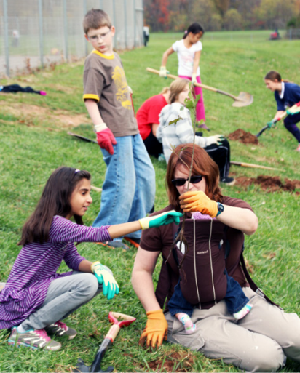
PEC teamed up with Mill Run Elementary School to create a naturally landscaped outdoor area for educating students, parents and the community. This past November, the school’s fourth and fifth grades participated in the project by planting 75 native trees and 135 native plants!
Our Work
Safeguarding the landscapes, communities and heritage of the Piedmont by involving citizens in public policy and land conservation. Learn more about our work by browsing the subject areas below and find out how to get involved!
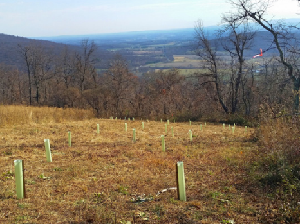
Two Thousand Trees Planted
An interview with PEC’s Sustainable Habitat Program Assistant Celia Vuocolo: What type of restoration happened at the Overlook this past fall? We did a large forest-edge planting of about 2,000 trees and shrubs. The goal was to create a “soft edge” where the forest meets the meadow…
Waterloo Bridge Update — Dec 2014
Text from our Dec 2014 Member Newsletter:
PEC, Fauquier County, and Culpeper County commissioned a report that identified a more cost-effective option for the full rehabilitation of the historic Waterloo Bridge on Waterloo Road (Route 613). The bridge has a long history dating back to the late nineteenth century, but it was closed due to safety concerns last winter.
The Future of Greene County
Greene County Public Hearing for 2015 Comprehensive Plan Update. On November 19, residents will have the opportunity to share their ideas about Greene’s future with the county Planning Commission. The commission is holding a “public hearing” to hear from residents as it begins its review of the county’s Comprehensive Plan. The current Plan was approved in 2010. This may be the only chance residents have to voice their opinions to the whole commission and influence what actually gets revised in the Plan.
Coyotes, Our Elusive Neighbors
For those of us old enough to remember when Looney Tunes ruled the afternoon cartoon television slot, the name Wile E. Coyote holds fond memories of a scrappy canine and his many failed attempts at catching the infamous and speedy Road Runner. To many children this was their first exposure to Canis latrans, who, next to the Gray Wolf, is North America’s other well-known and often misunderstood wild.
While Wile E. Coyote is known to prowl about on the flat, long desert highways of the American West, our Eastern coyote here in Virginia inhabits a different kind of backdrop. Coyotes are found in almost every environment in our state: forests, fields, suburbs, and city alleys. They are a notoriously secretive and seldom seen species. If you do happen to see a coyote, it is most likely due to chance, illness (such as rabies, mange, canine distemper, etc.), or because the animal has become desensitized to humans, which is often the result of either intentional or unintentional feeding.
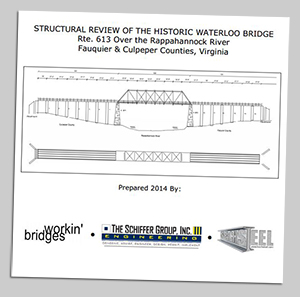
Waterloo Bridge Report
An encouraging new report commissioned by The Piedmont Environmental Council, Fauquier County, and Culpeper County has identified a more cost-effective option for the full rehabilitation of the historic Waterloo Bridge on Waterloo Road (Route 613). The bridge has a long history dating back to the late nineteenth century, but it was closed due to safety concerns last winter.
Route 29 Improvements on Track in Charlottesville
In our last newsletter, we shared great news regarding the demise of the ill-conceived Western Bypass. As you might recall, a major blow to the project had been delivered back in February, when the Federal Highway Administration (FHWA) announced serious reservations about the viability of the project. It made it clear that the necessary federal approvals were indoubt unless VDOT reevaluated the entire project, including a new review of alternatives.
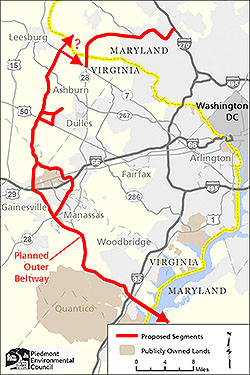
Outer Beltway Update
The Bi-County Parkway project, a key component of the Outer Beltway scheme, is on hold… for now.
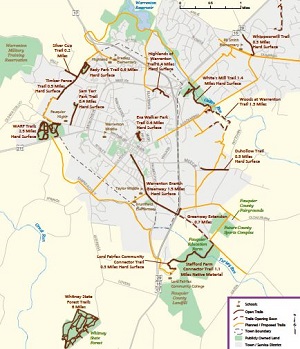
Explore Warrenton Trails
See a map with Warrenton’s trails, and find out where to view additional trail maps in Fauquier County.
This is Big!
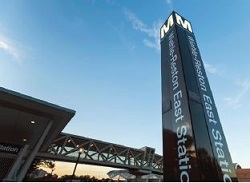
The opening of the Silver Line this past July was an important step toward a better future for the Washington metropolitan region and the Commonwealth of Virginia. For decades, Tysons has been an example of 20th century development, urban and suburban areas that don’t quite work—too many cars, no sidewalks and not enough green space.