
In a dramatic win for historic preservation, after three years of controversy, Walmart has dropped its plans to build a Supercenter at the edge of Wilderness Battlefield in Orange County. On the first day of a court case contesting Orange County’s decision to approve the big-box store, Walmart made a surprise announcement — that it had reversed its course, deciding not to build on the historic property but to preserve it.
Our Region
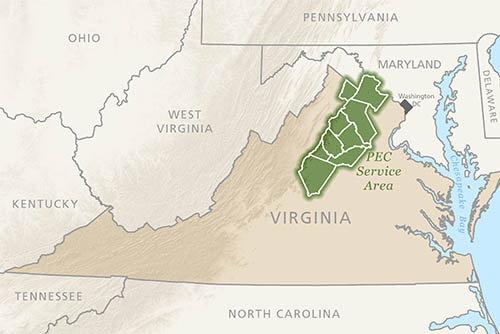 PEC focuses on nine counties and one city in the northern Piedmont of Virginia: Albemarle, Charlottesville, Clarke, Culpeper, Fauquier, Greene, Loudoun, Madison, Orange, and Rappahannock.
We also team with local organizations to promote thriving communities and healthy natural resources in a much larger region, including the Shenandoah Valley, the central Piedmont, and the Journey Through Hallowed Ground Corridor. In addition, we are proud to serve as fiscal sponsor of the Coalition for Smarter Growth, an organization that focuses on land use and policy in the greater Washington D.C. area.
Protecting the Cedar Run Watershed
When Mike and Margrete Stevens first came to Fauquier County eighteen years ago, as the new owners of Bonny Brook Farm, near Warrenton, they made friends with their neighbors Julian and Sue Scheer and Hilary and Rich Gerhardt (the Scheers’ daughter and son-in-law). This friendship with a family of dedicated conservationists led the Stevens to start hosting a wildflower walk on their land each April, as a sky-colored carpet of Virginia Bluebells blossoms along Cedar Run.
Cows, Not Condos
Bev McKay's family has been farming the land that he just protected in Clarke County for over 200 years. Mr. McKay raises dairy cattle on the property, as well as crops, such as corn and barley, to feed the cows.
The land is good for farming, with gently rolling fields and rich loam soils. Because of its value as productive farmland, the USDA and PEC worked together to purchase an easement on 103 acres, over half of which are prime agricultural soils.
Walmart Picks Alternative Site for Orange Store
In late May, Walmart announced that it has chosen an alternative site for its store in Orange County — a successful outcome for preservationists who, for years, pressed Walmart to build its store at a location that would not negatively impact Wilderness Battlefield.
Building Fences for Cleaner Streams
Farmers are using a unique incentive program coordinated by PEC to substantially expand water quality protections in our region. The program helps cover their costs for fencing livestock out of streams.
A Wasteful Bypass and a Better Plan
VDOT gave plans for the Charlottesville Western Bypass an F. So why spend half a billion dollars on it?
That's the question that PEC posed to Charlottesville and Albemarle residents though ads in local papers and a mailing that we sent to 15,000 homes — part of our full-on campaign to stop this wasteful bypass from moving forward ahead of better alternatives.
Saving Nature in Town
Three children romped down the trail, shouting in unison, "We found the Osage Orange! We found the Osage Orange!" The softball-sized fruit, with its bright green, wrinkled shell was the last thing they needed to complete a 26-item scavenger hunt on the Chapman-DeMary Trail in Purcellville — having already discovered hackberry, wild grape, a small island in the creek, a bug on the ground, a good hiding place, and the rest.
Big Growth in Greene

When Brian Higgins joined PEC’s staff as our first full-time field officer for Culpeper and Greene, this summer, he had to hit the ground running in Greene County. For one thing, the county is considering a rezoning for a development of nearly 1,200 units—a single project that could increase the county’s population by 20%.
PEC Initiates Community Discussion on Rt. 22/231 Corridor
During the week of April 12th, 2010, PEC hosted Ian Lockwood, a nationally renowned transportation engineer and designer, who initiated a community discussion on the future of the Rt. 22/231 corridor.
The High Cost of Unfocused Development
Loudoun’s 2011 Debt Obligation Tops $175 million
Years of unsustainable land use decisions have left Loudoun with substantial debt. In the next fiscal year alone, Loudoun has a debt obligation of $175.5 million (which equates to 24.2 cents of the tax rate). This astounding figure is expected to peak at roughly $240 million in 2015.