Albemarle PC to get update on county’s affordable housing efforts; Charlottesville PC to consider special exceptions for 24-unit apartment complex on Barracks Road
Our Region
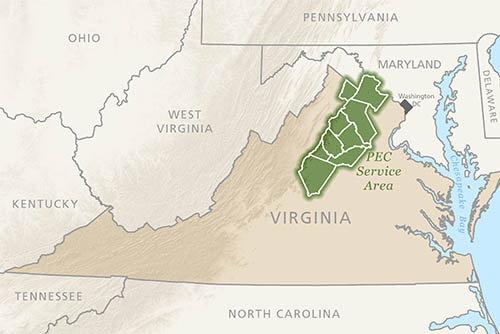
PEC focuses on nine counties and one city in the northern Piedmont of Virginia: Albemarle, Charlottesville, Clarke, Culpeper, Fauquier, Greene, Loudoun, Madison, Orange, and Rappahannock.
We also team with local organizations to promote thriving communities and healthy natural resources in a much larger region, including the Shenandoah Valley, the central Piedmont, and the Journey Through Hallowed Ground Corridor. In addition, we are proud to serve as fiscal sponsor of the Coalition for Smarter Growth, an organization that focuses on land use and policy in the greater Washington D.C. area.
Cville Area Land Use: Week Ahead for June 2, 2025
Charlottesville City Council to hold public hearing on utility rate increases, $12M in spending from CIP contingency fund
Proposed Gigaland Data Center Development Looms Over Remington
A proposal for a massive data center campus known as “Gigaland,” if approved, would have major implications for Remington and Fauquier County and pave the way for more transmission lines and data center approvals. We are urging residents of Fauquier to oppose the project at the upcoming public hearing at the Fauquier County Planning Commission on Wednesday, June 18.
Data Center Resources for Communities, Community Leaders & Elected Officials
A list of links and resources to better understand data centers and their impacts.
Proposed Transmission Line Routes in Loudoun Could Have Significant Impacts for Residents
Increasing energy demand in Loudoun — the data center capital of the world — requires extensive new infrastructure buildout. To meet the load demand, fueled principally by data centers, Dominion Energy has initiated several new/expanded major transmission line projects, including the Morrisville-Wishing Star Electric Transmission Project. Over the last month, Dominion has held four county-based open houses to present options for the Morrisville-Wishing Star route to community members.
Loudoun Development Tracker
In an effort to track development applications that could impact important natural, cultural and historic resources, as well as the quality of life for Loudoun residents, PEC has created a shared spreadsheet that anyone can view.
Cville Area Land Use: Week Ahead for May 26, 2025
This week: Charlottesville PC to review proposed amendments to new zoning code; Rivanna Water and Sewer Authority to hold public hearing on $550 million capital program
Cville Area Land Use: Week Ahead for May 19, 2025
This week: Charlottesville City Council to get updates on efforts to assist the unhoused; Two Albemarle bodies to review updated economic development strategic plan
Broad Run Bridge Expansion Proposal Threatens Chapman-Beverley Mill

Chapman-Beverley Mill Historic Site. Photo credit: Virginia.org
Sign the Change.org petition urging VDOT to reconsider its proposal to replace and significantly widen the I-66 bridge at Broad Run, which would put the historic Chapman-Beverley Mill at risk of significant, irreversible damage!
A proposal from the Virginia Department of Transportation (VDOT) would replace and significantly widen the I-66 bridge at Broad Run, leading to potentially disastrous implications for historic Chapman-Beverley Mill, as well as the Broad Run-Little Georgetown Rural Historic District and the surrounding area.
We are urging community members and those who share our concerns about this issue to attend VDOT’s upcoming public hearing on Thursday, May 29, 2025 and/or submit written comments to voice your opinion and commitment to protect these precious historical landmarks and conservation lands from the unnecessary and costly development of VDOT’s proposal.
Scroll down for hearing info and location, as well as how to submit written comments.
Background

In summer 2023, VDOT approached PEC about its proposed replacement of the bridge “superstructure” for the portion of Interstate 66 that crosses over Broad Run, directly in front of the Chapman-Beverley Mill. (A superstructure is the elevated portion of the bridge where cars drive. Here is another example of a superstructure project in Virginia, and here is more general information about superstructures).
However, in January 2025, VDOT sent us this letter, notifying us that it had decided to pursue a full bridge replacement for reasons it points to as being the expected lifespan of the substructure, the cost of a new bridge relative to the superstructure placement and the fatigue stress caused by the existing design.
VDOT’s new proposal would significantly widen the shoulders on both sides of the bridge by 30 feet, supposedly intended as pull-off areas for trucks and breakdowns.
PEC and other consulting parties, including the Bull Run Mountains Conservancy, Prince William County, Fauquier County Board of Supervisors, and the Buckland Preservation Society, have all raised concerns that this new proposal extends too close to the historical Chapman-Beverley Mill and the surrounding Broad Run/Little Georgetown Rural Historic District. Collectively, we are requesting more information about why such a wide shoulder is necessary.

Public and privately conserved land appears in green.
The Fauquier Board also recently passed this resolution asking VDOT to hold a public hearing on this important project.
That hearing will take place on Thursday, May 29 in Marshall, VA.
VDOT Public Hearing Info
When: Thursday, May 29, 5 – 7 p.m. (Inclement weather date: June 5, 2025)
Where: Marshall Community Center, 4133-A Rectortown Road, Marshall, VA 20115
What you can do:
1. Speak at the public hearing if you can, and/or
2. Submit written comments to VDOT by June 9:
• Print and fill out the comment form and mail it (mailing address listed on the form). You can also drop off the comment letter at the public hearing.
• Email comments to Mr. Kevin Barnholt, Project Manager, Virginia Department of Transportation at [email protected]. Please reference “Interstate 66 Bridge Over Broad Run Comment” in the subject line.
With multiple groups raising concerns and the potential loss of irreplaceable historical landmarks, it’s clear that additional discussions are needed to ensure that this thoroughfare is protected from further harm, both now and in the future.
PEC position: Just the existing bridge structure should be repaired, as originally planned, and the bridge should not be fully replaced and certainly not widened.
Sign the Change.org petition urging VDOT to reconsider its proposal to replace and significantly widen the I-66 bridge at Broad Run, which would put the historic Chapman-Beverley Mill at risk of significant, irreversible damage!
Talking Points
We urge those who share our concerns to attend the upcoming public hearing on May 29 and/or
submit comments to VDOT by June 9, 2025 to express your opposition to VDOT’s new proposal to replace and significantly widen the bridge, which would have potentially disastrous implications for the Chapman-Beverley Mill.
Below are key points you should know about the proposed bridge expansion. In addition, we have provided a link to download more talking points for use when providing input, which include additional details on VDOT’s proposal and our concerns about the potential impacts to the Chapman-Beverley Mill, Broad Run-Little Georgetown Rural Historic District and the surrounding area.
Here’s what you need to know:
- Under the original 2023 proposal, all work would have occurred within the existing footprint, and VDOT stated there would not be a significant increase in the bridge’s width. The new plan, which calls for full replacement of the bridge and its support structure, is costly and unnecessary, and would have much more drastic implications. Specifically:
- Such a replacement will require new pilings and new foundations to be installed, which may require blasting or other excavation impacts. Foundation work near the fragile Chapman-Beverley Mill structure would create vibrations that could put the Mill at risk of significant, irreversible damage.
- Widening I-66 by 60 feet directly in front of the mill will put the mill at risk.
- In addition, new shoulders and approaches would be required, all of which will increase the proposed impacts of the new bridge.
- VDOT hasn’t addressed the impact on the mill of the construction process and the finished product, as well as vibrations from traffic that will be closer to the Mill once the wider bridge is complete.
- Because the VDOT bridge project is federally-funded and has a potential impact on historic properties listed on the National Register of Historic Places, it invokes Section 106 of the National Historic Preservation Act. Section 106 requires VDOT to identify and assess effects on historic properties, consider alternatives to avoid or mitigate any adverse effects, and designate affected stakeholders as consulting parties to provide public input and recommendations on the project.
- VDOT has made a Determination of “No Adverse Effect” and sought agreement from the Virginia Department of Historic Resources (DHR). This determination of no adverse effect is the result of the Section 106 hearing.
- PEC asked DHR not to concur with VDOT’s determination and to request that the bridge replacement proposal’s impacts be reevaluated and that lower impact, more cost effective alternatives be pursued. In response, DHR sent this letter to VDOT outlining its concerns about the potential negative impacts of the bridge replacement and related work on the Chapman-Beverley Mill.
- Although VDOT sent this letter in response to DHR’s letter and questions, its response does not sufficiently address concerns about the long-term impacts of the wider bridge on the mill or ongoing long-term maintenance requirements and costs as well as other matters.
- Furthermore, shoulders on bridges are not preferred locations for vehicles to pull off. The bridge replacement and expansion opens the door to a wider I-66 and for the shoulders to eventually become travel lanes in the future, which would put traffic even closer to the historic Chapman-Beverley Mill.
View/download additional talking points on the Broad Run/Chapman-Beverley Mill bridge expansion by clicking below.
U.S. Route 29 Slated to Become an “Innovation Corridor”
This text was taken from an email alert sent out on May 15, 2025. Sign up for email alerts →

Dear Supporter,
U.S. Route 29 is the primary gateway into Albemarle County and Charlottesville, a Main Street of sorts that brings in residents and visitors from near and far to everything great the area has to offer. Several new economic development projects are taking place along the roadway between Charlottesville and Ruckersville in Greene County. These development projects have received little public attention, but have the potential for major impacts to the environment, transportation, land use, housing, schools, and the climate.
Economic development is an important tool for a locality, but Albemarle County already has several sectors like tourism, recreation, medical and agriculture that have both a positive economic and quality of life impact for area residents — not to mention the overall impact of the University of Virginia. We urge the County to prioritize supporting and nurturing these existing sectors that already bring great benefit to our community. Visitor spending brought nearly $1 billion to the area last year, nearly matching that of the annual $1.2 billion defense sector, while also serving as an additional motivator to preserve and protect our natural, cultural and historic resources, expand our trail and transportation systems, and increase climate mitigation funding.
The outdoor recreation economic sector has only continued to grow since the COVID-19 pandemic, as organizations like PEC and others have rallied around initiatives to increase public access to green spaces. The quality of life in our urban and rural areas is a major factor affecting retention and expansion of businesses as well as attracting new businesses. Supporting the agricultural economy also enables our farmers to farm, process, and market locally, where the community sees a return on investment through local job creation and tax revenue. Additionally, the uncertainty at the federal level calls into question why there would be a sole focus on growing the defense intelligence and biotech sectors.
Read on to learn about some of the proposed and approved projects and why they matter.
Economic Development in Albemarle County
As an outgrowth of the 2004 Crozet Master Plan, Albemarle County became more intentional about cultivating an effective economic strategy, restructuring its Economic Development Authority in 2016. Prior to that restructuring, in 2010, the county adopted an Economic Vitality Action Plan to address the need to create quality jobs with a focus on current local and existing businesses and to expand the commercial tax base.
Now, the county is working on a new Economic Development Strategic Plan, and PEC has joined the stakeholders committee. Look out for a future email with more on this initiative soon. In the meantime, I highly recommend you visit the Economic Development Strategic Plan public engagement webpage to learn about how the county is acting on economic development.
Major Projects Within Albemarle’s U.S. Route 29 Corridor

The projects listed below are currently in development in Albemarle County. As we learn more about these projects, we will continue to update you on ways to advocate for smart growth and resource protection. We’ll also remain focused on wider implications for land use, smart growth planning, transportation, infrastructure, natural resources and quality of life in our community.
In Albemarle County’s process for adopting the fiscal year 2026 budget, the Board of Supervisors and county staff have discussed the importance of expanding revenue from non-residential sources. However, absent from those discussions have been specific details about how much growth will occur by cultivating these new projects, how much that growth will cost and what are the possible impacts we need to plan for are.
Rivanna Futures
Last year, Albemarle County acquired 462 acres of land along the east side of U.S. Route 29 North adjacent to Rivanna Station, the home of three federal defense intelligence agencies, with the goals of retaining those Department of Defense installations and expanding the private sector in the community. The project is called Rivanna Futures.
An initiative with such goals will most certainly have major land use, transportation, water, energy, and infrastructure implications for the county and its residents, especially for the 8-mile stretch of U.S. Route 29 going up to the southern edge of Greene County.
GO Virginia “Innovation Corridor”
A state-wide economic development initiative called GO Virginia seeks to designate the U.S. Routes 15 and 29 as a Defense and Intelligence Industry Corridor. This would expand defense and intelligence development throughout the area from Fauquier County, down through Culpeper, Orange, and Greene Counties, and culminating in Albemarle County and Charlottesville.
In April, GO Virginia awarded over $613,000 in funding to the County for infrastructure design of Rivanna Futures.
A proposed new vision for U.S. Route 29, transforming the area into an economic development-focused “innovation corridor,” has the potential to impact the environment, transportation, land use, housing, schools and the climate.
This vision is shared by Albemarle County, UVA, the UVA Foundation, and others, with a major focus on growing the defense intelligence and biotech/biomedical economic sectors extending from Charlottesville and UVA along U.S. Route 29 to just north of Ruckersville in Greene County. It is also part of a regional effort to establish an “innovation corridor” along the 60 miles of U.S. Route 29 between Fauquier County to Charlottesville.
Project VITAL: Virginia Innovations and Technology Advancements in Life Sciences
Following the groundbreaking for UVA’s Manning Institute for Biotechnology in 2023, Governor Youngkin announced that a network of research institutions will be established between the University in Charlottesville, Virginia Tech’s Fralin Biomedical Research Institute at VTC in Roanoke, and Virginia Commonwealth University’s Medicines for All Institute. Initially branded as Virginia’s Research Triangle, Old Dominion University in Norfolk, Va. was later added to the research network. The announcement emphasized the desire for increased commercialization between the four cities, similar to North Carolina’s Research Triangle. UVA officials have estimated that the Manning Institute will generate hundreds of jobs and potentially thousands indirectly by attracting biotech and pharmaceutical companies to the greater Charlottesville/Albemarle region — focusing on bringing in new talent from outside that region.
Consider, will these projects bring an influx of people and their families to the region? What will this mean for traffic, schools, housing, cost of living, pollution, and climate? The community has had much to say about these topics in recent years as traffic and the cost of living have increased. Where is this deeper analysis happening, and can the county make it public for feedback from its citizenry?
Haven’t heard much about these major projects? Likely others haven’t either. So, send this to a friend and have them join our mailing list to stay informed about what’s going on in Albemarle and Charlottesville and ways you can get involved.
Thank you!
Rob McGinnis, PLA FASLA
Senior Land Use Field Representative
Albemarle & Greene Counties
[email protected]
(434) 962-9110