
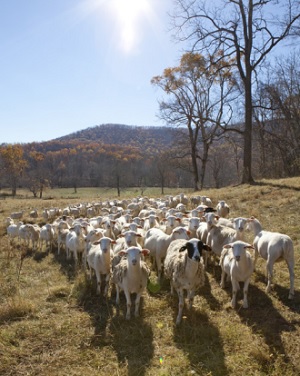
Like many Piedmont farms, Over Jordan Farm in Rappahannock has been a pasture-based operation for decades. After 20 years of overgrazing, however, it’s facing issues that are common in the region—poor soil health, a lack of grass and plant diversity and the resulting lack of nutrients for livestock. This not only decreases a farm’s profitability, but it’s also a major source of runoff and soil erosion in VA.
Working Farms & Food
Farmland and forests produce the necessities of life and provide essential natural services. In PEC’s nine county area, over 180,000 acres of farmland and 140,000 acres of forests are protected through private, voluntary land conservation.
Expanding Beef Cattle Profitability in VA’s Northern Piedmont
Currently:
• Most weaned and backgrounded calves leave the state for fattening in out-of-state feedlots.
• A small percentage of calves are kept as stockers before shipping to out-of-state feedlots.
• Most cow-calf operations take commodity price. Some buyers pay premiums.
• Beef returns as “boxed beef” for retail to metro-consumers. Value/revenue is lost out-of-state.
A small percentage (<10%) of the region’s farms and cattle are conception-to-carcass operations that direct market beef (mostly pasture raised or grass-fed) at a premium to consumers. They process beef (usually one or two at a time) at one of six custom facilities. These producers are seeking additional slaughter and processing capacity.
Pastures in the region are currently underutilized with gains at about 1 lb/day.
Efficiencies in cattle and pasture management, grazing, and transit, processing, even paperwork could increase returns to producers and the region. Processing and sales volumes could greatly increase. Additional acreage would be employed in grazing cattle retained in the region. Total returns to the regional economy would increase.
Loudoun Farm Incubator
The concept of incubators to launch new farm businesses has been developing in the sustainable agriculture community for years. Veteran agriculturalists understand that, much like a successful farm business, a successful farmer incubator requires very particular skills and experience.
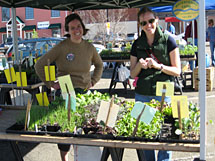
Defining our Food Labels
When talking about our food, we constantly hear terms like ‘organic’, ‘local’, ‘free-range’, and ‘grass-fed.’ These labels are meant to guide consumers’ food purchasing decisions by offering information on the farming methods used to grow or raise food, and the reassurance that food safety risks have been minimized. More often than not, however, I find it difficult to distinguish the plethora of different labels.
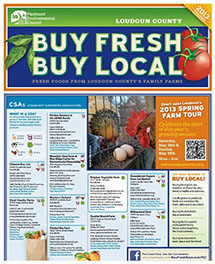
Discovering Local Food
In my role as the Buy Fresh Buy Local Coordinator for The Piedmont Environmental Council (PEC), local food is an everyday topic of conversation. From broader discussions on how to encourage larger institutions to purchase locally or how to make the food distribution system more efficient, to quick conversations with farmers about a new ethnic vegetable variety or gourmet garlic — Buy Fresh Buy Local is all about strengthening our local food system so that it supports farmers and consumers alike.
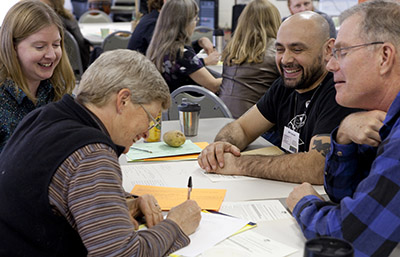
Buy Fresh Buy Local Work Session
Piedmont Environmental Council has been a Buy Fresh Buy Local (BFBL) chapter coordinator since 2007. Over that time, our three BFBL chapters have grown to include over 600 farms, farmers’ markets, retailers, restaurants, wineries, and specialty food producers all committed to our local food system.
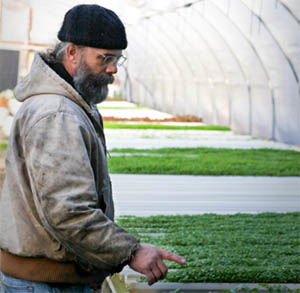
Planet Earth Diversified
You might think it unlikely that a farmer as grounded as Michael Clark of Planet Earth Diversified would get his inspiration from the spaceship Apollo 13. But if you take a tour of his farm, you'll see just how technology and careful engineering play into every aspect of its production.
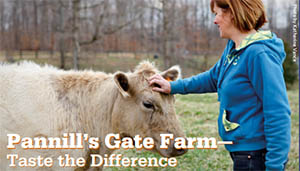
Pannill’s Gate Farm
“Come ‘ere babies, who’s gonna come visit?” Patty Johnson calls out as we climb the fence into the field at Pannill’s Gate farm near Culpeper, Virginia. The cows regard her carefully, presumably weighing their chances of getting food or a scratch on the head. Every day, Patty is out in the fields, checking on her entirely grass-fed herd of Red Angus and Murray Grey cattle. For her, the practice of rotational grazing, or moving the cows to a new strip of pasture daily, “re-establishes that relationship- why I am here and why I do this.”
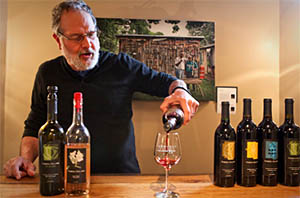
Fabbioli Cellars
For Doug Fabbioli of Fabbioli Cellars in Leesburg, growing his winery and his vines in a way that is environmentally and economically sustainable is a center point of his business philosophy. “Honestly,” he says, “environmental and economic sustainability really go hand in hand.”
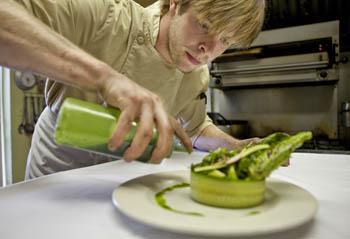
L’etoile
Mark Gresge is a self proclaimed food nerd. He loves food. He loves researching food history, learning about why people eat what they eat, what foods pertain to particular regions — he can't get enough. We all know that food nerds are not a rarity in Charlottesville. Yet, it's the path that Mark's passion led him down that's rare. Mark went from being an engineer who loved to cook, to owning and operating the Main St. restaurant L'etoile with his wife, Vickie Gresge.