
In June 2011, the Albemarle County Board of Supervisors shocked constituents by holding an unpublicized, late-night vote to resurrect the Route 29 Western Bypass, northwest of Charlottesville. Since then, VDOT—under pressure from political interests in Lynchburg and the McDonnell administration—has put the Bypass on the construction fast-track. While communities north of Charlottesville may think this bypass is only a local issue, there are compelling reasons for Virginians everywhere to pay attention—and it’s not just the quarterbillion dollar price-tag. Big picture: this bypass is part of VDOT’s vision to transform Rt. 29 into a Central Virginia Interstate; acting as an alternative to I-81 and I-95. This is not only a bad idea, it’s not feasible without a massive right-of-way acquisition and billions of dollars in funding.
Maps & Resources
Changing Perspectives: My time as a PEC Fellow
PEC’s Fellowship Program, which just finished its sixth year, gives college and graduate students a comprehensive look at the work PEC does in this region—with the hope that the participants will take what they learn in the program into their future careers and communities.

Farm Wineries in the Piedmont: Finding the right balance
Over the past year, there has been an increasingly heated debate over whether and how local governments should regulate the entertainment activities of farm wineries in Virginia. This is a multifaceted issue with multiple interests involved, and what works for one county doesn’t necessarily work for another. As more farm wineries make their home in the Piedmont, localities will have to decide what future they envision for their rural areas and their communities—and how farm wineries fit into that picture.
Video Shows the Real Solutions to Traffic Problems on Rt. 29
Nobody doubts the need to fix traffic problems on Route 29. But the proposed $250 million Western Bypass is not the answer—nor is it a done deal. View this video produced by The Southern Environmental Law Center to learn about more cost-effective alternatives that would provide greater benefits to the Charlottesville-Albemarle community.
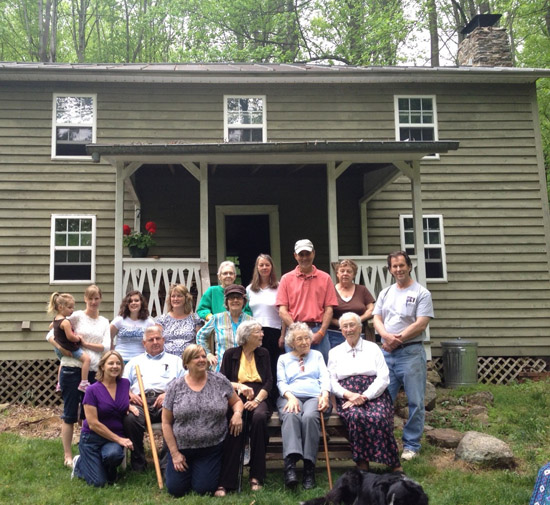
Hike Revisits Life in the Mountains
In the foothills of Greene County, on May 5, the woods were brilliant with lush spring growth. A gravel road led up and up into the hills; eventually it would end at the border of Shenandoah National Park. Down a long drive, set deep in the forest was an old house—a sturdy two-story frame cabin with a welcoming front porch, at the edge of a clear, rushing stream.

How Plants Fly
As my mother and I pulled up at the Jones Nature Preserve in Rappahannock, a brilliant bird dipped through the air—a rich tropical blue on delicate wings. They came in this week, Bruce Jones told me, the indigo buntings. He had led a bird walk over the weekend, and they saw 15 to 20 of these migrants, which flourish in the shrubby areas between his meadows and his woods.
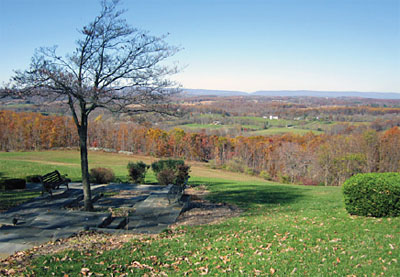
On the Ground Conservation
PEC thanks everyone who protected their land in 2011—preserving the Piedmont’s natural heritage for generations to come. Read a brief story from each of our 9 counties.
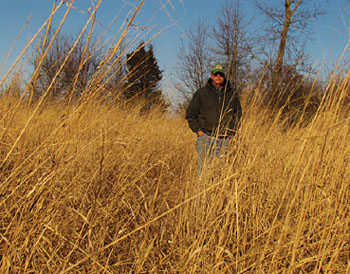
Making a Comeback
When Bill Sanford was a boy on Arrowpoint Farm in Madison County, at the confluence of the Robinson and the Rapidan Rivers, the fields were full of bobwhite quail. He could go out after school, he says, and find three coveys of birds in a field before he had to go inside to do his homework.
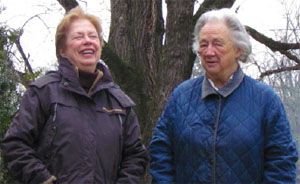
Forty Years of Conservation
Hope Porter and Sue Scheer have been fighting to protect rural land for decades. It was in the late 1940s that Porter and her husband realized what the post-war surge in automobile ownership and long-distance commuting could mean for Fauquier County, their home—unless people stood up to protect the countryside. Together with a few likeminded neighbors, they worked to establish the county’s first zoning, when any kind of land use planning was still a rarity.
Uranium Mining: “Not the Time to Relax”
The uranium in Virginia will remain safely underground for now, although pressure is still building to overturn Virginia’s ban on mining and milling this radioactive mineral.
Despite a massive lobbying effort by Virginia Uranium, LLC, it appears that efforts to end the ban this year lacked political support, particularly after a National Academy of Sciences study released in December confirmed that uranium mining and milling would expose Virginians to unprecedented risk. On January 20, Gov. Bob McDonnell requested that there be no effort to lift Virginia’s ban on uranium mining this year, but directed state agencies to start drafting regulations for potential uranium mining and milling.