
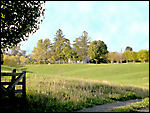
CULPEPER, FAUQUIER, ORANGE — PEC’s staff follows Comp Plan updates and revisions in our nine-county region closely, and we’re currently keeping a sharp eye on the process in Culpeper, Fauquier and Orange Counties.
Maps & Resources

Spectra Energy Gas Pipeline Suspended
If you’re not on our email list, you may have missed that there was some welcome news on the proposed Spectra Energy gas pipeline, which affected Albemarle, Culpeper, Fauquier, Madison, Orange and Rappahannock Counties.
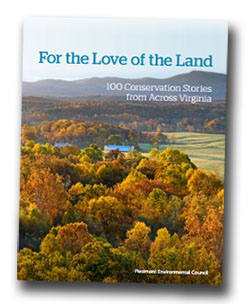
For the Love of the Land: 100 Conservation Stories From Across Virginia
For the Love of the Land features 100 conservation success stories from across Virginia, representing every legislative district—a sampling from among thousands of places in the Commonwealth that are now protected forever. At a time when many of the special places in Virginia could easily be lost, these stories remind us why land conservation is so important.
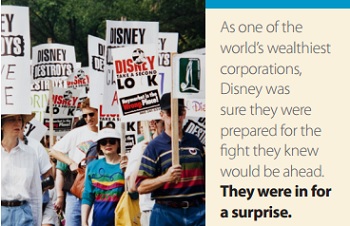
When Mickey Came to Town
Virginia’s northern Piedmont is a beautiful and vibrant place—boasting of forests, rivers, mountains, farmland, thriving towns, and numerous historic and cultural resources. But all of this came under threat in November 1993, when the The Walt Disney Company made a surprise announcement that they planned to build an American history theme park near what was then the small town of Haymarket, VA—only four miles from Manassas Battlefield.
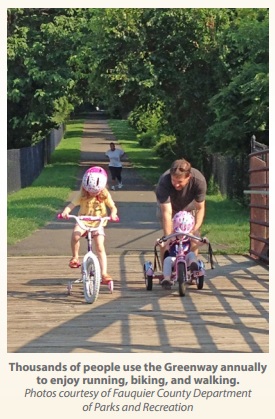
Expanding the Warrenton Branch Greenway
The Warrenton Branch Greenway is a treasured community resource in Old Town Warrenton. The 1.5 mile-long trail not only provides a great outdoor recreational space, but it is also an important historic resource—as it follows the old Orange and Alexandria Rail-road line that was built in the 1850s. Today, thousands of people use this trail annually to enjoy running, walking and biking.
From the Field: PEC’s Piedmont Memorial Overlook
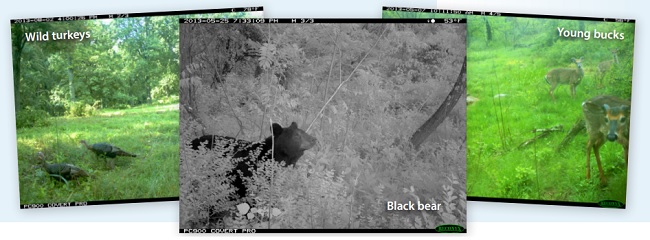
The first two steps in land management are to assess what condition the land is in and then decide what your goals are. PEC is going through both of these steps at the Piedmont Memorial Overlook—our 50-acre tract that straddles Clarke and Fauquier county.
On the Ground- Fall 2013
There's a lot going on throughout the region, including short stories from Albemarle, Clarke, Culpeper, Fauquier, Madison and Orange.
Looking Ahead
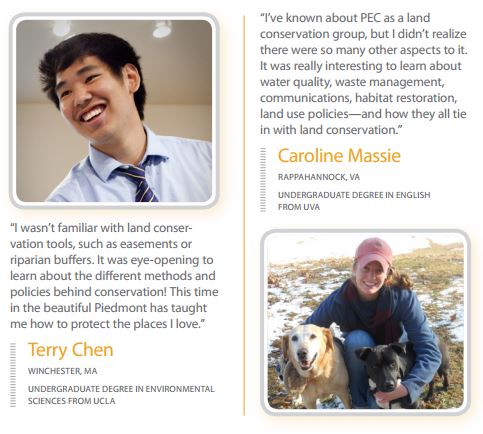
PEC’s Fellowship Program, which just finished its 7th year, gives college and graduate students a comprehensive look at the work PEC does in this region. Through classroom discussions, field trips, hands-on activities, and a final project—participants gain practical knowledge and skills to transition into careers in conservation, urban planning, agriculture, historic preservation, public policy, and other related fields. PEC’s staff obviously thinks the Fellowship is a great program, but don’t take our word for it!
Transportation Updates
A quick update on the Charlottesville Western Bypass and DC Outer Beltway
Restoring Local Food Systems — An educational seminar series in Charlottesville
Though the local food movement has picked up momentum in our region, there are still a number of challenges that local food producers and distributors face as they try to create a sustainable local food economy. Last January, The Piedmont Environmental Council (PEC) hosted a work session for their Buy Fresh Buy Local chapters in Charlottesville, Loudoun, and the Northern Piedmont. The goal was to provide a space in which local food providers could bring up a topic of interest, meet others who are interested in a similar issue, and then take part in constructive conversations and strategic planning centered around a plan of action.