This text was taken from an email alert sent out on May 6, 2026. Sign up for email alerts →
Dear Supporter,
As data centers requiring more and more power continue to flood our region, we are seeing a concerning new trend: data center proposals that include onsite natural gas turbines to use as their main power source, as a means of bypassing the long wait to be connected to the electrical grid.
This stop-gap approach is a public health and environmental crisis in the making. If these gas turbine power plants become the regional standard, the combined air pollution will degrade Virginia’s air quality for decades.
Gas turbine-based power plants emit harmful air pollution, including fine particulate matter (PM2.5), which is widely recognized as one of the most harmful pollutants to human health. Extensive scientific evidence shows that long-term exposure—including at levels below current federal standards—is associated with increased risk of various respiratory, lung and cardiovascular health problems.
The Hidden Health Costs
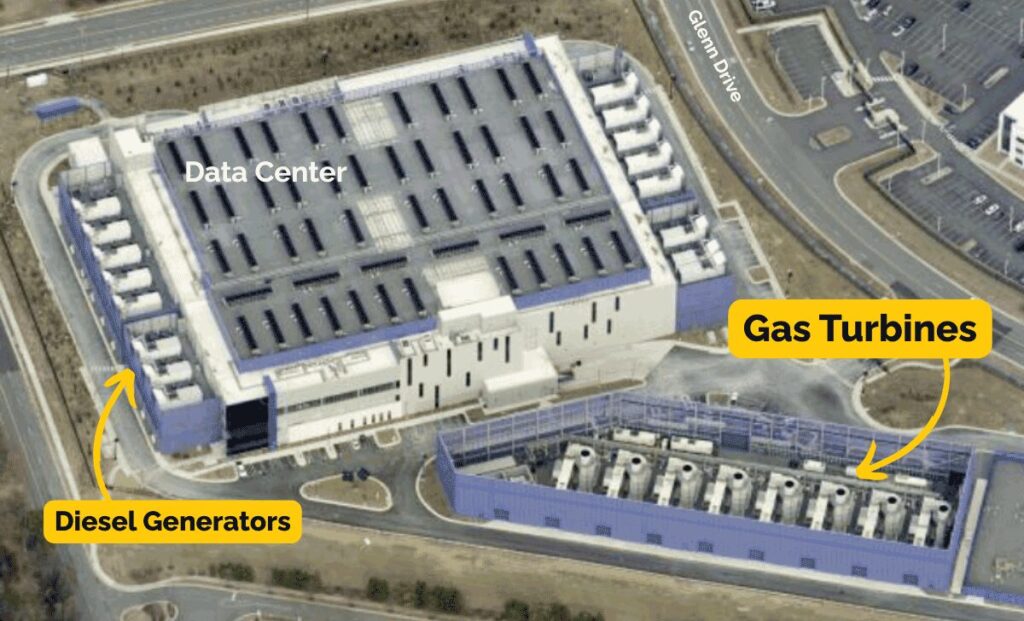
To quantify the health risks, PEC commissioned an independent study by EmPower Analytics Group. The study focused on the Vantage VA2 facility in Sterling, which is the first in Virginia to use this 24/7 gas power, to model potential public health impacts when these turbines operate in populated areas.
The Vantage VA2 data center in Loudoun County, which uses eight natural-gas simple-cycle turbines for full-time power and has a permit for 51 diesel generators for emergency backup power, is located right next to a residential community. The constant noise it produces had already raised significant concerns from many neighbors, but we wanted to understand the public health implications of emissions from this type of facility.
Study Findings
The findings of the study are a wake-up call for the entire region. Emissions from these on-site natural gas power plants could translate to millions of dollars in annual public-health costs for Virginians.
Permitted emissions specifically from the Vantage VA2 data center’s onsite power system could result in:
- $53 million – $99 million per year in health-related damages, potentially up to $265 to $495 million over five years
- 17-33 additional premature deaths over the next five years across the impacted region
- Increased instances of non-fatal hospital admissions, asthma-related impacts and lost productivity
- Increased emissions in communities with existing air quality burdens
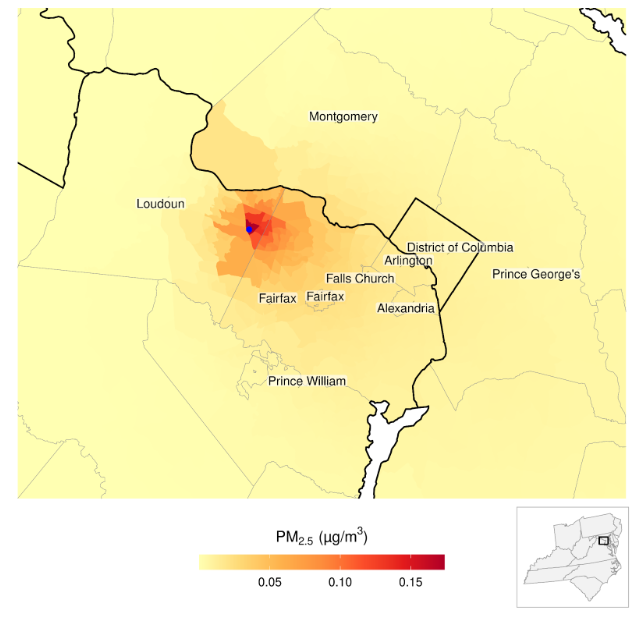
Impacts from air pollution are not limited to nearby residents: The study shows that people living miles away can be affected by a data center’s onsite natural gas turbine power. In the case of Vantage VA2, its emissions reach more than 2.5 million people, including those living in neighboring counties and parts of the broader Washington, D.C. metropolitan region. In addition, areas estimated to have some of the highest impacts from the Vantage facility overlap with marginalized communities, which are more vulnerable to air-pollution impacts.
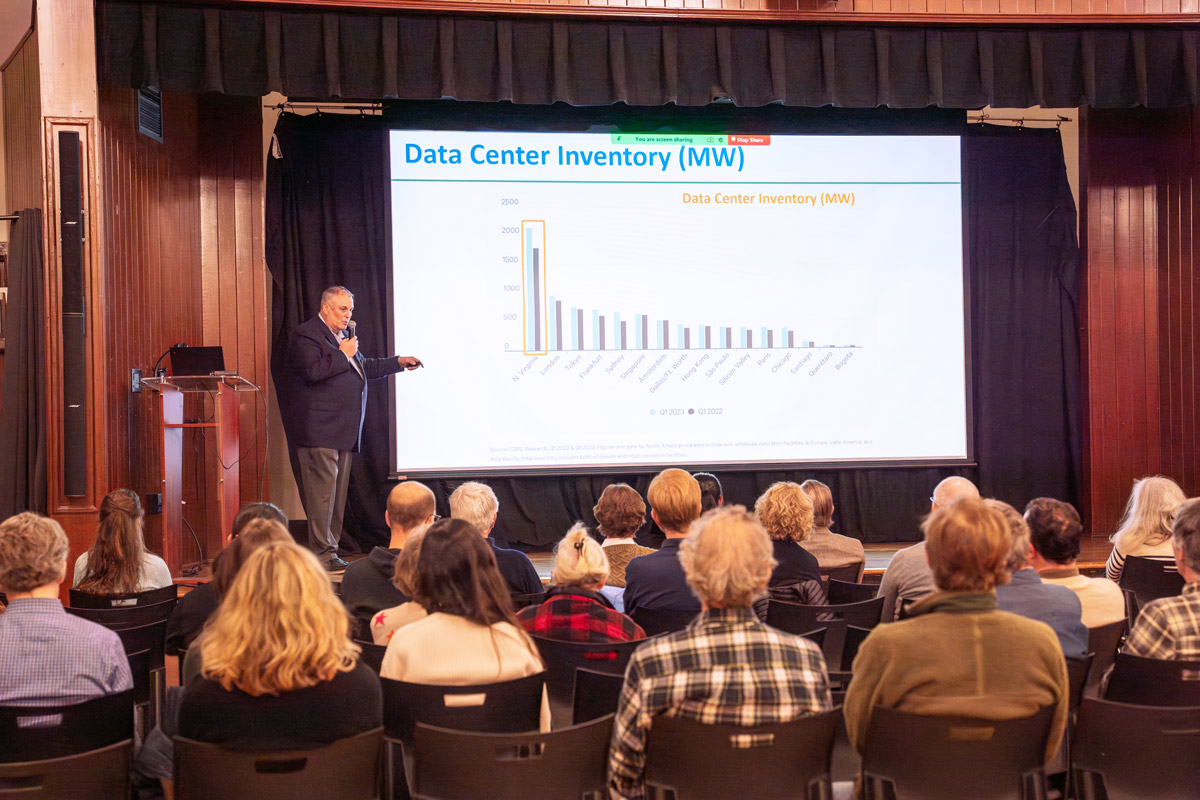
→ We recently presented the Vantage study findings to the Sterling community living near the data center: View the recording and slides.
Emissions from Vantage VA2 and from intermittent use of backup diesel generators at multiple other nearby data centers have a cumulative impact on air quality – over 13,000 generators are currently permitted across Virginia.Other studies by Virginia Commonwealth University, University of California and George Mason University have also revealed harmful impacts from data centers and their backup diesel generators.
Two Reports: Two Very Different Questions
Last week, the Virginia Department of Environmental Quality (DEQ) released a report critiquing our study. However, the two reports have entirely different objectives and answer very different questions, which we highlight in our recent response. DEQ’s report evaluates the facility’s compliance with regulatory standards and what type of study is needed to demonstrate compliance. Conversely, PEC’s study evaluated what allowable emissions from the use of onsite gas turbines for power might mean for population health and estimated the potential scale of public health impact — which regulatory permitting models are not designed to estimate.
Under current regulations, smaller generation unit emissions are authorized without public comment and without specific analysis of the localized health impacts. DEQ relies on a dispersed set of air quality monitors across the entire state and modeling that looks back at data over three years to demonstrate that there is general compliance with National Ambient Air Quality Standards. However, the data center industry is poised to build out much larger onsite capacity, with the potential for significant local impacts. The PEC/EmPower study is focused on providing an estimate of those impacts.
Despite DEQ’s take on our study, we are glad to see that it is finally taking steps to actively measure and study the impacts of data center emissions on air quality by setting up more air quality monitors and a new webpage, the Data Center Air Monitoring Project, which are much-needed sources of important public information that will complement its existing Issued Air Permits for Data Centers webpage.
Read our full statement →
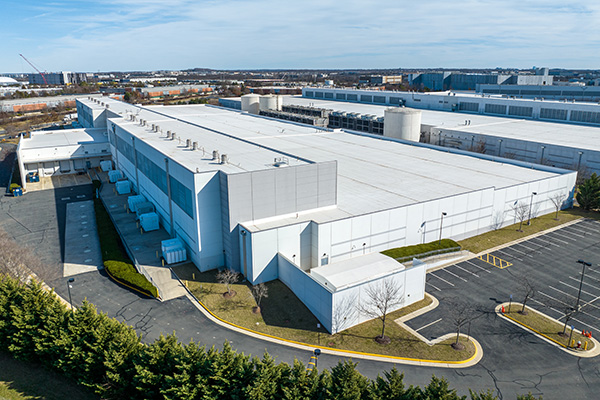
De facto industrial gas plants are moving next-door to homes, schools and parks
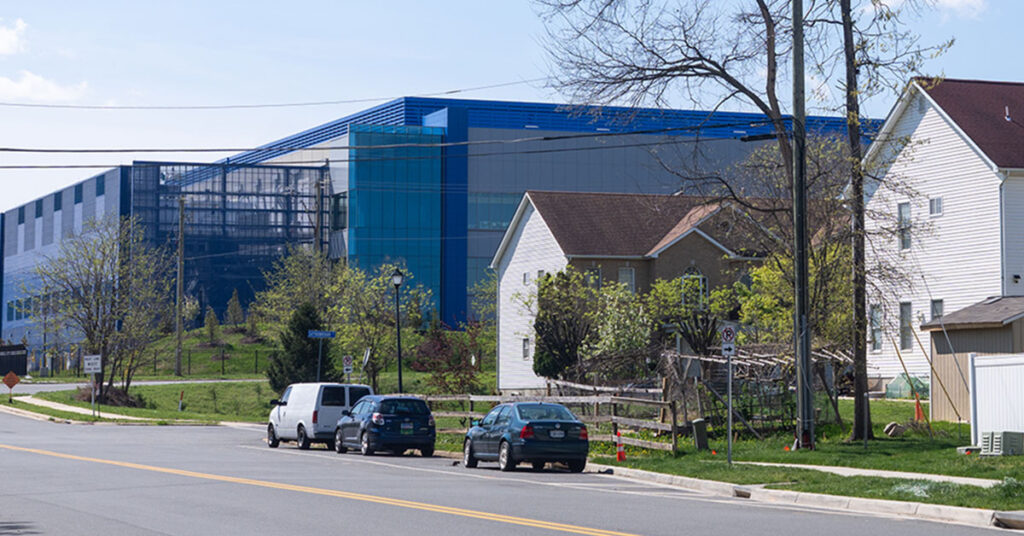
Photo by Hugh Kenny, PEC.
More onsite power plants at data centers have been proposed in our region: Another data center developer in Loudoun is proposing 23 gas turbines at the Digital Dulles site. That’s about three times as many turbines as the Vantage VA2 facility of our study, just 15 minutes away. Meanwhile, developers of Remington Technology Park in Fauquier County are proposing 13 onsite gas turbines in an area with two other fossil fuel power plants right next to a residential neighborhood.
There is currently little in the way of state requirements to stop data centers from building onsite gas turbine power; the decision is mostly in the hands of the localities, which may not fully comprehend the air quality impacts on nearby neighborhoods.
DEQ’s minor air permit for onsite gas turbine power systems does not require public input and does not consider siting or cumulative impacts from other nearby pollution sources. It is simply a standalone determination that the pollution being released is below 100 tons per year of any of the five criteria pollutants (PM2.5, nitrogen oxides, sulfur dioxide, carbon monoxide and volatile organic compounds). In areas where you have clusters of data centers – often near schools, parks, residents and medical facilities – each additional gas turbine that is under that threshold quickly adds up.
It’s well past time for permitting agencies and elected officials to prioritize public health over unchecked expansion driven by the world’s largest corporations.
Contact Your Elected Officials Now
Gas turbine power plants don’t belong next to homes! Tell your elected officials to reject data center proposals that include onsite natural gas power near homes or schools and amend their regulations to not allow them as accessory to data centers, but as a standalone, electric-generating facility that needs more thorough review of public health impacts. We encourage people to contact their local elected officials with that message.
Here’s what you can do:
1. Look up your state and local elected officials.
2. Send them an email.
3. Use our sample letter.
4. Personalize the email with your experiences and how this impacts you.
A Growing Footprint… and the Alternatives Being Overlooked
> More Data Centers. More Power. More Transmission Lines and Gas Pipelines.
Data centers’ power demands — even when temporarily employing expensive and less reliable onsite gas turbines — are driving the buildout of several high-voltage transmission lines throughout our region. Notably, the proposed Valley Link transmission line would cut through a rural area of the Piedmont that nearly half a million Virginians call home, clearing thousands of acres of forested and farmed land. One new gas plant is already being planned along the Valley Link corridor and we expect more gas infrastructure, such as pipelines and compressor stations, to follow.
We support a “pause to plan” approach to managing data center demand, with transparent accounting and appropriate safeguards at the state level. Read more →
> Better solutions exist, if we slow down: Distributed generation and storage
Distributed energy solutions can provide reliable, less costly clean power to more sustainably meet economic development needs in the short term, rather than massive fossil fuel projects that lock us into an unsustainable and costly energy future. Distributed energy is less reliant on distant generating sources and incorporates a mix of customer-owned, community-based and utility-scale power, reducing environmental impact and resulting in a more resilient and reliable grid. Read more about our vision →
Thank you for your continued support and engagement on important issues in our region. Feel free to contact me with any questions.
Sincerely,
Julie Bolthouse
Director of Land Use
[email protected]
(540) 347-2334 x7042

Board of Supervisors websites
Click on your county below to find your Board of Supervisors’ members and contact information for your letter. Note that for some, there is an email address to send an email to the whole Board, and for others, you must click on each supervisor to view their individual email addresses.
Letter template
We encourage you to use the template below as a starting point, customizing it with your own personal experience and how this impacts you, which is important for elected officials to hear.
Dear Supervisors / Delegate [insert last name] / Senator [insert last name],
As a resident of Virginia / [County Name] County, I’m very concerned about the recent trend of data centers in Virginia proposing and building onsite natural gas turbines for primary power. There is extensive scientific evidence showing long-term exposure to fine particulate matter (PM2.5), such as that emitted by gas turbine-based power plants, is associated with increased risk of various health problems – even at levels below current federal standards. And yet, data centers are often located right next to homes, parks and schools.
Air pollution from data centers’ onsite natural gas turbine power and backup diesel generators reaches people living miles away. With the more than 13,000 generators permitted in Virginia, there is a cumulative impact on air quality that is not currently being considered by Virginia DEQ as part of its permitting process for onsite gas turbine-based power.
[Add personal stories, impacts, etc. to your letter].
Gas turbine power plants don’t belong next to our homes. Please reject data center proposals that include onsite natural gas power near homes or schools and amend your regulations to not allow them as accessory to data centers, but as a stand alone, electric generating facilities that need more thorough review of public health impacts.
Thank you for hearing my concerns.
Sincerely,
[Insert Full Name]