
This op-ed ran in the Richmond Times-Dispatch on Oct. 23, 2025.
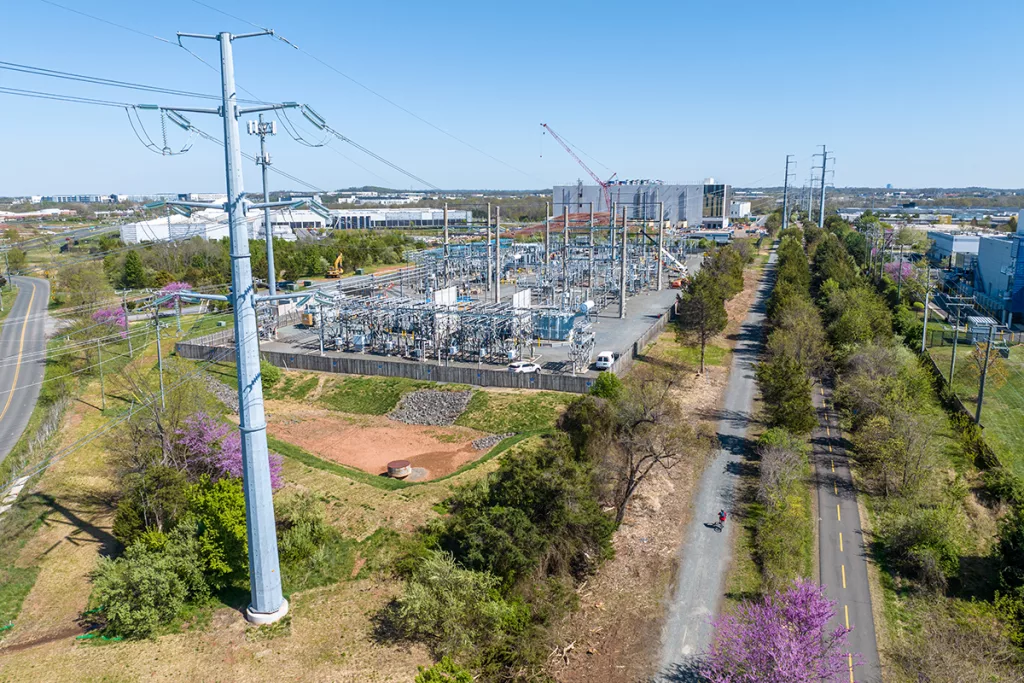
It’s no secret that Virginia’s data centers consume unprecedented amounts of energy. Billions of dollars of new power generation and transmission infrastructure is needed to meet data center demand. As of now, all of Virginia’s ratepayers are on the hook to pay for this through their electric bills. Families, farms and small businesses will be subsidizing the richest tech companies in the world unless the SCC acts.
The State Corporation Commission has the authority, and the opportunity, to definitively solve this problem in November, when it rules on Dominion Energy’s rate structure proposal as part of a biennial review. While relatively unknown to the general public, this case is one of the biggest decisions the SCC will ever undertake — and one that will have lasting impacts on all Virginians for generations to come.
The bottom line is: Virginia’s current energy rate structure is set up in such a way that puts average ratepayers — people, families, small businesses, anyone who pays an electric bill — on the hook for the massive costs of energy-related infrastructure needed to support the data center industry. The SCC in November has a chance to put Virginia on a smarter track, by changing that structure to properly place these costs on the companies that demand them, thereby protecting average ratepayers from skyrocketing electric bills and the cost of impacts on communities and natural resources.
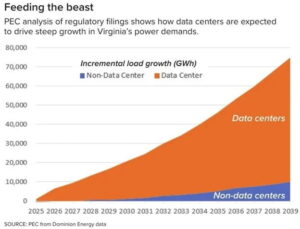
Recent headlines sounding the alarm about an imminent energy crisis and rising energy costs are not an exaggeration. They’re based on the facts presented in the SCC ratepayer case. Dominion’s new Integrated Resource Plan estimated that data center growth would drive up residential bills significantly. Dominion estimated that a residential customer paying $142 per month now would pay $277 in 10 years and $315 in 15 years. This is only the tip of the iceberg; many more years of generation requirements and a ballooning number of data centers are not included in Dominion’s computation. Virtually all new energy demand in Virginia over the next 10 years is a result of data center usage as illustrated below using Dominion Energy’s data.
Dominion’s individual contracts with data center developers are secret and not subject to state oversight. These contracts contain unrealistic in-service dates and promise power far beyond what is available. Some of the new proposed data center campuses will require the power equivalent of multiple nuclear plants that do not currently exist — and are at least a decade away from coming online.
The result is a significant “crisis by contract,” created by Dominion and the richest companies in the world, that burdens all Virginians with significant costs and impacts — no matter where they live. You won’t need a data center in your backyard to feel the effects.
Beyond the financial impacts, grid reliability is another pressing issue. A Department of Energy report says Virginia is the one of the states most likely to experience rolling blackouts in the not so distant future. Bringing more data centers onto the grid in a rushed manner to meet the unreasonable contracts Dominion Energy has signed pushes our grid to the brink. We’ve already experienced overburdened systems too close to home. This past summer, the federal government had to intervene when Maryland’s grid came very close to failure. Likewise in the same period there was a power outage in Loudoun, which caused hundreds of backup diesel generators to kick in with predictable negative air quality impacts.
The Piedmont Environmental Council submitted testimony in the Dominion Energy rate case, along with more than two thousand Virginia residents and businesses. The time has come for the SCC to:
- Set a strong precedent that relieves residential and small business customers from further bearing the financial brunt of this industry’s expansion.
- Ensure data centers pay fair rates that reflect the demand they are placing on the system and the new power generation required to meet the increased load.
- Implement stricter, longer-term contracts with minimum charges and shorter ramp-up periods to minimize financial risk to other ratepayers and reduce speculation that could lead to overbuilt infrastructure.
- Require data centers to pay for their own dedicated transmission lines rather than that cost being subsidized by all ratepayers.
Beyond the State Corporation Commission, which regulates the utilities, legislators at every level of Virginia government will need to, finally, deal with the consequences of their hands-off approach to data center development in the state, whether they want to or not. New polls suggest they will face an electorate this fall that is more aware of data center impacts on their wallets and their communities. The more Virginians actually know about data centers, the less they like them.
Our state has been on the forefront of data center development longer than any other place in the country. By now, Virginia should be smarter about the way we manage data center development. But, a lack of oversight, secrecy and greed has turned our state into the wild west. The General Assembly and state agencies have failed to provide legislative or regulatory oversight that would have prevented the unsupportable number of data centers already built or in the pipeline.
Virginia should not just be the best state for business; it should be the best state for a smarter digital future. The SCC can take the first step come November by protecting every ratepayer from subsidizing the richest companies in the world.