
Shenandoah National Park is one of Virginia’s most beloved and visited outdoor spaces, attracting 1.7 million visitors in 2025. It’s also a global conservation priority for biodiversity protection and climate resiliency. For these reasons, The Piedmont Environmental Council has been strategically identifying and conserving privately-owned lands running along the park’s eastern edge with a project called the Shenandoah Borderlands Conservation Initiative.
For visitors to Shenandoah National Park, the undeveloped tracts of private forestland bordering the park are visually indistinguishable from the park itself. Because of that, they make an important contribution to the scenic landscape that draws millions of people each year for recreation and supports Virginia’s robust tourism and outdoor recreation economies.
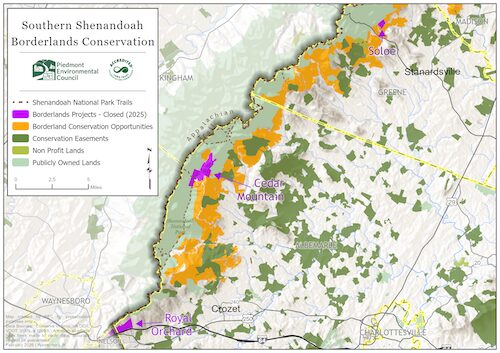
These properties provide key ecological services to the region as well. Their forestland improves air quality by pulling carbon from the atmosphere and increases the region’s ability to withstand flooding from intense storm events. The headwater streams flowing through these properties help ensure clean drinking water for downstream communities. By buffering the park’s natural resources, they are part of a vital wildlife corridor that provides undisturbed, contiguous habitat for species — like the cerulean warbler — that require interior forest to breed.
PEC staff conceptualized and developed the Shenandoah Borderlands Conservation Initiative and secured over $8 million in highly competitive federal grant funding through the U.S. Forest Service’s Forest Legacy Program. The funding supports development of five conservation easements, to be held by the Virginia Department of Forestry, that will permanently protect over 5,000 acres of forestland bordering Shenandoah National Park. This spring, we celebrate the recent completion of two of those easements: the 822-acre Cedar Mountain in Albemarle County and the 400-acre Royal Orchard, which lies in both Albemarle and Nelson counties.
Albemarle County ranks among the top 15% of all counties nationwide for growth. Without conservation easements, these properties face development pressure from nearby Crozet and Charlottesville. By conserving the Shenandoah Borderlands, PEC, the Virginia Department of Forestry and landowners are protecting the land’s many public benefits — clean water, clean air, public access, scenic viewsheds, wildlife habitat, flood mitigation and more — for generations to come.
Cedar Mountain
By Jessica Edington, Publications Assistant
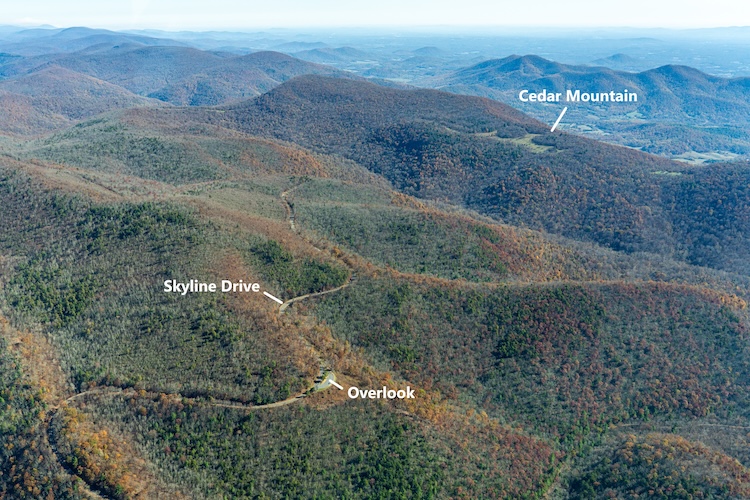
The landowner of Cedar Mountain, a newly-conserved 822-acre parcel in Albemarle County, says he traces his fondness for open space back to his days as an Eagle Scout in Roanoke, where he spent his weekends hiking the Appalachian Trail between Blacksburg and Afton. “I’m quite familiar with the terrain and the trail and the park,” he said. “And when we acquired this property, it felt like a coming home.”
Cedar Mountain’s forestland and spring-fed creeks provide habitat for wildlife, including white-tailed deer, black bears and eastern wild turkeys, as well as rarer species like the migratory cerulean warbler and the endangered James River spinymussel. Native brook trout, which are increasingly threatened by climate change and habitat degradation, rely on the cold headwater streams that flow through these mountain lands.
The landowner had always hoped to pursue a conservation easement for this special property, but credits PEC’s outreach and on-the-ground support for carrying that intention to reality.
“It is a pretty extraordinary piece of property virtually surrounded by the national park. Its remoteness and natural beauty, and the breadth and quality of the wildlife, is unique. We have 2 miles of the North Fork of the Moormans River and 4 miles of tributary streams that feed right into Sugar Hollow Reservoir. So protecting that is important for the region,” the landowner said.
The easement protects land around a segment of the North Fork Moormans River Trail, which leads from Sugar Hollow Reservoir up to Shenandoah National Park at the top of the ridge. Hikers may not realize that many of the trails that start in the national park, like this trail, pass through private land, and that public access to these trails is made possible by the generosity of those landowners — who could choose to close off that trail access or to sell or develop their land.
To protect public access to the North Fork Moormans River Trail, while working on the conservation easement for Cedar Mountain, PEC connected the landowner with the Shenandoah National Park Trust to donate a separate trail right-of-way easement. Through its Good Neighbors program, the Trust will take on stewardship of the portion of the trail that passes through Cedar Mountain.
“Ensuring access to public lands helps cultivate a personal relationship with the outdoors and the park,” says Good Neighbors Program Manager Elizabeth Mizell. “With the support of public and private partners, the owners of Cedar Mountain have invested in their community by protecting the land and public access to the outdoors.”
The landowner is looking forward to the impact of conserving Cedar Mountain. “I think it will ensure and enrich the park experience and the public access experience for generations, hopefully for centuries, and beyond.”
Royal Orchard
By Faith Schweikert, Communications Specialist
The Afton Mountain corridor is a critical transportation route for people, intertwining Interstate 64 and U.S. Route 250 over Afton Mountain. But it’s also critical for wildlife, who depend on the undeveloped land to live.
Concern for this important wildlife corridor that allows animals to move safely through increasingly developed areas is what led to Mary Buford Hitz’ interest in land conservation. “The beauty of where we are lucky enough to live will inevitably bring added pressure to land values. It’s important for us to think ahead and preserve what we can,” Hitz said.
The Hitz family looked into what they could do to protect the Royal Orchard property they owned on the east side of Afton Mountain’s Rockfish Gap, including building consensus among over 200 family members. Thanks to PEC’s work with the family to develop a conservation project and apply for funding from the U.S. Forest Service’s Forest Legacy Program, the 200 family members — spearheaded by Andrew Carter and Alex Bocock — were able to permanently protect 400 acres of forestland and open space bordering Shenandoah National Park, Skyline Drive and the Appalachian Trail through a conservation easement held by the Virginia Department of Forestry.
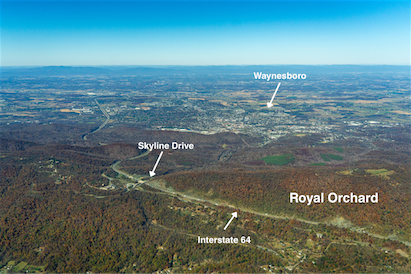
The land, which is primarily forested, provides an invaluable buffer between Interstate 64 and the adjacent national park, while also improving climate resiliency through carbon sequestration and flood mitigation. Royal Orchard contains the headwaters and a combined 4,200 feet of stream frontage on four tributaries of Stockton Creek, all of which ultimately flow into the South Fork Rivanna Reservoir. Its conservation helps protect the public water supply for Albemarle, Charlottesville and other downstream communities.
Contiguous undeveloped land provides natural habitat for the variety of wildlife and plant species that exist in this area, including two state-endangered bat species and one of Virginia’s most significant autumn raptors.
“There’s plenty going on in those woods,” Hitz said. “Those who hike in the area have seen bears, wildcats, foxes and all kinds of birds and other species.”
Her family’s connection to the land began when Hitz’ grandmother, who at the time had five children under 10 years old in Richmond, saw a classified ad in the newspaper for an apple orchard. She asked a friend to ride up and take a look for her. He returned to say “it was the most difficult place to get to and also the most beautiful view he had ever seen.”
Hitz says her grandmother took the last of their money, purchased the property site-unseen and “lived happily ever after…My mother [then] cared deeply for the land and passed that on to me.”
This article appeared in the 2026 spring edition of The Piedmont Environmental Council’s member newsletter, The Piedmont View. If you’d like to become a PEC member or renew your membership, please visit pecva.org/join.