New legislation advances clean energy and energy independence for Virginia

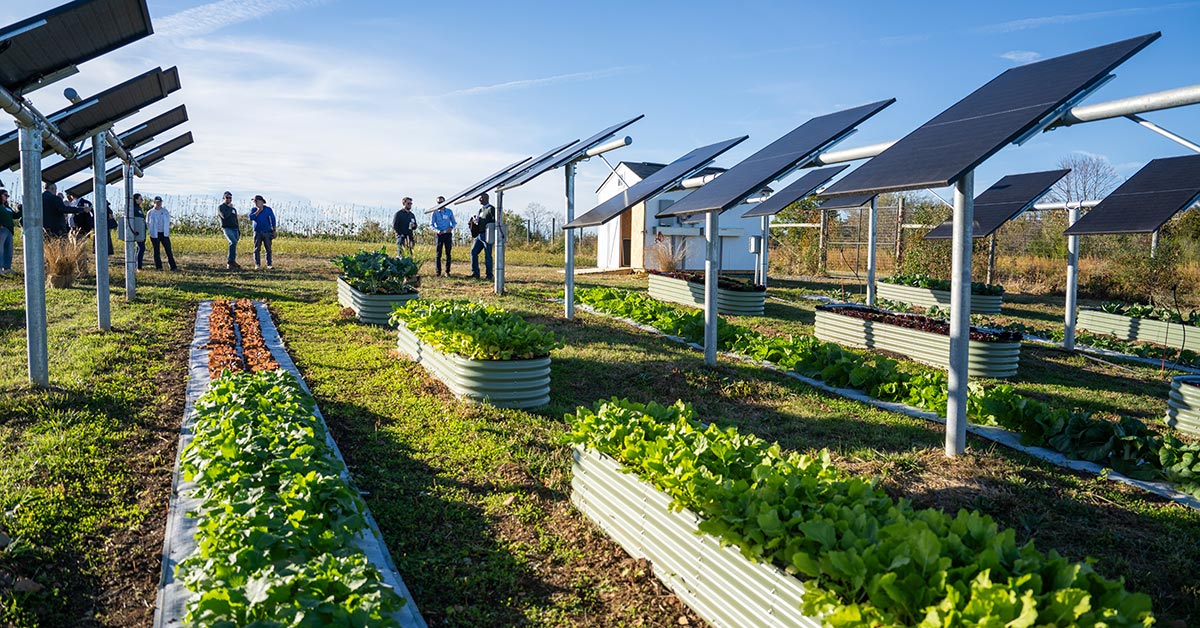
Warrenton, VA. (June 17, 2026) – Today at The Piedmont Environmental Council’s Community Farm at Roundabout Meadows — the site of Virginia’s first crop-based agrivoltaics project — Gov. Abigail Spanberger ceremonially signed legislation (SB 340/HB 508) that officially defines the term agrivoltaics in code. A formal definition for agrivoltaics, which integrates solar energy into agricultural production, is critically important to pave the way for well-developed, properly sited agrivoltaics across Virginia. This legislation, co-sponsored by Senator Russet Perry and Delegate John McAuliff, is one of 12 solution-oriented energy bills PEC either authored, informed or advocated for in the General Assembly that have been signed into law. PEC worked on these practical legislative proposals with partners before the 2026 General Assembly session, laying the groundwork for accelerating underutilized small-scale, distributed generation and storage opportunities in Virginia. These bills contribute to the Commonwealth’s clean energy future while also enabling energy independence for more Virginians.
“The topic of agrivoltaics is one that has been top of mind for me for years,” said Gov Abigail Spanberger, “because it has always been a question of how is it that we can ensure that our communities–and importantly our farmers–have the ability to keep land in production, but also the option to leverage the technology that can help them offset their on-farm costs and also allow them to be leaders. By establishing clear enforceable definitions of agrivoltaics and code of Virginia, we are protecting farmers. We are making clear that the use of agrivoltaics prioritizes agricultural productivity, keeps land in production for the life of the solar array and is part of an existing farm business.”
Until now, Virginia has lacked an official definition for agrivoltaics. This is critical, not only to build policy and incentive structures for such projects, but also to avoid poorly developed agrivoltaics – which can undermine the future of this promising approach. Working alongside the Virginia Farm Bureau, PEC helped develop an official definition for agrivoltaics that will ensure dual use solar projects take best management practices into account. This bill, which garnered strong bipartisan support and was a priority bill for the Governor, defines agrivoltaics to mean:
“…the intentional co-location of agricultural production and solar energy generation on the same land that:
- is designed to prioritize and sustain agricultural productivity while integrating renewable energy;
- allows the ongoing production and sale of agricultural products throughout the solar array’s life;
- is a part of an existing farm business; and
- ensures flexibility for farmers to adapt to market conditions and support operational needs.”
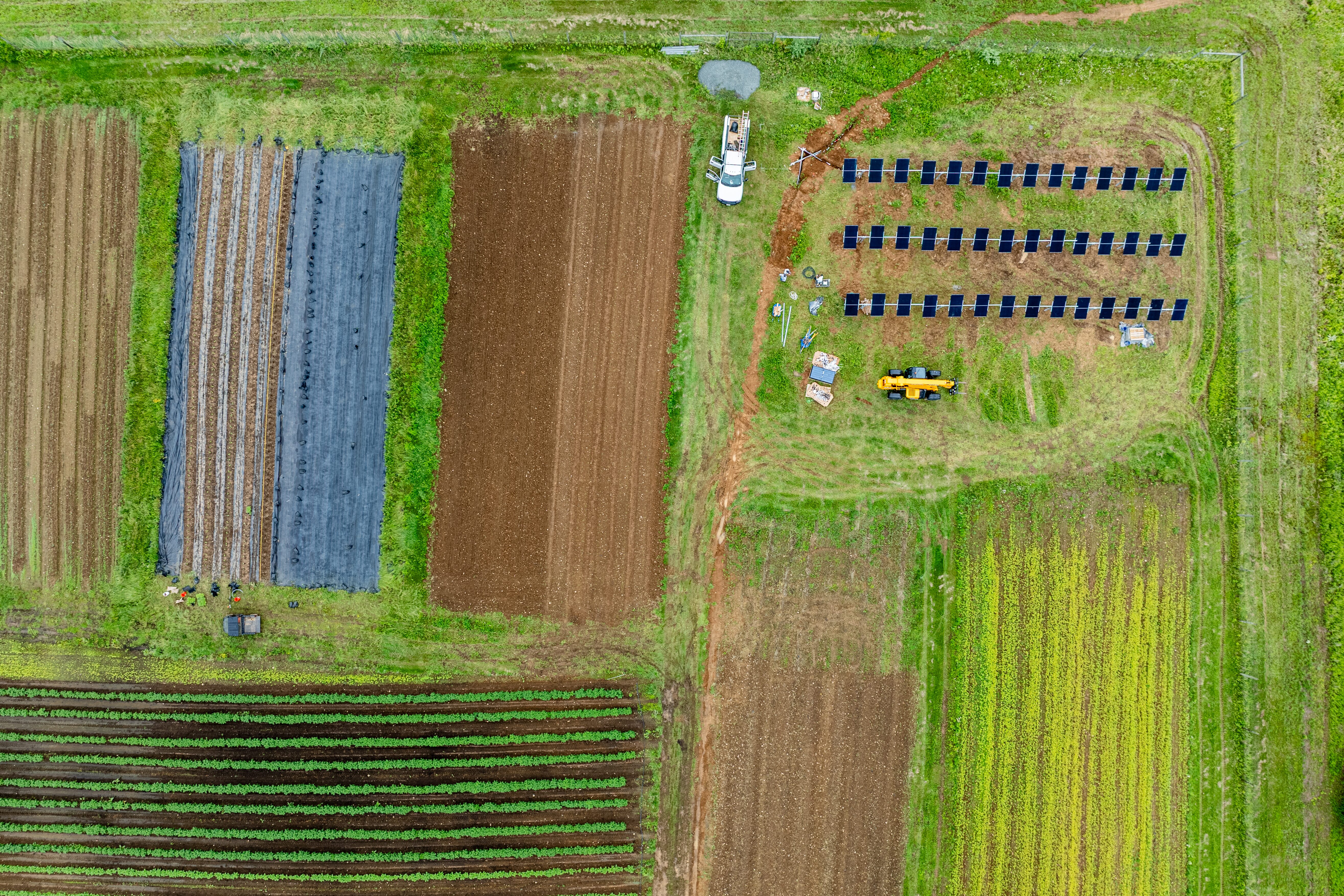
PEC’s Community Farm demonstrates a real-world example. It also has full battery backup, which allows the farm to run fully on solar and battery in case the electricity grid goes down. When multiple farms, businesses and homes use battery backup, the energy they produce and store together can function as a “virtual power plant,” furthering the potential for decentralized power generation, mitigating new transmission and generation impacts, and compensating those owners for their contributions to the power grid.
“We’re proud to convene this bill signing at the site of the first crop-based agrivoltaics project in Virginia,” said PEC Senior Energy & Climate Advisor Ashish Kapoor. “Behind me, you can see kale, lettuce, beets, broccoli, garlic and more, growing under solar panels that are generating energy to reduce this farm’s electricity bill. In fact, we have had no electric bill this year. This site provides a model for other farms in Virginia, and we hope farmers who want to achieve more energy independence will consider integrating solar energy production into their crop production. Virginia has 39,000 farms. If ten percent of those farms installed an agrivoltaics project that produced just 1 megawatt of power on a few acres, we could produce the equivalent power of four nuclear power plants.”
The agrivoltaics definition bill also provides a critical foundation for a future stakeholder group that will develop potential incentives to advance agrivoltaics in the Commonwealth. In addition, the definition can guide regulation of agrivoltaics in other solar policies.
PEC, a land conservation organization, advocates for clean energy solutions that respect and preserve the region’s natural resources and rural economy. PEC made an investment in the study and implementation of the Community Farm agrivoltaics project to serve as a demonstration site for farmers, installers, developers and policymakers to visit and to inform distributed generation policy in Virginia. PEC hopes the project will create a path forward that supports both Virginia’s climate goals and its agriculture — a critical backbone of the Commonwealth’s economy. The project was made possible with the financial support of current and former PEC board members George Ohrstrom, Mark Ohstrom, Mike Morency, Natalie Pien and Roy Jacobson, as well as the Lazar Foundation, Catesby Foundation, Land Trust Alliance and technical assistance from the U.S. Department of Energy’s National Lab of the Rockies.
Contact: Elizabeth Ransom, Media & PR Specialist, [email protected], 540-347-2334 x7029
###
The Piedmont Environmental Council (PEC) works to protect and restore the lands and waters of the Virginia Piedmont, while building stronger, more sustainable communities. Founded in 1972, PEC is a locally based, community-supported 501(c)3 nonprofit and accredited land trust. At the core of PEC’s approach is a focus on educating, engaging and empowering people to effect positive change in their communities.
Quotes from the ceremony:
PEC Senior Energy & Climate Advisor Ashish Kapoor:
“It takes agricultural production and solar production on the same tract, said PEC Senior Energy & Climate Advisor Ashish Kapoor. “That’s the simple definition, and it has similar promise if developed properly. And that’s why starting with the robust definition that puts agriculture in the driver’s seat creates a foundation for future progress in this space and can truly serve agricultural and rural communities: protecting them from escalating utility costs, diversifying income streams, and keeping agricultural land in agriculture. From integrating solar with specialty crops to cattle grazing under panels.”
Virginia Farm Bureau President Scott Sink:
“I think this is a prime example of when things work when you have different ideas all come together and create what we have behind us, said Virginia Farm Bureau President Scott Sink. “Farming, we’ve always been sustainable, observing land is what we’re about. But also use it in an efficient way and also helping it for the next generations. And so a bill like this that we’re signed in today – thank y’all for sponsoring it – pushing it through brings all those things together. It’s an example of what we could do when we do work together to preserve agriculture and make it economical for all the staff. So thank you on behalf of our members and our producers all across the state.”
Virginia Delegate John C McAuliff:
“Here in House District 30 agriculture is more than just an industry.” said Virginia Delegate John C McAuliff. “It is part of who we are. It shapes our landscape, supports our local businesses, and reflects generations and generations of hard work, innovation and stewardship of the land we love here. But like many communities across Virginia and across the country, we are losing farms here. Far too often, agricultural land is sold for development or for uses that threaten to take it out of production entirely. This trend threatens not just individual farms, but the long term future of agriculture in our region. So this year we asked ourselves a simple question, how can we help farmers continue doing the work we all depend on, while giving them the flexibility to adapt and succeed in a changing economy? Today, what we’re doing is celebrating the beginning of an answer. This legislation establishes a clear farmer first definition of agrivoltaics to ensure that solar development does not significantly displace farming activity here in the Piedmont and here in Virginia.”
Virginia State Senator Russet Perry:
“One of the things that I have learned in my time in the General Assembly is that some of the best ideas come from listening to the people who work the land every day,” said Virginia State Senator Russet Perry. “And as the chair of the Rural Affairs Subcommittee in the Senate, I’m especially privileged to get to have those conversations often. And Virginia agriculture remains our largest private industry. It’s part of our economy, part of our heritage, and part of what makes communities like Loudoun County, Fauquier County, and the rural communities across the Commonwealth. So very special. But we also know that farming’s not easy. As my good friend Delegate McAuliff said, rising costs, developmental pressures, land values, labor shortages, and unpredictable markets have made it increasingly difficult for many family farms to stay in operation for new farmers. The barriers can be even higher and even greater. That’s why this bill is so important. But this bill at its core is about preserving farmland and expanding opportunity. And as John said, agrivoltaics gives you another tool, the toolbox to do that.”
Virginia Secretary of Agriculture and Forestry Katie Fraizer:
“When I think back to our transition process for the Spanberg administration, said Secretary of Agriculture and Forestry Katie Fraizer, “this bill, this issue was one that was at the top of the list of things that we needed to address to continue to move forward. The important opportunity that agrivoltaics presents to Virginia’s farmers, it is a cross-section between agriculture and energy production, in which, as we’ve heard, solar and farming operations are co-located on the same land. It is an opportunity to produce more on the same acre rather than losing ground, providing farmers with a new revenue stream, access to renewable energy and another tool in their vast sustainability toolbox. By ensuring that we have the building block of the definition of that prioritizes agricultural production while allowing for solar production on the same land, we are setting an important course for, for the prosperity of our farms across the commonwealth.”
Chief Energy Officer Josephus Allmond:
“For years, conventional wisdom has forced us into a zero seven game, viewing solar panels as a replacement for crops rather than a partner,” said Chief Energy Officer Josephus Allmond. “Today we are rejecting that false choice. Agrivoltaics moves us from an either-or mindset to both by integrating solar infrastructure with active agriculture, whether it’s grazing livestock under panels, protecting high value specialty crops, ensuring soil health, proving that our commonwealth doesn’t have to choose between its rural heritage and its economy. We can protect our working lands while accelerating our transition to affordable, reliable, and clean. This bill is a result of deep collaboration. As you’ve heard this morning, it took farmers who wanted to expand revenue streams, but needed an established definition to protect their contractual interests. It took conservationists who wanted to protect our soil and it took energy developers who wanted to build projects that last. It took the vision of the General Assembly to see that we could create a framework that works for everybody.”
Downloadable images from today’s press conference (Please credit: Hugh Kenny, PEC):
- Ashish Kapoor, PEC’s Senior Energy and Climate Advisor, delivering remarks
- Scott Sink, President of the Virginia Farm Bureau, delivering remarks
- Delegate John McAuliff delivering remarks
- Senator Russet Perry delivering remarks
- Secretary of Agriculture and Forestry Katie Frazier delivering remarks
- Chief Energy Officer Josephus Allmond delivering remarks
- Governor Abigail Spanberger delivering remarks
- Governor Abigail Spanberger delivering remarks
- Governor Abigail Spanberger delivering remarks
- Governor Abigail Spanberger signing SB 340/HB 508
- Governor Abigail Spanberger signing SB 340/HB 508
YouTube recordings:
Gov. Abigail Spanberger Youtube
Full Recording Youtube
Ashish Kapoor Youtube
Scott Sink Youtube
Del. John McAuliff Youtube
Sen. Russet Perry Youtube
Sec. Katie Frazier Youtube
Chief Josephus Allmond Youtube