
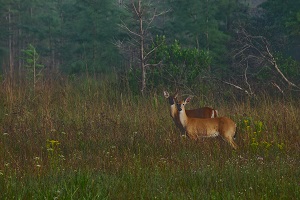
Fall is a busy time for wildlife in the Piedmont, particularly for mammals as they rush to prepare for the coming winter – storing food caches, finding mates, and burrowing den sites. During this time, white-tailed deer enter “the rut”: hormones rage, antlers grow, and males seek out females. Historically, it’s this time of year when you’re most likely to see deer, especially as bucks pursue does and the does play coy. Today, however, you are very likely to encounter deer any time of year — not just during the rut.
Restoring Wildlife Habitat
Whether you live in urban, suburban or rural areas, you can make a positive impact on surrounding fish and wildlife populations. Our web resources are intended to give you the tools to manage your Piedmont lands and waters for greater biodiversity, productivity, and environmental quality.
A Season Full of Activity
I hope you’re enjoying the delightfully cool spring. Personally, I’ll take all the cool weather I can get before the dog days of summer hit. Any cicadas in your neck of the woods? We'll see if the cool weather means that Brood 2 Cicadas will persist longer than usual. Check out this wonderful video on the life cycle of these fascinating creatures. This text was taken from an email sent out on June 6th, 2013:
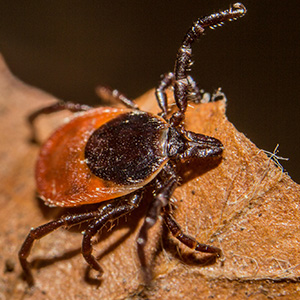
Lyme Disease
In a departure from my normal column on creating habitat, here is some knowledge on ticks ecology and preventative measures from the perspective of an ecologist who spends a lot of time outside. With a little education and forethought, you and your family can better enjoy the outdoors all season long. First – a word of warning: I’m not a health professional by training, so always consult your doctor if you have health concerns.
Building a Home for Wildlife: Houses, Nests, & More
Just like humans, wildlife species have four primary needs to survive: food, water, shelter and space. These four components form the basis of wildlife habitat, and each species fulfills these needs differently. Yet, for all species, if one of these four components is missing in a given area, it can affect the species’ population. In this article, I’ll be focusing on one of these needs – cover (the wildlife term for “shelter”) — and what are potential solutions when it’s a limiting factor in an environment. Specifically, how we can use man-made cover to help out wildlife.
Presentations from the November 2012 Invasive Plant Symposium
Our November 2012 Invasive Plant Symposium was a great success! Over 140 people attended this event in Middleburg, co-sponsored by PEC, Sacharuna Foundation, Virginia Working Landscapes, and United Plants Savers.
Invasive Plants: Why Bother?
When I work with landowners on how they can better manage their properties for wildlife habitat, many common questions concern invasive plants. These questions include: “What is that weird, abundant vine/shrub/tree/pond muck? And how do I get rid of it?” Other times, it’s: “Do I need to worry about plant X?” or “Why bother?”
Healthy, Safer Families, and Communities
Arsenic and rocket fuel in our water. Gender-altering hormones and medications in our rivers and streams. PCBs, dioxins and pesticides in breast milk. Lead in children’s toys and women’s lipstick. Hazardous ingredients in air fresheners, development disrupting chemicals in plastic baby bottles and dangerous fumes from vinyl shower curtains. Our world is awash in chemicals and pollutants that pose health risks to our families, our communities and our environment.
What is the Connection Between My Home and My Drinking Water?
Although your property may not have a stream or pond on it, all land is a part of a watershed and has some effect on the condition of waterways. Land and water are intricately connected by the natural water cycle.
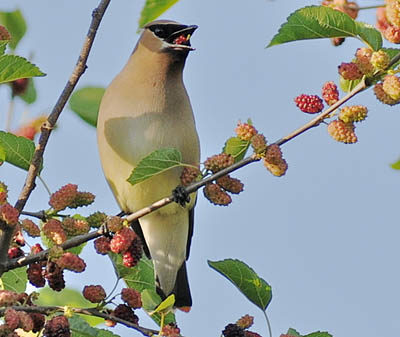
How Plants Fly
As my mother and I pulled up at the Jones Nature Preserve in Rappahannock, a brilliant bird dipped through the air—a rich tropical blue on delicate wings. They came in this week, Bruce Jones told me, the indigo buntings. He had led a bird walk over the weekend, and they saw 15 to 20 of these migrants, which flourish in the shrubby areas between his meadows and his woods.
Better Habitat: Water, Woods and Beyond
Learn about Wildlife Habitat in the Virginia Piedmont — what it is, why we care, what a landowner can do to improve it. The following PowerPoint presentations were given to members of the Orange County Hunt in March, 2012.