Piedmont Environmental Council Partnership with American Farmland Trust Protects Greene County Farm
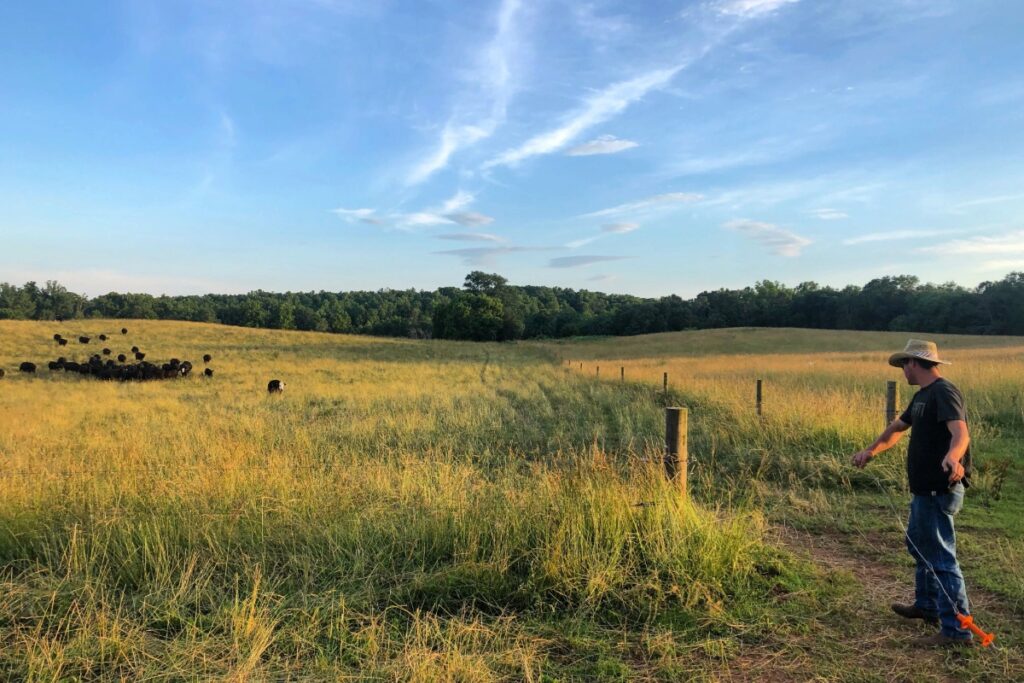
At Work on Long Acre Farm. Credit: Gillian Bowman.
Warrenton, VA. (April 27, 2026) – Thanks to creativity, collaboration, and a conservation solution put together by The Piedmont Environmental Council (PEC) and American Farmland Trust (AFT), 226 acres of a cattle farm operated by Dustin Watson in Greene County will remain in his family and be protected forever by a conservation easement. The easement is particularly important at a time when Virginia is losing working farmland at a record pace. The farm is located near Ruckersville, which is experiencing explosive residential growth (like all of Greene County). According to the United States Census of Agriculture, Virginia lost 488,000 acres of farmland between 2017 and 2022, more than it did in the previous 15 years.
Watson, who lives on Long Acre Farm and runs the family’s cattle operation, always wanted to be the fourth-generation family member to own the farm. In 2023, the farm was co-owned by his late mother and his aunt, who needed to sell. But, as a young farmer, Watson did not have the money to buy out his aunt, and while she did not have plans to run the farm operation, she could not afford to give the farm away, either. The farm’s future was in jeopardy.
According to AFT research, about 300 million acres of farmland will change hands in the next two decades. As current farmers age and retire, the future of about a third of agricultural land in the United States is uncertain. Due to rising costs, development pressures, and declining interest, farms like Long Acre are often sold, divided and developed. Between 2017 and 2022, 10% of all Virginia farms ceased to operate, according to the U.S. Census of Agriculture.
Watson did not want Long Acre Farm to be part of those statistics. “My grandfather bought this farm in 1939, and this is where he wanted his legacy to be,” Watson said in a video produced by AFT. “I ended up calling the extension agent here in Greene, and she told me about a new program with the Piedmont Environmental Council that is purchasing conservation easements on working farms in the Rappahannock watershed.”
That program was the United States Department of Agriculture Natural Resources Conservation Service (NRCS) Agricultural Conservation Easement Program (ACEP-ALE) program, designed to help landowners like the Watsons, land trusts like PEC, and other entities work together to protect working farms through conservation easements that limit land conversion and nonagricultural uses. The program provides grant funding that allows the purchase of the conservation easement on the property. NRCS Virginia currently manages over 157 conservation easements protecting over 21,000 acres.
“Protecting working farms while keeping them in production is central to our mission at NRCS, said NRCS Virginia State Conservationist, Dr. Edwin Martinez Martinez. “This easement ensures this land remains a productive operation while also delivering important water quality and conservation benefits. Through strong partnerships, we are able to keep producers on the land and protect resources that matter to communities across Virginia and the Chesapeake Bay watershed.”
With PEC at the helm of a complex negotiation among partnering organizations, a solution was set in motion. AFT would loan Watson the money to buy out his aunt, while PEC committed to securing state and federal grants to purchase the conservation easement once the farm was in his name. Then, Watson would use the money from the sale of the easement to pay off the loan. The whole process would take more than two years.
At first, it seemed a conservation easement wouldn’t work for Watson, because he didn’t own the property. “But part of PEC’s identity as an organization is to be able to bring a proactive approach to solving conservation problems. A great deal of conversation, negotiation, and brainstorming ensued, and we landed on what turned out to be a creative solution,” said PEC Conservation Director Michael Kane.
At last, in early April, Long Acre Farm was officially, and perpetually, protected with an ALE developed by PEC and held jointly by PEC and the Culpeper Soil and Water Conservation District. PEC purchased the easement with funds it successfully secured from the ALE program and the Virginia Land Conservation Foundation.
Now, not only is the Watsons’ productive farmland forever protected, so are the property’s other important natural resources. Long Acre holds 24 acres identified as “prime farmland” and 136 acres identified as “farmland of statewide importance,” 86 acres of open fields and pasture, and 133 acres of working native hardwood forest. In addition, 1.5 miles of perennial streams on the property flow to the Rapidan River, a major tributary of the Rappahannock River, which provides drinking water to downstream communities and ultimately flows to the Chesapeake Bay. The easement protects the water quality in these streams and the riparian buffers along their banks, which support habitat for both aquatic and terrestrial species. Visible from the Appalachian Trail and Shenandoah National Park, the farm holds important scenic value as well.
“This conservation project was built on good will and trust among the parties, including AFT, Dustin and his family and PEC,” said Kane. “Our shared goal was to keep the farm in the family and operational. Conserving the farm through the ALE program was essential, but we also needed agreements by Dustin and his family to conserve the farm and, in turn, for PEC to purchase the conservation easement. These commitments provided AFT the assurance to make the loan to Dustin.”
Generous support from The Volgenau Foundation for farmland conservation in the Rappahannock watershed enabled PEC to commit to purchasing the easement even before securing the necessary matching grant funds from the Virginia Land Conservation Foundation. Conservation of Long Acre Farm is part of PEC’s Rappahannock-Rapidan Conservation Initiative, which seeks to bring together the conservation of working farmland, protection of our streams and rivers, and restoration of wildlife habitat in the Upper Rappahannock watershed. The Volgenau Foundation’s support has been critical to accelerating this initiative, helping PEC to work with farmers, public agencies, and other partners to make conservation a tool for reinvesting in rural economies. Long Acre Farm is the sixth Agricultural Land Easement project PEC has completed in the last two years, conserving over 2,330 acres in Orange, Madison, Culpeper, and Greene counties.
PEC envisions more agricultural land being conserved through this model. “Created under the 2014 Farm Bill, the USDA’s Agricultural Land Easement program is one of the most significant sources of federal funding available for conservation, yet has rarely been used in Virginia. “As part of our strategic plan goals, we identified an opportunity to spur farmland conservation by making greater use of the ALE program,” Kane said. With ALE program funding, PEC can help landowners use conservation easements to protect high quality farmland soils, protect water and keep land in production.
Contact: Elizabeth Ransom, Media & PR Specialist, [email protected], 540-347-2334 x7029
###
The Piedmont Environmental Council (PEC) works to protect and restore the lands and waters of the Virginia Piedmont, while building stronger, more sustainable communities. Founded in 1972, PEC is a locally based, community-supported 501(c)3 nonprofit and accredited land trust. At the core of PEC’s approach is a focus on educating, engaging and empowering people to effect positive change in their communities.