Analysis shows the health impacts of on-site fossil fuel power at one data center in densely populated Northern Virginia
WARRENTON, Va. (March 4, 2026) – A new independent analysis finds that emissions from the Vantage Data Center’s permitted on-site power system in Loudoun County could result in $53 million–$99 million per year in health-related damages, driven primarily by premature mortality as well as respiratory and cardiovascular disease.
“When large data centers use fossil fuel turbines for power in populated areas, even modest increases in air pollution can have real health consequences,” said Dr. Michael Cork, founder of EmPower Analytics Group and a Harvard-affiliated health scientist. “Our analysis shows that emissions allowed under this facility’s permit could lead to up to $99 million a year in health-related damages.”
The study, conducted by EmPower Analytics Group and commissioned by The Piedmont Environmental Council, evaluates the public-health and economic impacts of fine particulate matter (PM2.5) emissions from Vantage’s permitted on-site power system, which includes eight natural gas turbines and 51 diesel generators.
Fine particulate matter (PM2.5) is widely recognized as one of the most harmful air pollutants to human health. Extensive scientific evidence shows that long-term exposure — including at levels below current federal standards — is associated with increased risks of heart disease, stroke, respiratory illness, asthma exacerbation, and premature death.
“This study shows what just one data center with gas turbines does to air quality,” says Julie Bolthouse, director of land use at The Piedmont Environmental Council. “Data centers already bring disruptive and damaging environmental impacts before adding on-site gas plants. This ‘bring your own generation’ concept means data centers waiting for connection to the grid could expedite operation by building their own gas plants on-site, which are often near existing schools, parks, residents and medical facilities.”
Using the U.S. Environmental Protection Agency’s COBRA health impact model, the Vantage facility’s permitted emissions result in an estimated $53 million – $99 million per year in health-related damages, driven primarily by an estimated 3.4–6.5 additional premature deaths per year across the impacted region, along with additional costs from nonfatal hospital admissions, asthma-related outcomes, and lost productivity.
If Vantage’s annual impacts remain at this level, its total estimated health damages could total $265 million – $495 million over 5 years and $1.59 billion – $2.97 billion over 30 years, corresponding to 17–33 premature deaths over 5 years and 102–195 deaths over 30 years.
Air pollution does not stop at property lines. Emissions from the facility would affect not only nearby communities, but also neighboring counties and parts of the broader Washington metropolitan region. The highest estimated annual-average increases in PM2.5 occur in Sterling, Dulles Town Center, Oak Grove, and Dranesville. More than 2.5 million people live in areas where the study estimates increases in fine particulate matter from this facility.
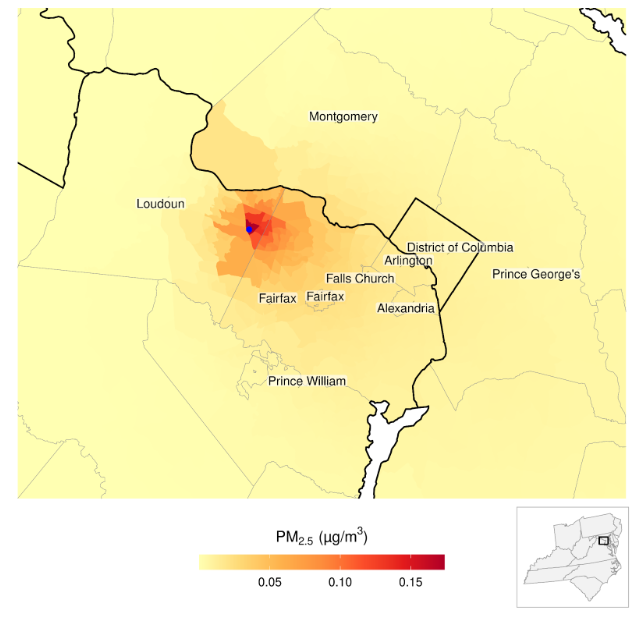
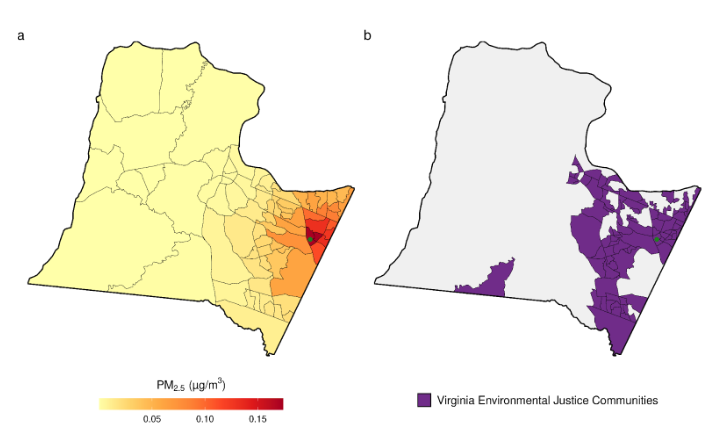
Most concerning is the cumulative impact on vulnerable communities. The background PM2.5 levels in the affected region are already elevated relative to national averages and are close to the current federal annual standard. Emissions from the facility add to ambient pollution levels in communities with existing air-quality burdens. The highest estimated impact is in areas identified as Environmental Justice communities seen in the side-by-side maps below.
Figure 2 (below). Estimated increases in annual PM2.5 (a) and Virginia Environmental Justice Communities in Loudoun County, Va (b).
The Vantage facility is one example of a broader trend of data centers proposing on-site fossil fuel generation to address grid constraints. We know of several more data centers proposing to use gas turbines for power generation to avoid delays in connecting to the grid, including Remington Technology Park in Fauquier County, which is proposing 13 gas turbines onsite.
The Vantage on-site power system is permitted to generate approximately 135 megawatts of electricity under a minor air permit. These small onsite power plants only require minor air permits, with no public input in the process, and limited review to ensure they meet the permit criteria. With continued constraints on the grid, along with the recent push by the Trump Administration for data centers to bring their own generation, we expect to see more of these proposals, along with additional cumulative health impacts from increased emissions.
“Once again, the state is not assessing the impacts before we say ‘yes.’ By not considering the cumulative impact of many small applications like this on the surrounding community during the permitting process, data center companies are able to bypass the normal, rigorous standards for building power plants,” says Chris Miller, president of The Piedmont Environmental Council. “Air quality is a nonpartisan issue and something every Virginian cares about. How many gas plants will be located next to schools, hospitals, neighborhoods and recreation areas? The decisions we make now will impact our communities for generations.”
Another study, done by Virginia Commonwealth University, also reveals the cumulative impact of all the permits that have already been granted in Northern Virginia. Together, the VCU and PEC study illustrate the growing public health emergency from backup power, and now onsite power production, at data centers that largely escape scrutiny by our state’s failure to acknowledge the cumulative impacts.
With hundreds of data centers in the development pipeline and others awaiting grid connection, decisions made now about how these facilities are powered will shape regional air quality for decades. It’s well past time for responsible planning that prioritizes community health and cumulative air-quality impacts over unchecked expansion driven by the world’s largest corporations.
#####
Media Contact: Mike Doble, The Piedmont Environmental Council
[email protected]; 703-579-7963