
This text was taken from an email alert sent out on November 6, 2025. Sign up for email alerts →

Dear Supporter,
After four years, 40 PEC action alerts, and many changes to the timeline, the Board of Supervisors adopted the Albemarle County Comprehensive Plan update (AC44) Wednesday, Oct. 15!
The completion of a plan that maintains foundational policies for people and the environment — like the Growth Management Policy — while including new (and hard-fought for) changes — like removing a proposed cap on conservation easements and incentivizing Smart Growth in the Development Areas, is a massive achievement.
A 20-year plan for the community should only be made with robust input from that community. PEC emphasized this throughout the process, advocating not only for policies that would support Albemarle County, but also for opportunities for others to share their views on the plan. PEC’s persistence on several occasions ensured the AC44 website and materials were updated and that the timeline was amended to include more public engagement. That’s also why you heard from us so frequently.
In the end, Albemarle County has a solid Comprehensive Plan that we can be proud of and use as a guide going forward.
Thank you to everyone who wrote letters to the Board of Supervisors or Planning Commission, spoke at work sessions or public hearings, filled out questionnaires and surveys online or in-person, asked questions at community meetings, or reached out to PEC in the last four years to let us know what you desire for this great community we call home.
The plan is better because of you. View the most up to date (as of sending) document here →
Major Takeaways
The county’s Growth Management Policy remains largely intact
By centering density where services already exist, this policy is critical to protecting Albemarle’s Rural Area communities and natural resources from sprawl while promoting smart growth in the appropriate location: the Development Areas.
Because of its wide-ranging implications, maintaining this long-standing and widely-supported policy was one of PEC’s major concerns during the AC44 Comp Plan update.
Renewed Focus on the Value of the Rural Area
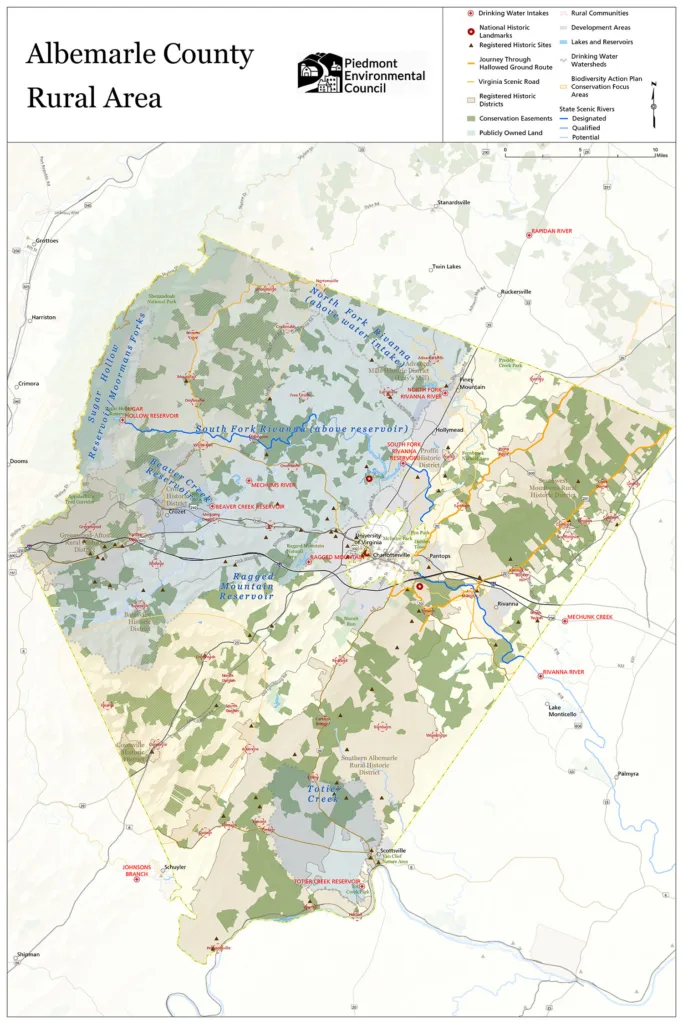
The Rural Area represents 95% of Albemarle County’s geographic area and includes rural communities and many of the area’s natural, cultural, historical (and therefore economically important) resources. Despite this significance, early in the update process it appeared that county staff were not initially intending to plan for it on the same level as the Development Areas. As the goals and landscapes of these rural and peri-urban areas are distinct from each other, PEC advocated alongside community members in rural Albemarle from the beginning to ensure that AC44 include a strong recommendation for the preparation of a Rural Area Plan. Thanks to this advocacy, that recommendation was included.
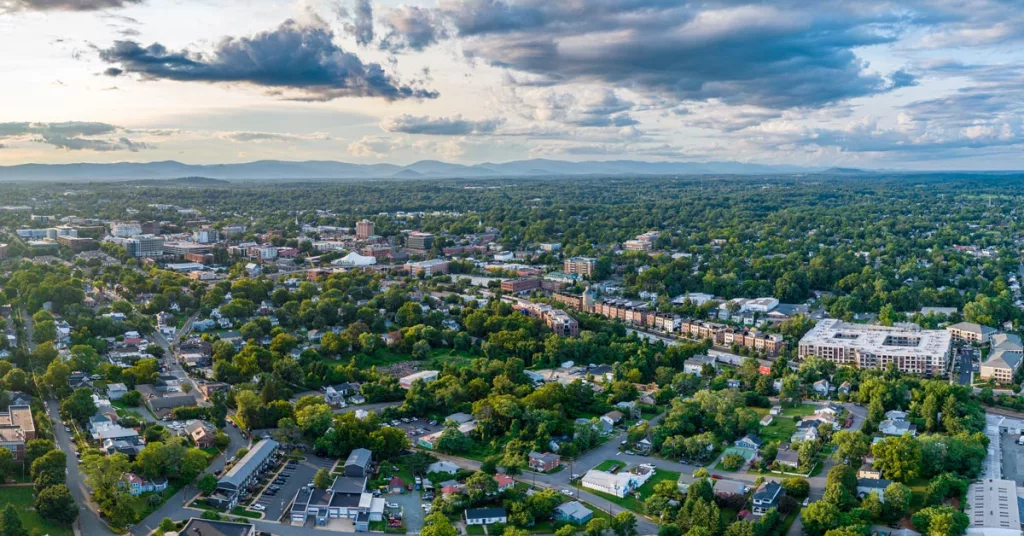
For over 50 years, PEC has been committed to protecting what we all love and value about the region through comprehensive planning. In this update, many of our policy goals were realized. Many of the outcomes below represent the culmination of significant advocacy to address the consistent pressures to weaken protection of the Rural Area.
AC44 Outcomes Aligned with PEC’s Advocacy:
- The Board of Supervisors did not expand the Development Areas;
- The Growth Management Policy remains largely intact from the 2015 Comp Plan Growth Management Policy, including the initial water supply protection rationale for creating the Rural Area;
- Inclusion of a section in the Rural Area Land Use chapter that makes the compelling case for land conservation;
- Elimination of a county staff recommendation for mapping where the Development Areas should expand in the future;
- Removal of the draft recommendation for a percentage cap on total acreage of conservation easements;
- Inclusion of action items to incentivize dense, multi-modal, mixed-use development in the Development Areas;
- Creation of a distinct Rural Area chapter, after the county initially proposed to plan for both the Development and Rural Areas in a combined chapter;
- Inclusion of a strong recommendation for the creation of a Rural Area Land Use Plan;
- Removal of the draft recommendation for receiving zones in the Rural Area as part of a potential, future Transfer of Development Rights program;
- Elimination of proposed Small Area Plans to explore commercial development at the Yancey Mills and Shadwell I-64 interchanges;
- Elimination of a County staff recommendation for commercial development within crossroads communities in the Rural Area;
- Inclusion of a recommendation that addresses the need for an updated Historic Preservation Plan and regulations to advance historic preservation policies;
- Inclusion of action items to implement the county’s Stream Health Initiative;
- Inclusion of action items to support conservation programs and conservation easements, including reestablishment and funding of the county’s Purchase of Development Rights program;
- Inclusion of an action item to explore creation of a county groundwater monitoring program;
- Inclusion of many of the affordable housing policies and action items from Housing Albemarle, the county’s housing plan; and
- Recognition that the value of forests and important agricultural soils must be considered when sitting large-scale solar energy generation facilities in the Rural Area.
PEC’s work was guided by our AC44 Policy Platform and Vision for Albemarle:
PEC envisions an Albemarle County with the majority of its rural lands permanently protected, with intact natural and cultural landscapes, healthy waters, and working farms and forests. The County’s urban areas are vibrant, mixed-use, and walkable, with everyday access to open space, parkland, and recreational opportunities. Equity and climate action are north stars in planning and zoning decisions, and everyone has a chance to help determine the County’s future.
Our AC44 policy platform was also informed by our Albemarle County Climate Platform that was built upon the findings of in the Overview of Albemarle County Climate Change Impacts and the Climate Risk and Vulnerability Assessment, both of which were the result of the collaboration of Albemarle County, Resilient Virginia, PEC, and others.
PEC Looks to the Future

Changes to Albemarle’s landscape are already underway from large-scale projects like Rivanna Futures, which is tied to the Defense Intelligence Innovation Corridor along U.S. 29 from Fauquier County to Charlottesville, and Virginia’s Research Triangle, tied to UVA’s Manning Institute of Biotechnology. Implementing the actions in AC44 and following standard established policies is essential for ensuring the county plans for the impact of projects like these and for the community’s other priorities.
PEC’s focus has turned to making sure that the Comprehensive Plan is actually implemented as intended. This includes updating the Biodiversity Action Plan, beginning the initial planning for the Rural Area Land Use Plan, and identifying effective strategies to promote smart growth in the Development Areas, especially by modernizing the zoning ordinance in the county. Stay tuned for more on this soon.
Thank you for your continued support throughout this process and your engagement on other important community issues we’ve focused on during the AC44 process, like passing and maintaining a solid Data Center Ordinance that allows citizens and legislators to weigh in when proposals above 40,000 square feet are introduced and creating a Solar Ordinance that includes protections for the environment while promoting renewable energy.
We are grateful for the generous financial support of so many, which makes it possible for PEC to have staff working on the ground, directly with the people of our communities. Please consider making a donation or becoming a PEC Member today.
Thank you,
Rob McGinnis, PLA FASLA
Senior Land Use Field Representative
Albemarle & Greene Counties
[email protected]
(434) 962-9110