Reforms Needed
- A Pause to Plan
The county should support a statewide moratoria. Continuing to approve more data centers when the impacts are already severe and there are still unbuilt, but approved data centers in the pipeline is irresponsible and places an unfair burden on Loudoun residents, the rest of the state, and beyond.
Key Questions You Can Ask the County:- Would the county support a statewide pause to comprehensively plan for energy and impacts?
- Would the county support a statewide pause to comprehensively plan for energy and impacts?
- Improved Oversight
The county’s Data Center Standards & Locations CPAM//ZOAM must stay on schedule and include effective measures to reduce data center impacts.The changes should include updated noise ordinance regulations, increased screening and setbacks, and limits for onsite generation.
Key Questions You Can Ask the County:- What expertise is the county pursuing to learn about data center best practices?
- Are there lessons learned from the issues with gas turbines at our only data center with onsite power, Vantage VA2?
- How will the county involve the community in workgroups to update data center standards?
- Increased Transparency Standards
At the local level, a public inventory of data centers should provide metrics on the number of facilities, square footage, emissions data, projected water usage, and projected energy usage.The county should also work with the state to ensure that there is adequate notice, monitoring, and mitigation of air quality impacts from backup generators. Further, the County should support state efforts for more transparency on energy planning, including substation locations and expected in-service dates.
Key Questions You Can Ask the County:- At full buildout, what is the expected energy usage of approved data centers and what need is there for more transmission lines and substations?
- How many more backup diesel generators can we expect once approved facilities are built? Is there a plan for additional air quality monitoring? How will noise be better managed?
- What is the local industry’s carbon footprint, and how much is offset by renewables
- What are the expected water needs of approved projects? What drought measures are in place and how will residents be prioritized?
- Resident Protections
At the state level, the county should continue to support fair cost allocation of transmission lines and generation that places the cost on to the data center industry instead of other electric ratepayers. The county should also offset portions of its high load demand by promoting battery and solar programs.
Key Questions You Can Ask the County:- What clean energy or assistance programs is the county implementing to offset impacts?
- Is Loudoun considering financial support to make transmission undergrounding more feasible?
- This year, the county supported extension of the data center sales tax exemption in its legislative program. Why did the County choose to take that position?
- How is the county diversifying its tax base and planning for future revenue dips or data center decommissioning?
How Did We Get Here?
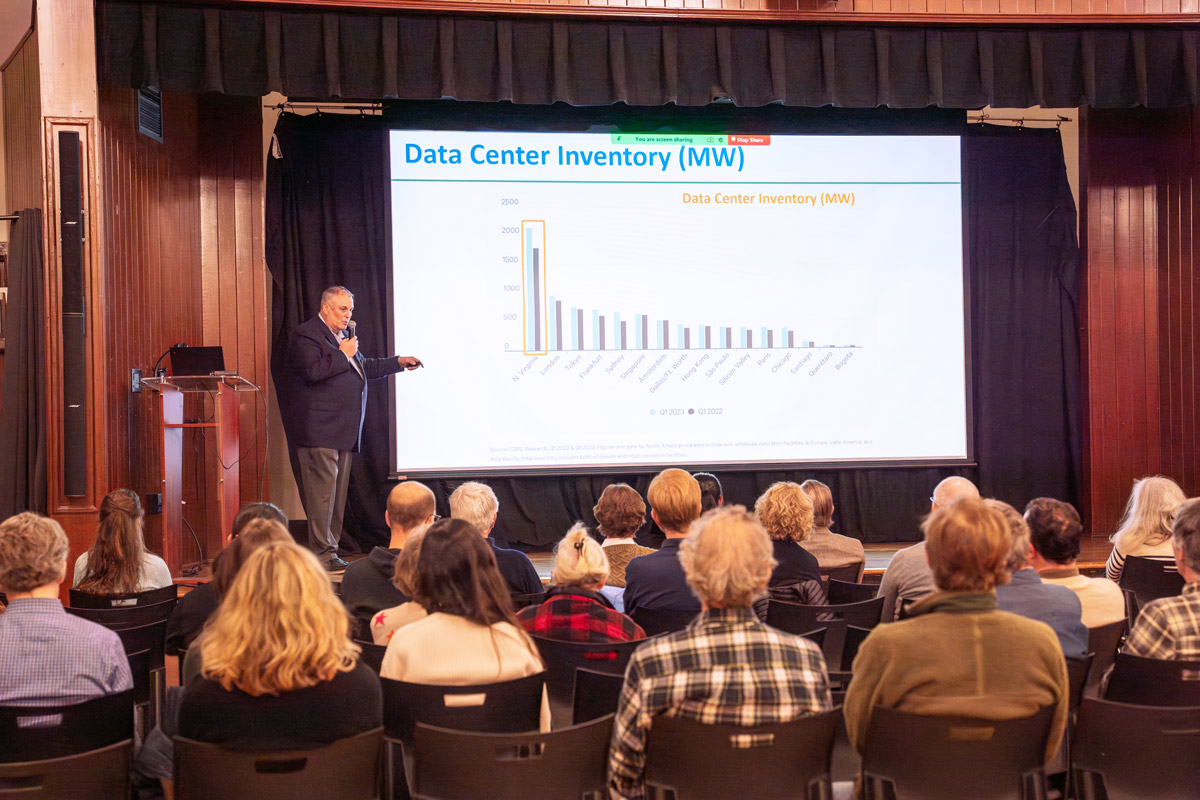
Loudoun County, Virginia—specifically the area surrounding Ashburn—features the densest concentration of data centers on Earth. The history begins with Cold War-era government fiber investments which drove the 1993 establishment of the MAE-East internet hub and in 1997, construction of the first data center in Loudoun. Campuses for UUNET (later, WorldCom), AOL, and Equinix were established in the county during this decade. The dot-com bubble burst in 2000, but that same year, the local zoning administrator made a crucial, quiet ruling that classified data centers as “office parks,” enabling decades of “by-right” development that lasted until the Board took action in 2025 (and still applies selectively to grandfathered applications and in areas administered under earlier zoning ordinances).
By-Right: Land uses allowed by your property rights under applicable zoning. By-right projects are approved administratively without the need for discretionary review or public hearings, provided they comply with existing code requirements. If a by-right use goes unchanged the county effectively agrees it is still the right use in the right place.
By 2006, Verizon was consolidating and scaling early fiber while Amazon was building its first footprint in the county, signaling Loudoun’s transition to a cloud computing hub. In 2008, Virginia enacted a sales tax exemption for the burgeoning industry—which remains in place and cost the state $1.9 billion this past year—while Loudoun launched its ‘Data Center Alley’ brand. In 2010, Loudoun Water also established the first reclaimed water program for data centers. In this early era, up until 2013, the county permitted an average of 6 data centers per year.
To encourage growth, in 2014, the Board of Supervisors streamlined data center standards. This promoted more data center development, increasingly “hyperscale” sized, for an average of 14 additional data centers per year from 2014 to 2023. The “Alley” soon sprawled beyond a simple corridor, with significant rezonings, such as True North (2018), Ashburn Corporate Center (2019), JK Technology Park 1 (2020), and both Brambleton South Industrial Properties and JK Technology Parks 2 & 3 (2022).
In the last decade, the Loudoun Board of Supervisors approved 38 rezonings explicitly for data centers and 36 rezonings with the possibility of data centers. In just the last year, the Board approved two: Cross Mill Center (Leesburg) and Arcola Grove Rezoning (Dulles). The Board also approved upzonings, allowing denser development in “by-right” areas. In 2018, the county hit 1 gigawatt (GW) of energy demand and by 2025, accelerated by the generative AI boom, county demand quintupled to 5.33 GW, representing nearly a quarter of Dominion Energy’s energy load in Virginia. Potable water consumption by data centers (in addition to their use of the reclaimed water system) also rose steeply, tripling over four years to nearly 952 million gallons in 2025. While the number of approved data center buildings remains unclear, according to a County study done by Kimley Horn, there were 162 data centers with building permits in 2023. As reported in the last budget cycle, data centers now generate 38% of the county’s General Fund revenue.
In 2024, the Board finally initiated a two phase Data Center Standards & Locations process to better manage data centers. Phase one ended “by-right” data center approvals in March 2025 and requires special exception approvals. Phase two will upgrade performance standards, and is ongoing.
“There has not been a single day without data center construction in Loudoun in more than 14 years”
~ Loudoun County Department of Economic Development website
Upcoming Decisions (More in the Queue)
July 9, 2026
Dulles Technology Park (LEGI-2024-0056, Sterling): The Planning Commission will discuss this proposal for three data centers off Shaw Road, to make a recommendation to the Board.
July 23, 2026
Spring Valley Tech Park (LEGI-2024-0074, Ashburn): The Planning Commission will hold a public hearing on this proposal for data centers off Evergreen Mill Road in the transition area.
Cochran Tech (LEGI-2024-0037, Leesburg): The Planning Commission will have a new public hearing on this data center proposal along Goose Creek on Leesburg’s outskirts.
October 20, 2026
Quantum Park (LEGI-2023-0097, Broad Run): The Board will decide whether to add more data centers to the Verizon campus on Waxpool Road.
Questions? Please contact Emily Johnson at [email protected].