“This farm has been in our family for over 100 years. This powerline would destroy so much of what we’ve built here.”
Charlie Goodwin grew up along a bend in the James River in Buckingham County, Virginia. The family farm is a picture of the area that surrounds the upper James — beautiful stands of trees, gentle hills with crops that stretch out of sight, and quiet, cared-for farmhouses.

Charlie lives near Fredericksburg now, but returns to the farm frequently. His parents lease out land to a local farmer and run an Airbnb on the site. His sister has a beekeeping business on the property, and the family has partnered with the James River Batteau Company, which hosts dinners and events on the farm and offers historical boat tours of the Scottsville area.
The Goodwins’ place could be a poster child for Virginia’s rural economy — an active farm that hosts multiple long-standing family and local businesses, all with a backdrop of rich historical significance. The property and its neighbors were all part of Snowden, a sprawling 1700s estate along the James River once owned by Thomas Jefferson’s father. The Smithsonian has been out twice to search for artifacts and the original farmhouse.
But it’s unclear if this particular farm will still look the same in a few years’ time. Three months ago, Valley Link Transmission LLC, a joint venture between Dominion Energy and other utilities, revealed the area is within a possible route for what would be the largest transmission line built in the state in decades.
An energy superhighway
The project, named Joshua Falls-Yeat for the two substations it would connect, would stretch about 115 miles from Lynchburg to Culpeper. The line has multiple possible routes, but all of them would impact hundreds of property owners and clear 2,600+ acres of forests and farms to make way for a 200-foot right-of-way. Transmission towers as tall as 160 feet would dot the corridor every quarter mile — skyscrapers through an otherwise rural stretch of the Piedmont.
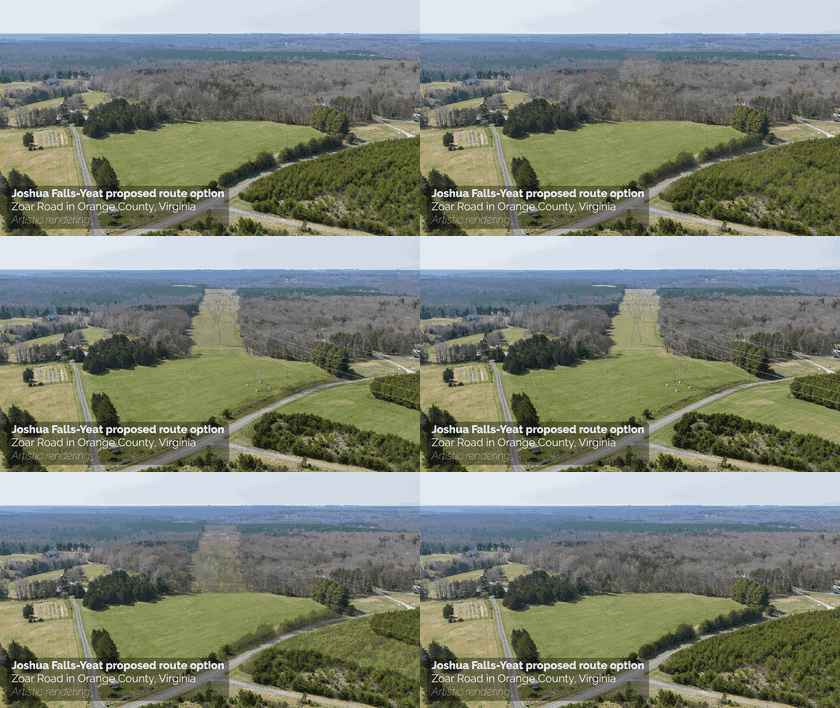
The line would also open the door to future development — the kind few could have anticipated just a few short months ago. Valley Link representatives themselves have referred to the project as an electrical backbone that would allow them to connect additional transmission lines and power plants throughout central Virginia. Some of the nine counties in the line’s path are already seeing that kind of development; just this March, Fluvanna’s Board of Supervisors approved a massive new gas plant near the county’s western edge. But for most of the region, the changes this line would bring are something no one asked for, and largely inconsistent with their local comprehensive plans.
Why it’s being proposed
So where did this transmission line come from?
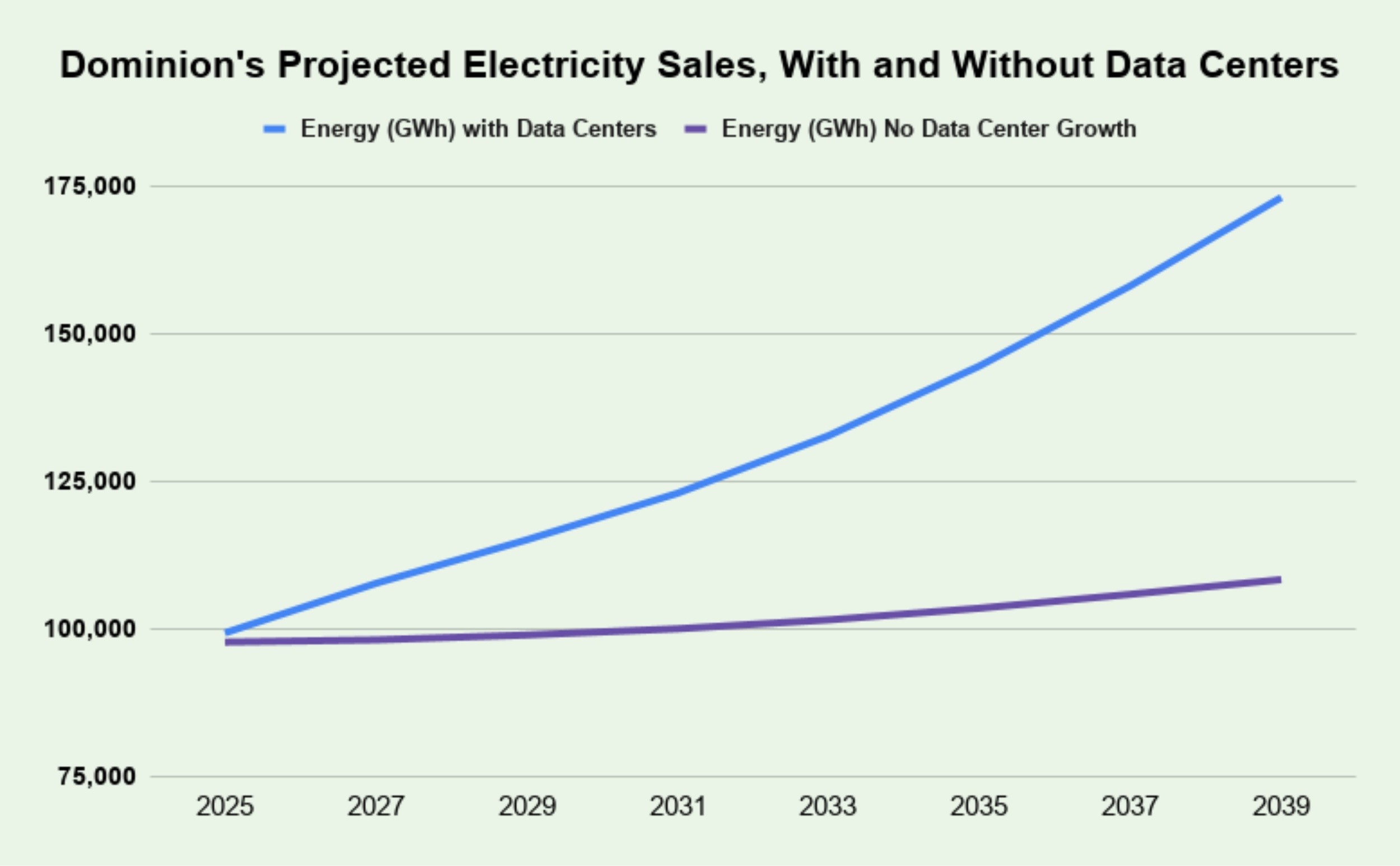
Data centers seem to be perennial front page news in Virginia, and for good reason. They consume massive amounts of electricity — as much as entire cities — and the industry’s power demand is a structural shift for our state. Despite a growing population, electricity demand in Virginia was essentially flat for most of the 2000s and 2010s, largely thanks to energy efficiency improvements in lighting and appliances.
But since 2020, Virginia’s electricity consumption has grown 23% and is expected to climb even faster, due almost entirely to data centers. Dominion Energy, the utility that owns most of the high voltage power lines in the state, revealed in February that it has received requests to serve data center customers totaling over 70 gigawatts — close to triple the current peak demand of the entire state.
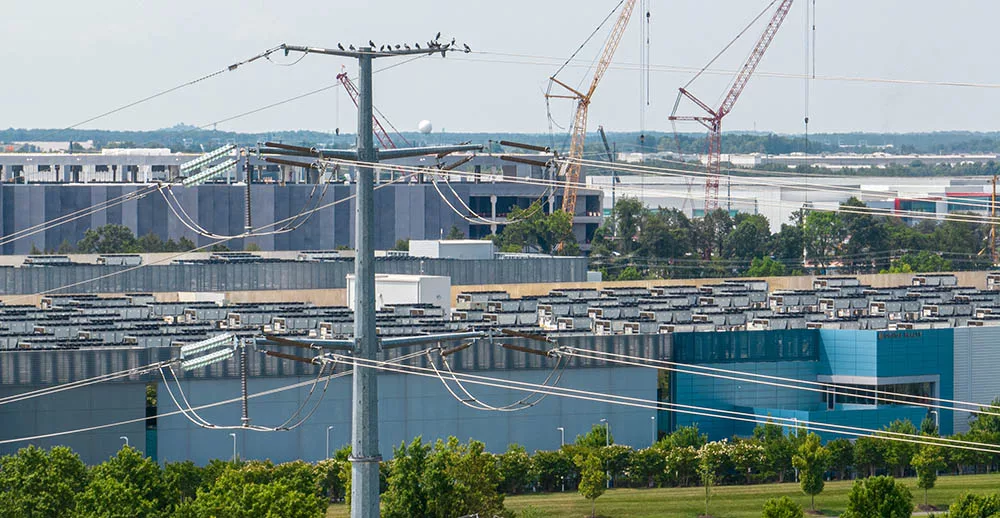
All that energy has to come from somewhere. The high-voltage transmission network, which moves electricity from power plants to population centers across the eastern United States, is the interstate highway system our grid relies on. Unlike homes and most other businesses, which are served by an intermediate network of low-voltage distribution lines (like the kind on wooden poles you might see in your neighborhood), data centers tie directly into this interstate system. Their power demands are driving an unprecedented expansion of this network, with Dominion reporting over 250 transmission-related projects planned or under construction in Virginia as of October 2025.
This buildout is one of the greatest threats to public and private lands in the state. Like an interstate highway, the impacts of the lines spider-web out to impact all of the surrounding land. The Joshua Falls-Yeat project that threatens the Goodwin family farm “has the potential to trigger development on either side, with on ramps for new generation and off ramps for data centers and other energy intensive uses. It could affect hundreds of thousands of acres,” says Piedmont Environmental Council President Chris Miller.
Other major projects in the pipeline
- The Morrisville-Wishing Star line filed with the state in late winter would add a new line on monopoles, some almost 200 feet tall, between Fauquier and Loudoun County, along a route that already hosts significant transmission infrastructure. The new lines would further burden residents and historical resources in the area, such as the nearby Manassas National Battlefield Park.
- Dominion recently proposed an upgrade to the existing Charlottesville-Gordonsville line that travels 15 miles through the Southwest Mountains Rural Historic District and the Journey through Hallowed Ground National Heritage Area. The current 50-feet-tall wooden poles sit largely below the tree line, but Dominion proposes replacing them with steel towers up to 150 feet tall in order to string another transmission line to them. These would be visible for miles through an area that has been federally recognized for its historic character and scenic value.
- Yet another utility company, FirstEnergy, is planning a similar rebuild project for a line that crosses the Shenandoah National Park between Page County and Sperryville. Its existing wooden poles would be replaced with steel towers as tall as 115 feet, which would have significant visual impacts on the Sperryville Historic District. The town of Sperryville is a critical gateway to Shenandoah National Park and Skyline Drive’s most visited entrance. Tourism at the park is an economic engine for the region, and the scenic and historic character of the surrounding communities is critical to the area’s draw. Just last year the National Park Service estimated that park visitation boosted the local economy by $175 million.
The costs
The scale of this buildout is massive. Dominion plans to spend as much as $3 billion a year on these projects for the foreseeable future, almost four times what it was spending at the beginning of the decade. Very few of these transmission projects would be required if not for data center growth. In fact, in 2024 Dominion reported to the Virginia State Corporation Commission in its Integrated Resource Plan that over 75% of their transmission project costs were either solely or partially driven by new data center energy demand.
But the data center industry isn’t footing that bill. A disproportionate share of costs are passed on to residential ratepayers, even for the lines Dominion ascribes solely to data centers. Burying these lines underground through sensitive areas is one way to reduce their impacts on communities and natural resources, but that can be many times more expensive, which is a tough pill to swallow when residents across the state are already on the hook for the bill.
PEC is hard at work trying to shift that burden off everyday Virginians and back to the data centers driving these projects. The State Corporation Commission regulates how costs for transmission are allocated across the commonwealth. PEC has been active in three cases before the commission over the past year arguing for fairer cost allocation, and we’ll be intervening in several more in 2026.

This pace of growth is entirely new for our grid, and it demands a new approach to how we build and pay for it. The richest companies in the world are driving it, and it’s only fair that they pay to build these projects in ways that respect the communities who host them. It’s worth fighting for a transmission system that protects the special places in our state, whether that’s a historic area designated by Congress, or a farm that’s been in the family for 100 years.
This article appeared in the 2026 summer edition of The Piedmont Environmental Council’s member newsletter, The Piedmont View. If you’d like to become a PEC member or renew your membership, please visit pecva.org/join.