
The Virginia Piedmont is one of the most breathtaking places in the country, with exceptional natural resources, productive farms and forests, and a landscape steeped in history. Nearly a half-million acres of conserved lands strengthen our quality of life and sense of place and serve as the foundation for well-functioning ecosystems, a strong local food supply and a refuge for a healthy variety of flora and fauna.
But this region isn’t what it is by chance. It’s taken the careful planning and work of countless people and organizations determined to preserve its beauty and irreplaceable gifts of nature for generations to come. Here, we highlight three of those people, who are protecting the Piedmont by growing local food, stewarding conservation easements and donating to make PEC’s work possible.
Sara Gouda
Community Farm Volunteer
By Catherine Fisher, Community Farm Assistant Manager
On a humid July morning, first-time volunteer Sara Gouda joined a group of volunteers gathered at PEC’s Community Farm at Roundabout Meadows. Sara found the Community Farm on a local volunteer website and was excited to work outside and learn how to plant and harvest. “PEC caught my attention most of all when I read that the farm donates almost 100% of the produce,” she said. “That really hit close to home, because when I was younger, we were always utilizing food banks. So it meant a lot to me that I could have this opportunity to give back in that way that was given to me.”
In 2025, the Community Farm grew and donated over 57,000 pounds of fruits, vegetables and herbs to local hunger relief organizations. By growing food for community members and practicing sustainable land management on the farm, volunteers support the Piedmont in a multitude of ways.
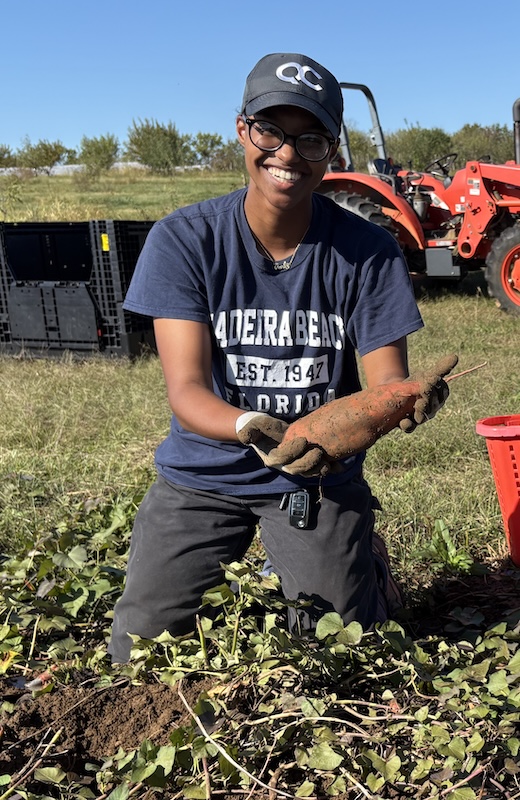
“I like that [volunteering] is different everytime,” Sara says. “Some days I’m harvesting beets, and other days I’m weeding in the greenhouse.” She fondly recalls another day pruning tomatoes in the caterpillar tunnel while learning from farm staff, a moment that reminds her of her childhood STEM classes in Fairfax.
“In elementary school, we were always finding ways to be outdoors and get our hands dirty,” she says. “We did this project called ‘Caring for our Watersheds’ and went out to Sugarland Run where we did a river dance and collected fish.” She observed insects, raised and released tadpoles, and saw turtles — her favorite animal — basking in the sun. Her appreciation for nature started at a young age, but Sara says the farm brings out the hands-on, outdoor-exploring version of herself that can often fade in adulthood.
With her quickness to smile and ability to strike up a conversation, she’s excited for the upcoming season and hopes to volunteer with a partner organization that receives the farm’s produce.
“Having a local food system makes it a lot more accessible,” she says. “It’s more boots-on-the-ground, and you can have a direct impact. You’re picking the fruits and vegetables with your own hands and it’s going straight to these people. It just makes it mean a lot more.”
Volunteer season at the Community Farm started in March, empowering volunteers to make a direct impact in the local community. If you find yourself working alongside Sara, say hello, and get to know one of the many incredible people protecting the Piedmont.
Emily Schmitz
PEC Donor
By Nora Seilheimer, Director of Advancement
For Emily Schmitz, the Virginia Piedmont is more than just a landscape; it’s a place that has shaped her life. Currently a double major in English and Environmental Studies at Davidson College, Emily’s academic interests are deeply rooted in childhood memories of exploring Shenandoah National Park and the clear waters of Sugar Hollow with her family.
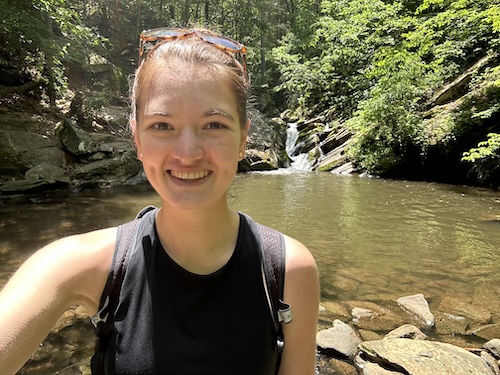
Her love of these special places and experiences has motivated her to learn more about them and what is needed to protect these and other natural resources. As the climate crisis became a concern for Emily, she recalls asking, “How could I, as a middle schooler, make an impact on this huge global issue?” Eager to find a way to turn her concern into action, she asked her parents for guidance. They encouraged her to look closer to home, focusing on organizations tackling environmental issues at the local level. This led her to The Piedmont Environmental Council, and at the age of 12, Emily decided to donate a portion of her monthly allowance to support PEC’s mission.
Through her involvement with PEC, Emily has developed a deep appreciation for PEC’s work in protecting natural systems while also supporting the communities within them. “We are not extricable from the environment,” Emily explains, highlighting her belief that environmental health and community health are the same. And she’s carried those lessons with her to college.
Her appreciation of community-based conservation led to a summer internship with the Town of Davidson where she helped track the town’s progress towards its climate action goals and developed programming for the town’s summer camp’s “Sustainability Day.” She also participated in a project placing markers on trees sharing the trees’ environmental and economic value. This effort turned a simple walk down the street into a lesson on the tangible value of nature for the visitors and residents of Davidson.
At Davidson College, Emily wrote an article for the school newspaper about the environmental impacts of data center development and through that experience gained a greater appreciation for PEC’s leadership on the issue.
While Emily misses Virginia, living in North Carolina for school has provided her with a broader perspective on environmental issues. “As I learn more about how change happens, I see how change at the local level is incredibly impactful and can create a model for how to create solutions for larger problems. Not only is PEC making a difference at the local level, but it has also helped establish this area of Virginia as a model for community-centered land use planning and conservation for the rest of the country. I am pleased to support PEC.” Thanks, Emily!
Michaela Weglinski
PEC Stewardship Coordinator
By Jessica Edington, Publications Assistant
For Michaela Weglinski, protecting the Piedmont through her work as PEC’s stewardship coordinator is all about connections.
“I enjoy bringing resources to landowners and helping connect our private landowner community with opportunities for land management practices that benefit both them and the natural resources of their conserved lands,” says Michaela. “I’m excited when they’re excited. Together, we share a passion for protecting and stewarding these lands that we all love in perpetuity.”
The protection that conservation easements provide is active, not passive. As an accredited land trust, PEC “holds” the easements on over 100 properties and is required to monitor each of those properties every year to ensure the conservation values of that land — things like wildlife habitat, prime agricultural soils, scenic viewsheds and unimpaired streams — are cared for in a way that’s consistent with the easement.
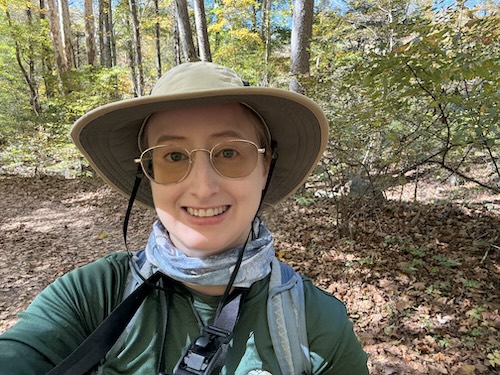
So, for much of the year, Michaela spends her time in the field, documenting observations and conditions of the property and meeting with landowners, land managers and conservation partners along the way. But that’s not all. “I’m a representative for both the conserved land and the land trust, and that means ensuring PEC is meeting our obligations to protect the land as well. And then I’m also working with the landowners who inhabit those lands,” says Michaela.
“Recently, for example, I met with a landowner in Madison County who had removed invasive bamboo from their property. Now, they’re looking at options for replacing that invasive bamboo with native trees along their stream, so I connected them with PEC’s Plantings for the Piedmont Program,” says Michaela.
During a monitoring visit last year, a landowner in Albemarle County told Michaela he hoped to see quail on his property again someday. He had spotted them in the area many years ago but had not seen any in recent years. Fortunately, PEC’s wildlife habitat outreach specialist Lauria McShane was out in the field with Michaela that day, and suggested a few native tree and shrub species for the landowner to consider planting on the property to make it more inviting for quail.
“I really like meeting with landowners and finding out what’s special about their property,” says Michaela. “Most of them are very proud of their preserved lands and many have really interesting stories about properties they grew up on or that were passed down through previous generations. With every field visit, I’m grateful for the opportunity to do my part to protect the Piedmont.”
This article appeared in the 2026 spring edition of The Piedmont Environmental Council’s member newsletter, The Piedmont View. If you’d like to become a PEC member or renew your membership, please visit pecva.org/join.