
Finally, the world is hearing the alarm that The Piedmont Environmental Council has been sounding for years: that the unconstrained and unregulated explosion of the data center industry is forever changing the face of not only Virginia, but communities around the world.
Thanks to standard PEC persistence — made possible by the generosity of our supporters — the impacts of data centers and their associated energy needs are now kitchen table conversations everywhere. People, and the media, are finally talking about the threat of brown-outs; about electricity bills doubling or tripling; about increased noise and air pollution; and about communities becoming industrialized dystopias with gigantic warehouse structures linked by miles of transmission lines strung on 200-foot towers.
It hasn’t always been easy, but PEC has been able to lead the way because we saw what lay on the horizon more than a decade ago.
PEC Saw What No One Else Could
“Because we have a very specific focus, and staff working directly on land use planning within a nine-county service area, we were aware of [the impacts of] data centers probably earlier than most people. But until about 2016, data centers were small, generally inside other buildings, confined to planned industrial and commercial areas, revenue positive, and their apparent environmental impacts were manageable,” said PEC President Chris Miller.
The first signs of trouble came in Loudoun County during the period from 2013 to 2018. Despite extended fights with a lot of community pushback, the county approved a natural gas peaker plant and then a significantly larger, new form of data center, both right next to the Goose Creek Reservoir. “This is when we learned that a component of large-scale data centers was backup generation with some 50,000 gallons or more of diesel fuel stored on site, in this case, next to the drinking water supply. That’s insane,” Miller said.
“And we were saying, ‘Hey, wait a minute. If data centers are moving out of industrial-zoned areas and demanding extra electricity, local governments need to analyze and prepare for the possibility of new power plants, transmission lines, and substations.’ We realized then that this is getting out from under reasonable oversight,” said Miller.
The Challenges of Explosive Growth, Temptation and Secrecy
Seemingly overnight, artificial intelligence and crypto-mining became global obsessions, and the nature of data centers rapidly changed, growing from single buildings to campuses of dozens of buildings across thousands of acres. Each building has gone from 30,000 square feet to ten times that size. The energy each data center campus needs has increased from 15 megawatts to 300 megawatts, enough to power 300,000 – 900,000 homes. Virginia now has 660 data centers, and Dominion Energy forecasts their peak energy load in 2045 will be more than 50 gigawatts — as much as the entire nation of the United Kingdom.
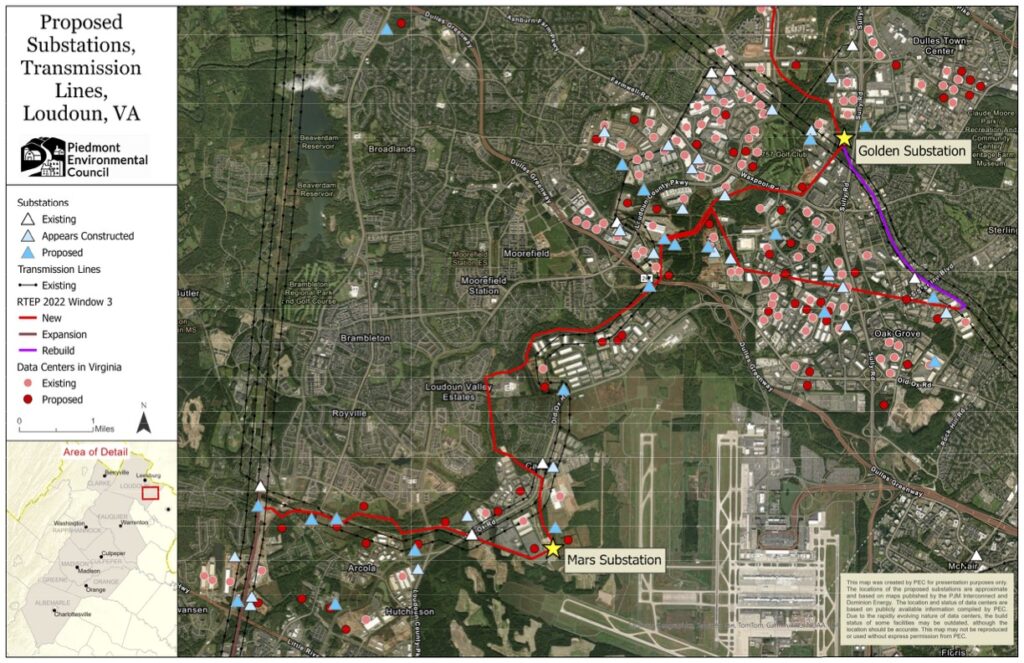
Providing all that power is going to take thousands of miles of new transmission lines, hundreds of new substations, and many massive new power plants along with hundreds of thousands of acres of solar. The cost of that buildout — $90 billion to $270 billion — will be spread across every Virginian who pays an electric bill, while Dominion makes a 10% return on that investment and wealthy tech companies get massive tax breaks and profits.
Meanwhile, more data center development is sprawling far beyond designated industrial zones into wetlands, pristine parks, national parkland and historical cemeteries. These are areas that once protected drinking water, aided climate resiliency, provided wildlife habitat, and attracted visitors and tourists from around the world. “We’ve seen a tectonic shift in local government priorities away from conservation, water protection, rural resources…
“The money has trumped everything,” Miller said.
Some county supervisors who once opposed this or that proposal are now selling their land to data center developers. The town manager in Warrenton, after facilitating a local approval, took a high-paying job with Amazon. In county after county in Virginia — a state where campaign donations can benefit candidates personally — elected local decision-makers repeatedly turn a deaf ear and a blind eye to hundreds of comments, letters and calls from constituents. And, for the past three legislative sessions, the General Assembly has blocked or deferred any meaningful legislation that could help protect people, communities and their resources.
The shroud of secrecy around data center projects makes it challenging to understand the problem. Proposals are often devoid of details communities and local governments need to make smart decisions — details such as the number and location of buildings; lighting; noise pollution; how much energy and water they need; and where it will come from. Details they do contain can be misleading. Probing questions and Freedom of Information Act requests from PEC, partner organizations, and even the media have been met with heavily redacted documents, claims about proprietary secrets, and non-disclosure agreements signed by local elected officials.
PEC, the people of Virginia, our families, small businesses — we are the proverbial David fighting a Goliath of epic proportions. “There is much more work to be done. We are facing an existential crisis,” Miller said.
PEC’s Relentless Persistence Moves the Needle
With the support of our board of directors and the generosity of donors, PEC has been perfectly positioned to shape the local, state and national conversations.
Our expert staff and volunteers have been the driving force behind the effort to dig up and fill in the missing details. “More than any other organization, we are manually researching every building permit and proposal out there and using that information to build detailed maps of existing, approved, and proposed data centers, transmission lines, substations, and air permits for diesel and gas generators. And then we’re estimating and projecting the aggregate impacts on air quality, water supply, electrical demand and the related need for additional energy infrastructure,” Miller said.
In 2023, PEC co-founded the statewide Data Center Reform Coalition of 50+ organizations and communities urging state lawmakers to institute commonsense reforms for the data center industry around four key pillars: 1) transparency; 2) state oversight and regulation, including requirements for mitigation; 3) financial protection for families and businesses; and 4) tying data center tax exemptions to standards that reduce pollution.

These pillars have formed the basis of dozens of legislative proposals over the past three years, and though the General Assembly has yet to muster the fortitude to take on the complexities or realities of the situation, we see the needle moving with each year. The coalition’s influence has steadily grown, with citizen lobbyists and professional representatives showing up at local, state and federal levels, and hosting press conferences, community meetings and protests.
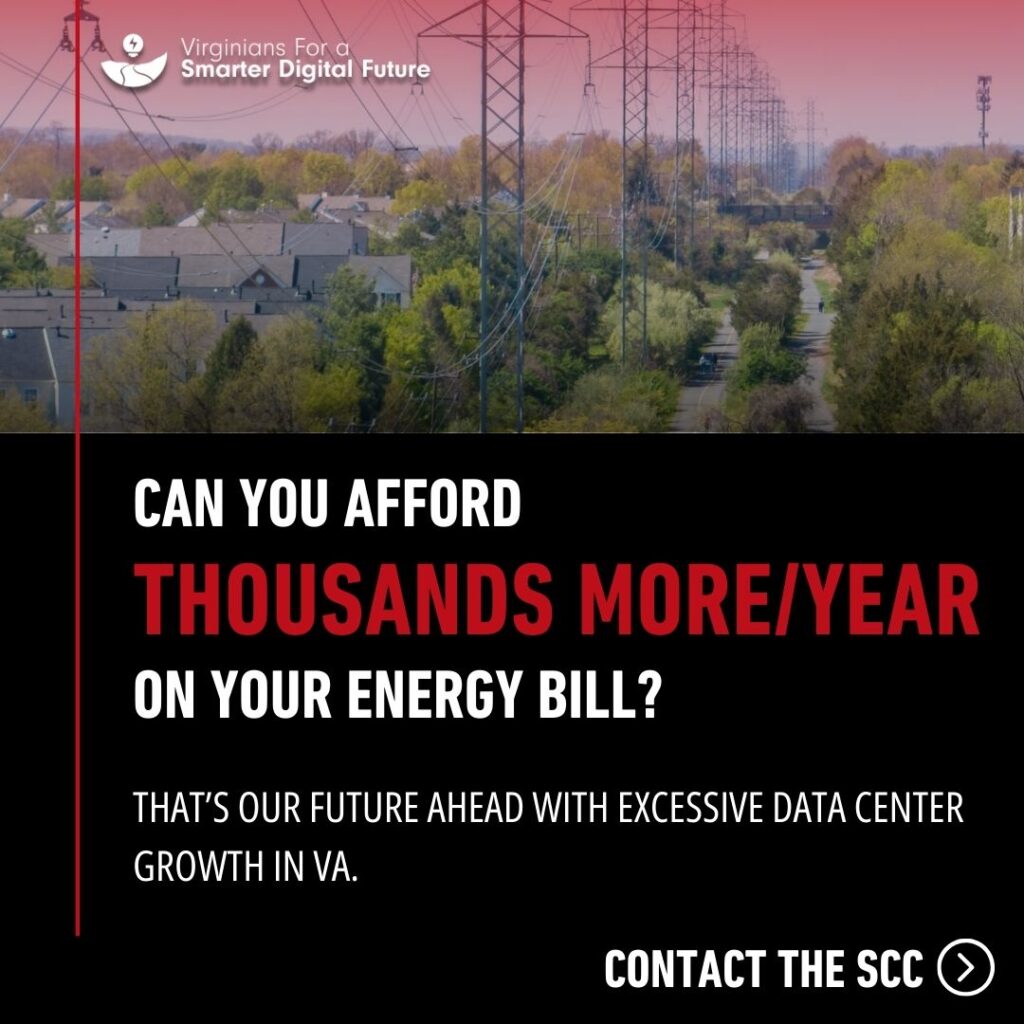
In fall 2024, PEC also launched Virginians for a Smarter Digital Future — an aggressive, statewide public awareness campaign to spotlight the impacts of data centers on all Virginia residents and provide the tools people need to advocate for themselves and their families, businesses and communities. Most recently, this campaign was focused on getting community members to understand and weigh in on the most important decision the State Corporation Commission has ever faced: Will Virginians continue to be forced to subsidize the hundreds of billions of dollars needed to triple Virginia’s energy system for the additional 47 GW of data center energy demand?
Our efforts are paying off.
We’ve held many dozen community meetings and sent more than 100 email alerts. Our digital and video ads reached more than 1.4 million Virginians, and our data center videos have been viewed and shared by more than 300,000 people. County governments in Loudoun, Culpeper, Fauquier and elsewhere are at last starting to reject poorly conceived projects and improve zoning ordinances to protect their communities.
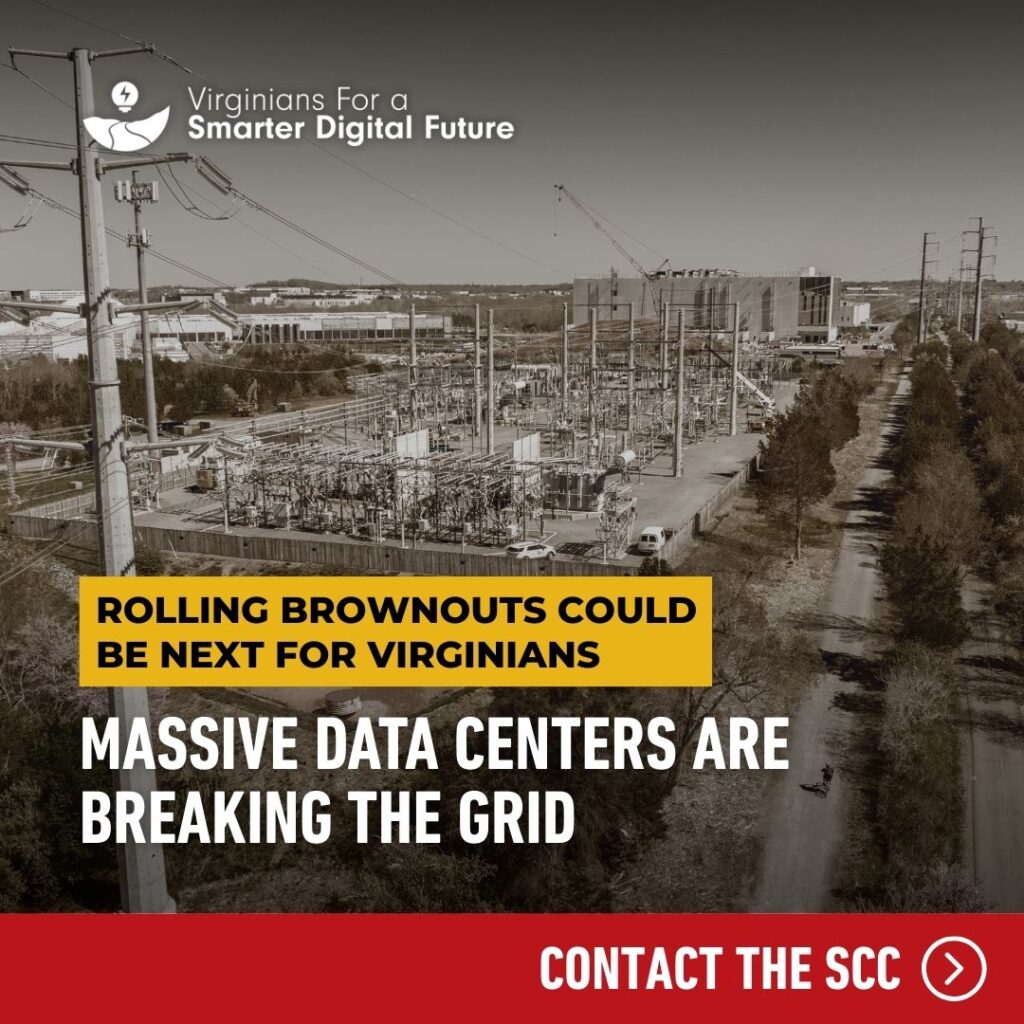
Our outreach and ad campaign inspired nearly 2,500 letters from across Virginia asking the SCC to hold data centers more accountable and to protect Virginians. In turn, the SCC has just created a new energy rate class for data centers and directed Dominion to recommend better cost allocation to reduce their burden on residential ratepayers.
Every day, we’re sending press releases, serving on panels, giving interviews and sharing information about how data centers are impacting all of us. PEC staff and consultants have been cemented as leading experts on data center impacts. Our maps, images, reports, and videos are repeatedly reused and republished by others, including the BBC, the Canadian Broadcasting Corp., the Wall Street Journal, Bloomberg News, Richmond Times Dispatch, Virginia Mercury, Now This Impact, More Perfect Union, Bay Journal, and a Swiss TV station. We field a continuous stream of interview and tour requests from national and international news media. And the information and conversations we share with them are forming the framework of headlines, broadcasts, podcasts and substacks around the world.
The Challenge Ahead
Still, money is power, and millions in political contributions and lobbying efforts are formidable foes. With every inch of headway we make, the data center industry doubles down with multi-million dollar ad campaigns, donations to local causes (that pale in comparison to their profits), and slick marketing efforts. Local businesses are selling out to data center developers. And the hope of future tax revenue is a compelling wolf in sheep’s clothing.
Currently, Virginia faces a dramatically increasing number of energy projects and an unimaginable onslaught of transmission lines proposals through conserved lands, suburban neighborhoods, historic sites and pristine rural corridors. Virginia is considering relaxing air pollution standards so that data centers can run polluting back-up diesel generators more often. And the federal government is pushing to accelerate the build-out of new power plants and transmission lines.
“And Virginia still does not have a data center plan… no established state regulations, no agencies to track how many or map their locations, no aggregate data to assess land or air quality impacts or water consumption, no centralized process where citizens can learn what’s planned for the communities they live in or where they might plan to move,” Miller said.
Instead, the entire situation is being driven by for-profit utility companies, their trade association —PJM —which manages the regional electric grid, and the wealthiest tech companies in the world.
“PEC is on mission, working to convey the most transformational financial and environmental impact our state has ever faced. In the end, we’d love good policy, but right now we’re trying to inform and empower people about how they can make a difference,” Miller said. The fact is, PEC has become known for our relentless determination and growing momentum in the face of powerful obstacles.
Goliath, meet David.
Since our beginning, one of PEC’s value propositions is that we are an on-the-ground organization with people working directly in our communities, attending county meetings, reviewing development proposals, learning the details and taking time and energy to mobilize people. We couldn’t work at that level, with that diligence, if not for the generous and sustained financial support — large and small — of our members. We need your continued support to keep the momentum going.
This article appeared in the 2025 winter edition of The Piedmont Environmental Council’s member newsletter, The Piedmont View. If you’d like to become a PEC member or renew your membership, please visit pecva.org/join.