
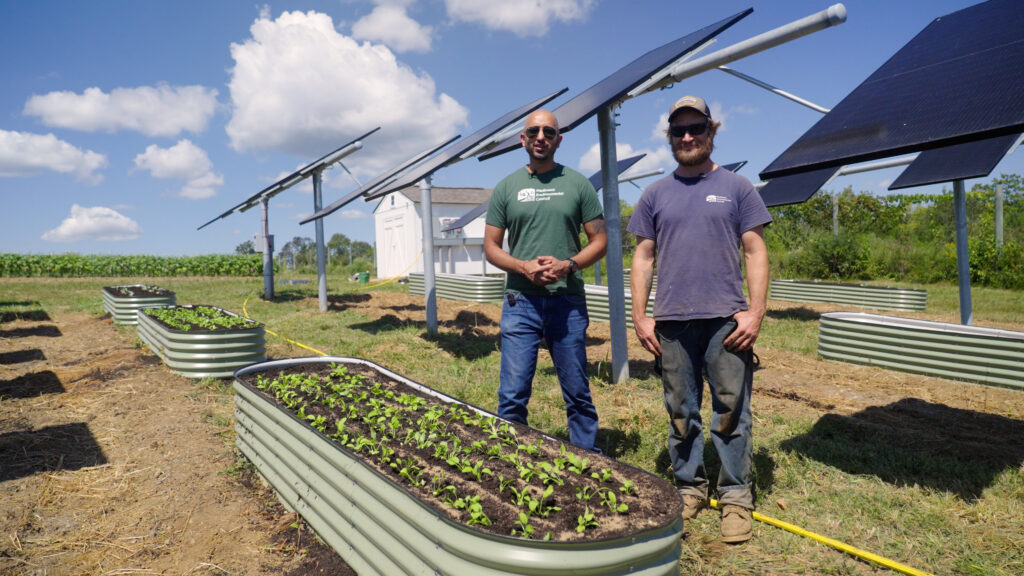
This fall, The Piedmont Environmental Council cut the ribbon on our new agrivoltaics project at the Community Farm at Roundabout Meadows, a 42-panel installation that now generates 100% of the energy needed for the farm’s operations. The project, the first of its kind in Virginia, has rows of vegetables planted between the panels and serves as a demonstration project to study and show how the dual-use of land for both agriculture and energy generation can help meet clean energy goals while keeping land in farming.
PEC advocates for clean energy solutions that respect and preserve the region’s natural resources and rural economy. This project is meant to demonstrate energy independence for farmers and how smaller-scale distributed generation and battery storage can be a much larger part of Virginia’s clean energy system, all without sacrificing working farmland. The design is engineered for easy adoption by other farmers, and the raised beds make the project equally relevant to urban settings, parking lots, rooftops and other built environments.
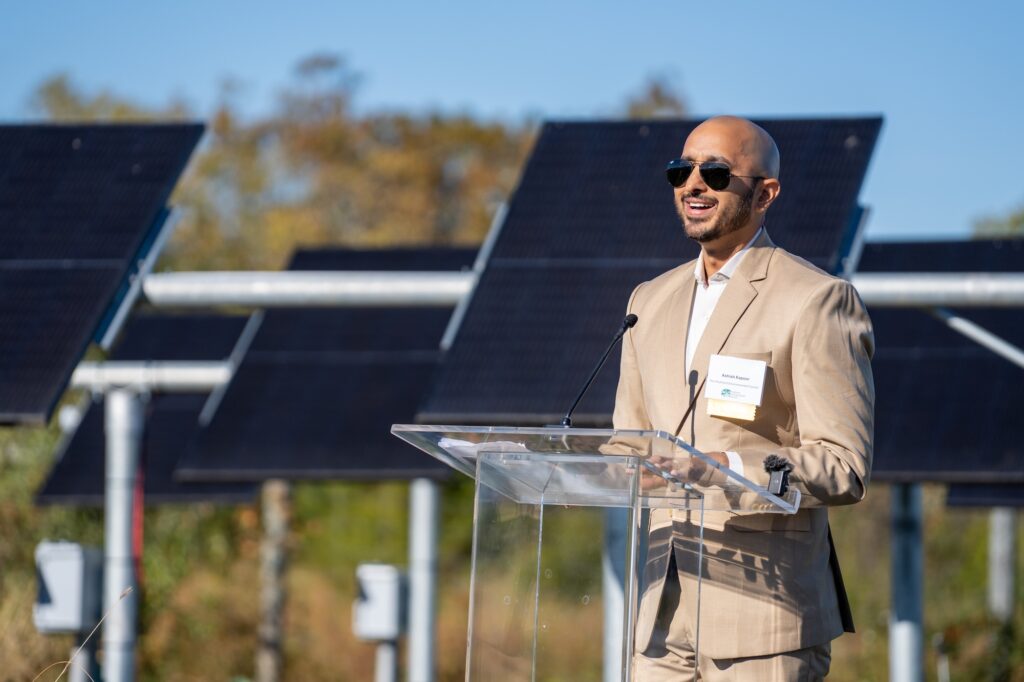
PEC’s Senior Energy & Climate Advisor Ashish Kapoor and Community Farm Manager Teddy Pitsiokos sat down to tell us more about this groundbreaking project that has the potential to revolutionize the conversation around solar and agriculture.
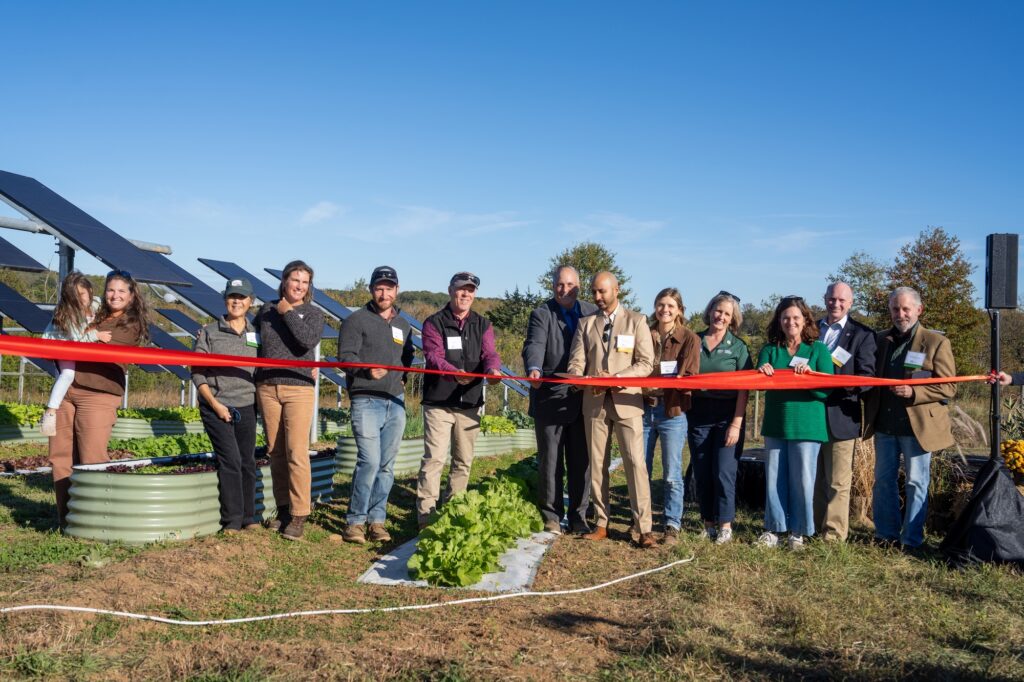
In October, PEC supporters, board members and staff — including Ashish and Teddy — gathered to cut the ribbon on the agrivoltaics installation at the Community Farm. Photo by Hugh Kenny
Jessica: How did the idea for this project originate?
Ashish: PEC’s headquarters in Warrenton has solar panels on it, and we’re one of the facilitators of the Solarize Piedmont program, so this is part of a distributed generation journey PEC has been on. The project was born out of conversations about different scales of solar and the conflict thus far between prime agricultural lands and solar generation and wanting to move toward solutions. Agrivoltaics is one way to do both things on the same land. And that hopefully can recalibrate some of these conversations.
Jessica: What are some of the lessons you have already learned from the planning, permitting and installation process?
Teddy: One of the biggest things we’ve learned is the importance of having farmers working on the project from the outset versus just pasting agriculture onto existing solar sites. What makes it agrivoltaics is the collaboration between energy and agriculture experts and the design being farm-forward.
Ashish: On the permitting side, one of the hurdles we grappled with was local zoning that wasn’t written with projects like this in mind. On the installation side, we hit bedrock and had extra cost to dig through that. We also had to pay for transformer upgrades, which may be pretty common for a lot of rural users. All of these things can make a project like this feel more challenging for an individual. So we want to find out how we can lower those barriers and costs for other folks that are looking to do agrivoltaics.

Jessica: What are you hoping to learn from this project?
Teddy: In addition to documenting the process and measuring the energy and crop output, we will be testing the soil for PFAS and heavy metals. We’ll also make and share our plans to recycle the panels and responsibly decommission the project at the end of its life cycle.
Ashish: We want to know how we can make these sorts of agrivoltaics projects easier to do. What works in this region would be different in the western U.S., or maybe even a different part of Virginia. I want to shout out the National Renewable Energy Lab, which helped us with the original technical assistance grant in the early stages of this project through the Clean Energy to Communities Program.
Jessica: What impact do you hope that this demonstration project will have on the tension that sometimes exists between agriculture and solar?
Teddy: Personally, I’m hopeful that having farmers involved in these processes will help create smarter, more profitable and more sustainable land practices.
Ashish: I hope this project helps show that we’re all on the same team here. There are no inherent sides to renewable energy. Everyone likes the idea of generating energy from your own land, using it to charge a back-up a battery and having energy independence while keeping the land in agriculture. Preserving prime agricultural land, creating energy independence and adding more renewable energy to the grid don’t have to exist in direct conflict with one another.
Jessica: What potential does agrivoltaics have to help farmers?
Teddy: The biggest thing is land conservation and keeping land in farming. And then there is energy savings, energy independence and potential income streams. That’s what we’re talking about when a farmer says, “What is this going to do for me?”
Ashish: As utility bills continue to go up, primarily due to costs associated with escalating data center demand, farmers with agrivoltaics projects will be more insulated from that — saving more and more money as time goes on. The pure savings over time is one huge boon. Add battery backup, and a farmer can run their farm operations if the power goes down. The energy transition doesn’t need to be a threat to the farming way of life.

Jessica: What role can agrivoltaics play in land conservation?
Ashish: From a solar developer’s perspective, the cheapest way to build solar, and the best place to build solar, is on prime agricultural land… which creates development pressure on farmland. And the more energy we need because of data centers, the more farmland will be lost to solar. So the more we can build solar on rooftops, on parking lots and through agrivoltaics, the lighter the development pressure on prime agricultural land.
Teddy: I think it’s important to take the expansion of solar energy projects as a given. These projects are coming either way, and we have to do something to keep this farm actually farming. Agrivoltaics is one way we do that.
Jessica: How do you see agrivoltaics fitting into Virginia’s clean energy future?
Ashish: If we put a small 1-megawatt project on each of Virginia’s 39,000 farms, that would generate 39 gigawatts of energy. That’s more than the current peak load in Dominion territory. Even getting a fraction of that potential is significant. Other states like Massachusetts and New Jersey have already added significant gigawatts of energy to the grid through smaller scale solar that was boosted by smart policy. The smaller projects can get online a lot faster, too.
When we add batteries into the mix, like we have on this PEC project, things get even more exciting. Not only does that give farmers energy independence for their operations, but with “virtual power plant” arrangements where they can sell some energy from their battery back to the grid — a little bit from this farm, a little bit from that home, a little bit from this business — collectively, you can create a whole ton of energy when the grid needs it most. So, we don’t have to build that $1 billion gas peaker plant that we all pay for through increases in our electric bills. Instead, farmers, businesses and homeowners get a solid bill credit for their energy contribution.
Jessica: How do you think policy could better support agrivoltaics?
Ashish: At the local level, making permitting and connection easier will remove some hurdles for projects like this. Boards of supervisors have already reached out and said, “This is interesting. How can we make this easier? How can we make sure that we’re not restricting these types of projects in future comprehensive plans or ordinance drafting?”
At the state level, protecting net metering, which pays full retail rate to small scale solar producers, is one of the core ways to incentivize agrivoltaics. Dominion is trying to cut net metering because it’s not as profitable for them, and that would knee-cap the value of all distributed generation, including rooftop solar and small-scale agrivoltaics. We need to rally and say, “OK, everybody agrees on the value of distributed generation. It conserves resources. It connects clean energy to the grid quickly and helps move along our journey in the Virginia Clean Economy Act. We should commit more resources to this type of generation.”
Jessica: What has surprised or excited you most about this project so far?
Teddy: Because I’m a farmer, I’m always surprised that some people feel uncomfortable on a farm. But for me, being around solar panels can feel unfamiliar or a little bit alien in a way. And if you think about a power plant, it’s not a friendly place: it conjures images of smoke stacks and pollution. Out at our agrivoltaics installation on the farm, it feels a lot friendlier to be in there with the plants around you. It’s the friendliest type of energy generation. So no matter which world you come from, agriculture or clean energy, you can come into this space and feel safe. There’s something familiar, but there’s also something new and cool to learn.
Ashish: What both surprises and excites me is that so far, I have found agricultural producers and farmers to be more excited about this project than large scale solar developers. That shows me that we’re really onto something that’s benefiting farmers and something that hasn’t been part of the conversation yet. It’s shown me that this tension is not really about renewable energy, it’s more about land use, land impacts, livelihoods and ways of life.
Jessica: What do you hope will be the ultimate outcome of this project?
Ashish: I think it can help reframe the conversation around the energy transition. And I think that conversation is in need of a reset. The transition has oftentimes been very prescriptive, and I hope this project will change people’s perceptions of what renewable energy can do for them.
Teddy: I hope that people make more of these agrivoltaics projects. I hope they learn from us and do it cheaper, and I hope it can make them money and keep their land in farming.
As part of our strategic plan, PEC is committed to using our own properties as a showcase for sustainable land management practices, facilitating public access, inspiring conservation solutions and demonstrating our vision, values and practices. Like many of these efforts, the agrivoltaics project at our Community Farm is made possible only through grants and generous private contributions.
This article appeared in the 2025 winter edition of The Piedmont Environmental Council’s member newsletter, The Piedmont View. If you’d like to become a PEC member or renew your membership, please visit pecva.org/join.