
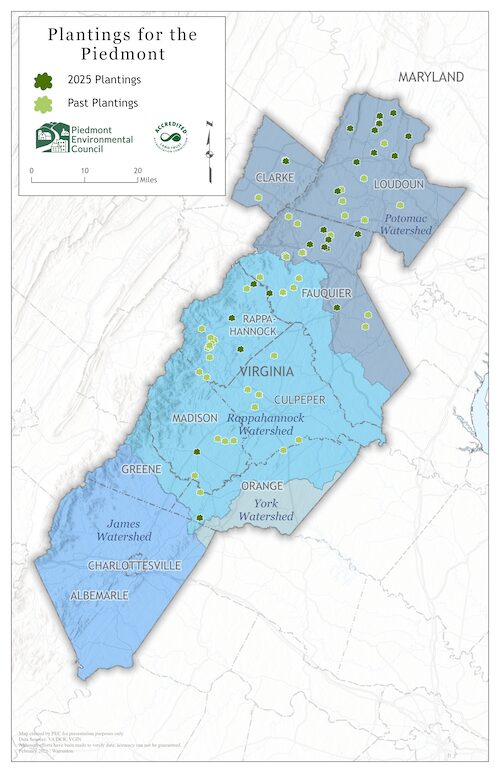
The end of every Plantings for the Piedmont season comes with a sigh of relief. New native trees and shrubs are in the ground; landowners can look out at the tangible result of months of planning and work; and PEC’s Plantings for the Piedmont team and partners get some much-needed time at our desks after months of field work and events. After compiling the data for 2025’s spring and fall plantings, I sat staring at my screen.
Could that be right? Did we actually plant 15,000 trees last year?
I reviewed the numbers again, and then again. We most certainly did — a record high. And none of it would have been possible without collaboration and partnerships.
It Takes A Village to Plant A Buffer
How does a planting project even get started?
Sometimes PEC is the first organization invited to a property, and we bring in other partners. Sometimes, we’re introduced to landowners by other organizations who were first on the scene. In still other cases, neighbor recommendations are the reason more riparian buffers — the forested areas along rivers, streams, creeks and other waterways that are essential for protecting clean water — get restored.
One of my favorite examples of collaboration and partnerships culminating into a riparian buffer restoration planting is a project we did last fall at Oakendale Farm in The Plains.
On a warm day earlier that summer, I visited Oakendale with a group of technical service providers who help landowners steward their lands. The farm is picturesque: sprawling hayfields, pastures and forest with a stretch of Bartons Creek — a tributary of the Little River, Lower Goose Creek and Potomac River watersheds — and several ponds.
As we walked the property, our group talked through landowners Frank and Tamara’s vision for the land and how our programs might support their goals. Justin Proctor from Virginia Working Landscapes had organized the visit and brought together representatives from PEC, the Goose Creek Association, the John Marshall Soil and Water Conservation District, and the Virginia Department of Forestry.
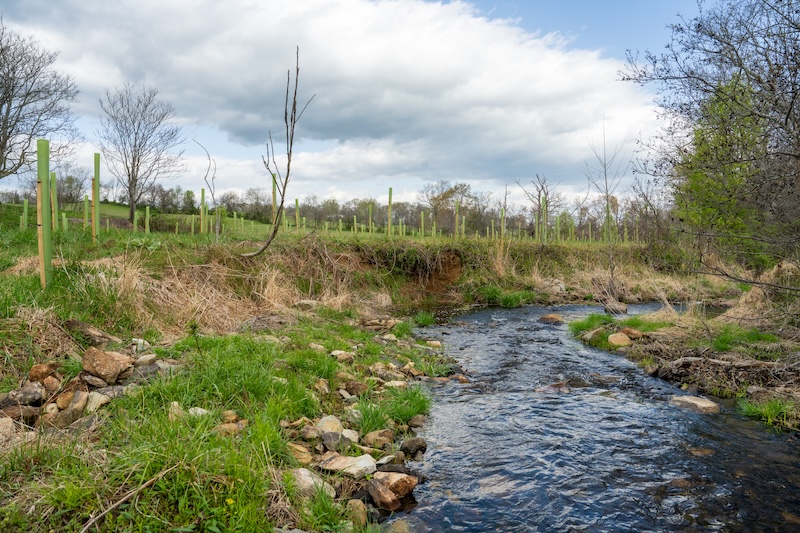
Justin, who had already been working at Oakendale to restore grassland bird habitat, pointed out a stretch of Bartons Creek that he’d had his eye on for years. Too little tree canopy, eroded banks and heavy sedimentation created what Justin called “a perfect example of a bad riparian buffer.” Already, Frank and Tamara had stopped mowing up to the stream to allow vegetation to stabilize the streambanks, but they wanted to take the next step toward improving water quality here and downstream.
With so many organizations dedicated to clean water and habitat restoration together at Oakendale Farm, we developed a plan.
- Frank and Tamara enrolled in a riparian forest buffer cost-share program with the John Marshall Soil and Water Conservation District;
- The Virginia Department of Forestry mapped out the plan for planting nearly 3,000 native trees and shrubs on the roughly 10-acre buffer;
- PEC worked with Friends of the Rappahannock and Shenandoah Habitats to get the trees in the ground;
- With support from a Small Watershed Grant from the National Fish and Wildlife Foundation, PEC paid the upfront costs of the tree installation and the funding gap not covered by cost-share;
- PEC worked with the Rappahannock Conservation Nursery to source live stakes (tree cuttings);
- Volunteers with the Goose Creek Association installed the trees;
And for the next three years, additional groups will support maintenance activities.
In other words, many hands made this project possible, and none of it would have happened without the landowners’ willingness to engage with us on conservation and restoration opportunities.
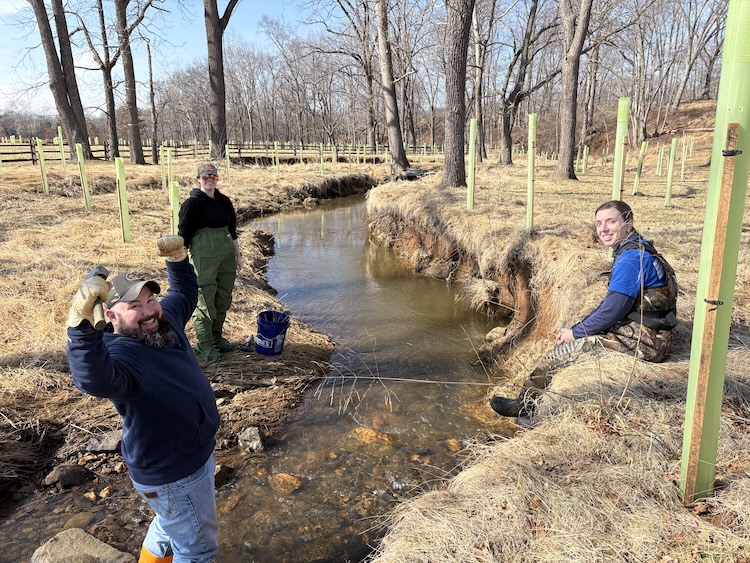
“It is really inspiring to meet landowners so motivated by — and then ultimately so rewarded by — their efforts to protect and improve wildlife habitat, watershed quality, soil health and regenerative agriculture,” says Justin. “When we set out as a community to protect the rural character of our region, this type of land and water stewardship really embodies that goal.”
We all now get to watch over the coming years as the buffers grow into corridors of native forest, benefitting local wildlife and improving water quality on the farm and for their neighbors downstream on the Little River, the Lower Goose Creek and the Potomac River.
Tree Plantings, Clean Water and the Chesapeake Bay
So, why does PEC plant trees anyway?
Because riparian forest buffers are crucial: they stabilize stream banks, reduce erosion and flooding, filter pollutants, create wildlife habitat, cool the water for aquatic life — and, ultimately, support clean water, which is the lifeblood of our land, communities and economy.
Supported by the U.S. Environmental Protection Agency and the National Fish and Wildlife Foundation’s Chesapeake Bay Stewardship Fund, PEC’s Plantings for the Piedmont program covers the costs of technical assistance, project design, materials, installation, and three years of paid maintenance for riparian buffers and “upland” agricultural tree planting projects. Our work sits at the essential nexus between land conservation and water quality.
Every planted tree plays a role in the restoration of our local watersheds, and, ultimately, the Chesapeake Bay — the largest estuary in the United States, with a watershed spanning six states and the District of Columbia. Along with numerous federal partners, each of these states has voluntarily signed on to the recently revised Chesapeake Bay Watershed Agreement to restore, conserve and protect the watershed — a commitment PEC shares.
A recent report found that both forest and urban tree canopy cover has continued to decline across the watershed. In response, the revised Chesapeake Bay Watershed Agreement sets a target to plant and maintain 7,500 acres of buffers annually through 2040. That’s about 2.25 million trees.
I find those numbers a little daunting, but I’m heartened by examples like Oakendale Farm, which shows that collaboration is essential to meeting these goals. Not one of the 15,000 trees PEC planted last year happened in isolation. As a native plant lover, I find it so rewarding to see villages come together to get our Plantings for the Piedmont projects in the ground and then to watch the buttonbush (a personal favorite), oaks, river birch and dogwoods — to name a few — emerge from their tubes, knowing they’re going to provide clean water and habitat benefits today and in the years to come.
This article appeared in the 2026 spring edition of The Piedmont Environmental Council’s member newsletter, The Piedmont View. If you’d like to become a PEC member or renew your membership, please visit pecva.org/join.