
Lands Permanently Protected Include historic Oak Hill, Bull Run and the Shenandoah Borderlands Project
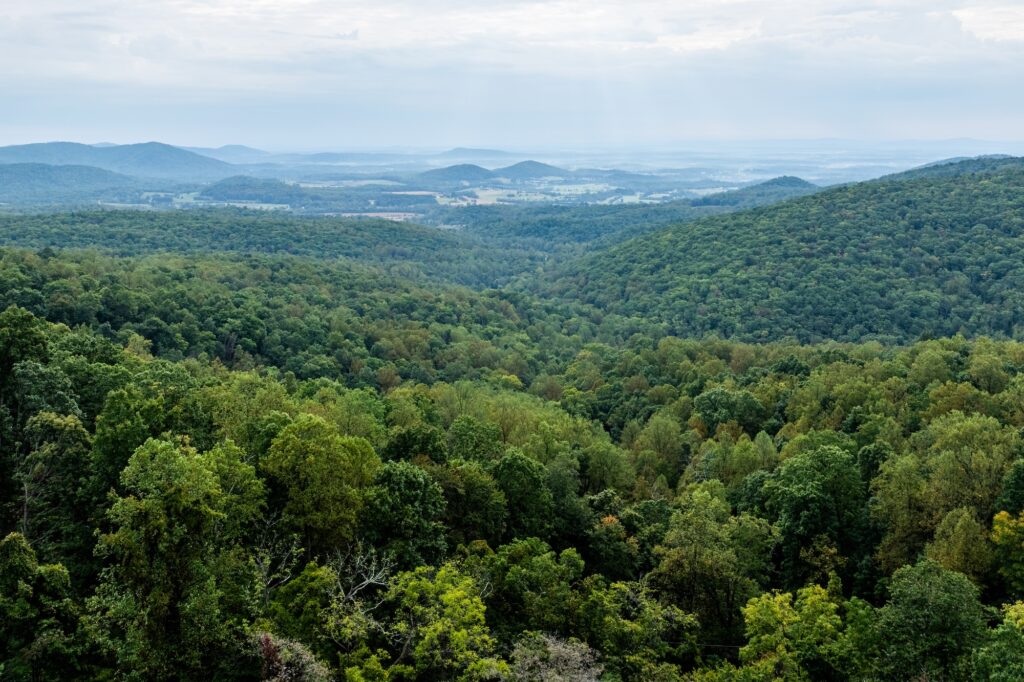
Warrenton, VA. (April 8, 2026) – In 2025, landowners and conservation organizations in The Piedmont Environmental Council’s nine-county region (Albemarle, Clarke, Culpeper, Fauquier, Greene, Loudoun, Madison, Orange and Rappahannock) conserved over 4,178 acres through conservation easements. The Conservation Fund’s purchase of Oak Hill in Loudoun County (about 1,196 acres) and the Virginia Outdoors Foundation’s acquisition of 178 acres for the Bull Run Mountain Natural Areas Preserve added another 1,374 acres. This means that total protected lands now comprise more than 28 percent of the PEC Region. (See Table 1.)
“At any scale and in every location, land conservation conveys immense public benefits,” said PEC Director of Conservation Mike Kane. “Land conserved in 2025 ensures the protection in the future of over 3,000 acres of forests, more than 2,700 acres of prime farmland, over 2,000 acres along scenic byways and 880 acres within historic districts.”
To support conservation, PEC continues to leverage the Farm Bill’s Agricultural Land Easement program with the Land Preservation Tax Credit and philanthropic funds to protect the lands that provide food and protect water supplies throughout the Piedmont. Those landscapes include historic districts and the scenic byways the area is known for, including the Appalachian National Scenic Trail, Skyline Drive and the Journey Through Hallowed Ground National Scenic Byway.
In the ecologically and culturally important Bull Run Mountains Natural Area Preserve, which straddles Fauquier and Prince William counties, the Virginia Outdoors Foundation has added 178 acres to the preserve’s 2,350 acres, thanks to a generous gift from a local landowner. These lands contain significant resources telling the story of the Bull Run Mountain’s cultural and natural history and enhance Virginia Outdoors Foundation’s ability to serve as a living laboratory and open-air museum used for scientific research and educational purposes.
The mountain range is home to ten unique plant, forest and woodland ecosystems supporting uncommon and threatened plant and animal species. The Battle at Thoroughfare Gap took place there during the Civil War. People fleeing bondage via the Underground Railroad are said to have hidden there during their journeys. The mountainside is dotted with historic ruins, including cemeteries, house foundations, fence lines, and a mill built in 1742, all offering clues about families and communities that once called these mountains home.
“This gift doesn’t just permanently protect habitat within one of Northern Virginia’s most important wildlife corridors but also protects sites of cultural significance,” said Joe Villari, preserve manager for Bull Run Mountains Natural Area Preserve. “The lands include the homestead of Mr. Jack Dawson, who passed away in 2012 at the age of 95 but is remembered by many as our last mountain man. The Dawson family handed down several generations of traditional knowledge to Jack on how to make a life here in these mountains. He lived like his ancestors before him, close to this land.”
In Loudoun County, nearly 1,200 acres of forests, farmlands, meadows and river front are now saved from development after The Conservation Fund purchased Oak Hill, the home of former U.S. President James Monroe and a National Historic Landmark. In addition to Oak Hill’s expansive natural resources, the property also holds stories of pre-colonial Indigenous tribes and the enslaved peoples residing at Oak Hill during Monroe’s ownership. Now the Virginia General Assembly and Governor Spanberger are weighing whether to make Oak Hill a state park, presenting a truly outstanding opportunity to open for outdoor recreation and cultural interpretation one of the largest remaining historic and natural landscapes in Northern Virginia.
“For over 200 years, Oak Hill has stood as a living monument to American history, but its future has long been in question,” said Heather Richards, vice president and mid-Atlantic regional director at The Conservation Fund. “Thanks to the support of our public and private partners, Oak Hill has the chance to be permanently protected and open to the public — for recreation, for historic preservation and for future generations. We urge Virginia leaders to take the final step and make Oak Hill a state park.”
As a state park, Oak Hill would expand access to fresh air, nature and trails on 1,200 acres of fields, forest, wetlands, wildlife habitat, and riverfront, and the home of James Monroe, the last founding father to serve as president. Its location within 30 minutes for 1.5 million residents in Northern Virginia and proximity to Dulles Airport would make it an important new resource for Virginians and visitors to our state.
In partnership with the Virginia Department of Forestry, PEC is leading the Shenandoah Borderlands Conservation Initiative, an effort to identify and conserve privately owned lands along the edges of Shenandoah National Park. The 1,222 acres conserved as part of the initiative in 2025 ensure that these lands will forever add to the larger Appalachian corridor that is widely recognized as a global conservation priority for its biodiversity, climate resiliency, clean drinking water sources and wildlife migration.
Conservation of privately-owned lands also offers important public benefits. In addition to wildlife habitat and clean water, conserved forestland reduces flooding from severe storms, pulls air pollutants and carbon from the atmosphere, and contributes to scenic viewsheds that both locals and visitors enjoy. Many trails that begin in the national park pass through private land, access made possible through the generosity of landowners. A National Park Service report showed that in 2024, Shenandoah National Park visitors spent $175 million in nearby communities. National Park tourism serves as a major economic force, and conserving the lands around the park adds to the awe-inspiring vistas that keep visitors returning.
Table 1 shows lands protected by conservation by county, including new conservation easements in 2025, total acres ever protected by conservation easements, and total acres ever protected by easements, NGO-owned and public lands. Maps illustrating conservation by county and across the entire PEC region are available at the hyperlinks in the table below.
| Table 1: Conservation by County and Region | ||||
County** | Easements closed | Acres Protected by Conservation Easements, 2025 * | Total Acres Protected by Conservation Easements * | Total Acres Protected by Easements, NGO-owned & Public Lands |
| Albemarle | 10 | 1,749 | 114,741 | 141,353 |
| Clarke | 1 | 22 | 27,748 | 32,222 |
| Culpeper | 1 | 8 | 21,363 | 22,770 |
| Fauquier | 7 | 662 | 112,490 | 131,198 |
| Greene | 1 | 89 | 10,501 | 28,948 |
| Loudoun | 9 | 796 | 67,057 | 79,942 |
| Madison | 1 | 193 | 17,654 | 73,235 |
| Orange | 2 | 228 | 40,277 | 42,358 |
| Rappahannock | 3 | 431 | 34,742 | 85,081 |
| PEC REGION | 35 | 4,178 | 446,572 | 637,107 |
*Numbers are rounded.
**County and regional maps are available at the hyperlinks.
Table 2 shows the types of resources conserved in the Virginia Piedmont in 2025 in acres. To see the county-level breakdown, click here.
| Table 2: Acres of Newly Conserved Land in Nine Piedmont Counties by Resource, in 2025 and in Total* | ||
| Resource | 2025 | Total |
| Wetlands | 284 | 11,304.8 |
| Forests | 3,018 | 216,650.7 |
| Battlefields | 322 | 32,828.4 |
| Historic districts | 886 | 141,570.6 |
| Streams | 10 | 1,866 |
| Appalachian Trail viewshed | 3,341.5 | 139,925.6 |
| Prime farmland | 2,764 | 217,769.4 |
| Scenic rivers | 71 | 28,000.7 |
| Scenic byways | 2,072 | 121,785.4 |
* For a list by county, click here.
Contact: Elizabeth Ransom, Media & PR Specialist, [email protected], 540-347-2334 x7029
###
The Piedmont Environmental Council (PEC) works to protect and restore the lands and waters of the Virginia Piedmont, while building stronger, more sustainable communities. Founded in 1972, PEC is a locally based, community-supported 501(c)3 nonprofit and accredited land trust. At the core of PEC’s approach is a focus on educating, engaging and empowering people to effect positive change in their communities.