
The health of the region is at risk if these rules are changed
Warrenton, VA (Dec. 3, 2025) — The Virginia Department of Environmental Quality (DEQ) has proposed a major change that would allow data centers to run polluting Tier II backup diesel generators during planned outage events, such as during construction projects and grid maintenance, that could last for days or weeks.
The current rules say that typical data center generators, usually called “backup generators,” may only be used for short periods for maintenance or during unplanned and unforeseeable disruptions of grid power.
The potential change away from these rules poses health dangers that are immense and, because of the prevailing winds in Northern Virginia, would stretch across the nation’s capital and reach as far as Baltimore.
Generators release emissions that can be harmful to public health and contribute to the formation of ground level ozone, including fine particulate matter, carbon monoxide, nitrogen oxides, sulfur dioxide, and volatile organic compounds, which are all regulated by the DEQ.
Different types of generators have different impacts and rules associated with them. The difference between Tier IV and Tier II generators is that Tier II generators are typically only used for short periods of time and have weak emission standards, as compared to Tier IV generators, which have significantly stricter hourly emissions standards and can be used for much longer periods of time, even as the primary power source of a facility. In Virginia, emergency generators only need to meet Tier II emission standards because of the limited amount of time they are expected to be used.
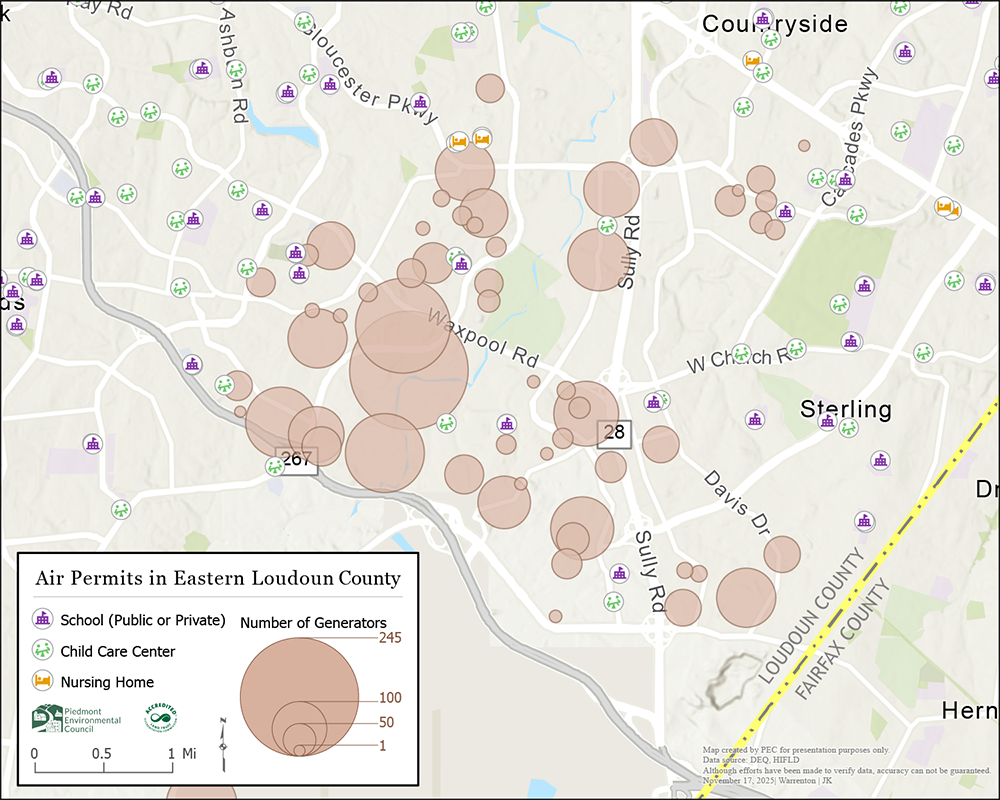
Currently, 9,000 Tier II diesel generators are approved in the state; 4,700 of those are in Loudoun County alone. If the DEQ rules change to allow generators to operate for extended periods, the region could be blanketed with tons of emissions containing fine particles that penetrate deep into the lungs and enter the bloodstream, causing more serious respiratory and cardiovascular problems, along with irritation to the eyes, nose, and throat.
“This decision is being evaluated without sufficient study or public comment,” said Chris Miller, president of The Piedmont Environmental Council. “There has never been a cumulative analysis of the air permits that have been approved in very close proximity to each other, especially in areas of eastern Loudoun and Prince William County where large clusters of generators are close to schools, child care facilities, and residential neighborhoods. There has never been a modeling exercise to evaluate the cumulative impacts of these thousands of approved minor air permits on the surrounding community, let alone the impacts of allowing these facilities to run for foreseeable scenarios as proposed. Periods of extreme hot and cold weather could exacerbate the health effects of the increased pollution, particularly on schoolchildren, the elderly, medically compromised people, and those participating in outdoor recreation. These potential effects should be evaluated and documented. The DEQ must put protecting public health first and delay this decision while conducting more analysis of impacts to public health and allowing more time for public input on those results.”
#####
The Piedmont Environmental Council (PEC) works to protect and restore the lands and waters of the Virginia Piedmont, while building stronger, more sustainable communities. Founded in 1972, PEC is a locally based, community-supported 501(c)3 nonprofit and accredited land trust. At the core of PEC’s approach is a focus on educating, engaging and empowering people to effect positive change in their communities.