
Without Comprehensive Reform, Virginia Will Continue to be the Cautionary Tale, Rather than an Example for the Rest of the Country
WARRENTON, Va. (Feb.11, 2026) – On Monday, Feb. 9, the Virginia Data Center Reform Coalition welcomed a standing-room-only audience of Virginians to Richmond to lobby for effective, statewide data center reform. This was the largest group of like-minded organizations and individuals assembled since the Coalition started going to Richmond to lobby on this issue four years ago. Participants met with more than 80 legislative offices during the day. With the mood of the electorate continuing to sour on data centers, the General Assembly has the duty to pass responsible data center reform this year.
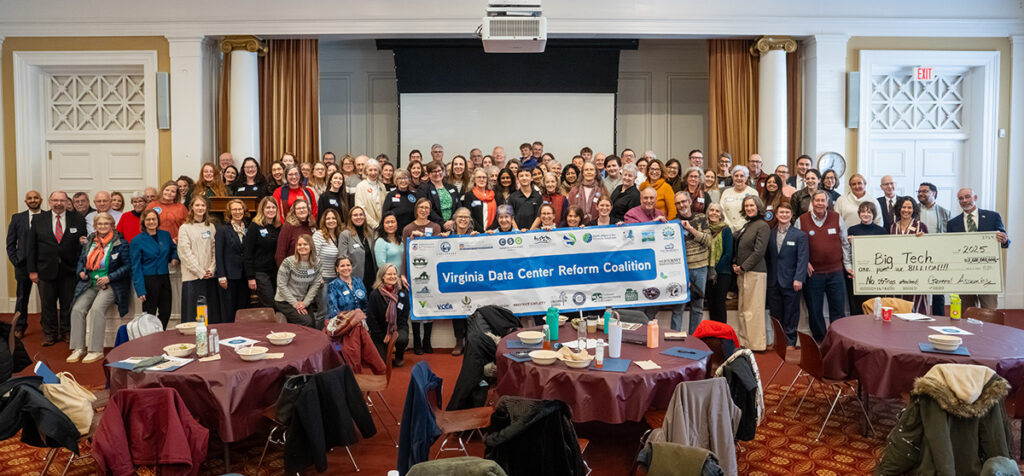
The day kicked off with comments by Senator Roem and Delegates McAuliffe, Sullivan and Thomas – all patrons of data center reform bills. They spoke about the mounting dangers of uncontrolled data center development, believe that action is overdue – and agree “the time is now” – for the General Assembly to pass legislation that protects Virginia’s citizens and our natural resources.
This week marks a critical moment in the General Assembly for data center reform legislation. Despite the introduction of more than 50 bills related to oversight, transparency, ratepayer protections and mitigation, General Assembly leadership appears once again unwilling to advance legislation that addresses all of the issues facing the state. Unfortunately, several bills, including HB658, HB589, and HB155, the keystone bill that the Piedmont Environmental Council endorsed, were heard and killed in the House, though their Senate companion bills are still being considered.
Senator Lucas’ amended version of SB253, which includes new provisions to shift certain capacity costs on to data center customers driving demand, is a promising step forward. However, it partially offsets the savings for ratepayers through a separate section that would limit the SCC’s ability to review the costs of undergrounding lower-voltage electric distribution lines (lines smaller than 138kV that are typically undergrounded, not large transmission lines).
But one bill does not go nearly far enough to address every area of reform needed to make a meaningful change. The goal of lobby day was to underscore the four pillars of data center reform and to advocate for all of the bills that address the following concerns:
- the continued lack of state oversight of large load customers connecting to the grid,
- the cost allocation of transmission lines or new power plants,
- mitigation of impacts, such as additional costs of undergrounding transmission lines that should be paid for by the data center industry,
- the huge tax exemption being given away to this industry; and
- state commitments to clean energy goals.
There’s still time. Several bills addressing each of the four pillars of reform are still live:
- State oversight (SB619, HB284/SB371, HB507) to evaluate and plan for the far-reaching regional impacts of data center development affecting neighboring jurisdictions and state policies.
- Enhanced transparency (SB553) around each data center’s energy use, water consumption and emissions.
- Ratepayer protections (SB339) that ensure average residents and businesses aren’t shouldering industry risks and subsidizing the operation of the richest companies in the world.
- Tax incentive reform (HB897/SB465) that ties tax breaks for data centers to best practices, pollution and energy efficiency.
With more than 500 data centers and counting, Virginia houses the largest share of data centers in the country and the world. Yet, we continue to lag behind dozens of states in terms of protections for ratepayers or our natural resources. Just last week, Pennsylvania Governor Josh Shapiro announced he will unveil a set of standards for managing the data center boom in Pennsylvania and called upon the state legislature to codify them in law. Virginians want the same thing – a comprehensive program of reform that protects communities, ratepayers and conservation resources.
Ben Verschoor, who went to Richmond as a representative of The Southwest Virginia Data Center Transparency Alliance based in Roanoke, was encouraged by the number of like minded groups fighting for data center reform: “Speaking to legislators directly was encouraging. Everyone we spoke to was interested in seeing real regulation of data centers now and not kicking the can down the road to next year. What was even more exciting was talking to other organizers who had heard about our fight against the proposed Google data center in Botetourt County and offered their help in that fight.”
“Virginia’s state leaders can no longer ignore the elephant in the room, and they can’t nibble around the edges either. Data center development is out of control, and poll after poll shows that voters are well aware of what’s at stake and want legislators to take action. As the country celebrates its 250th year, it’s hard to believe the birthplace of America, and a state that had such a profound impact on the founding of our democracy, is willing to let Big Tech trample our liberties so easily,” says Chris Miller, president of The Piedmont Environmental Council. “Virginia’s state motto ‘Sic Semper Tyrannis’ roughly translates to ‘Tyrants always fall.’ Our ancestors fought a revolution, at least in part, because the British were forcing them to subsidize the East India Company monopoly on tea AND taxing those purchases to fund the British empire; they would never have allowed global tech tyrants to determine our state’s future and override the concerns of local communities while also asking Virginia ratepayers and taxpayers to subsidize data centers and the energy and water infrastructure they require.”
More information can be found at pecva.org/datacenters.
#####
The Virginia Data Center Reform Coalition is a statewide coalition of more than 50 nonprofit organizations, community groups, HOAs and individuals urging state lawmakers to institute commonsense reforms for the data center industry, around four key pillars: 1) transparency; 2) state oversight and regulation, including requirements for mitigation; 3) financial protection for families and businesses; and 4) tying data center tax exemptions to standards that reduce pollution