
This text was taken from an email alert sent out on February 23, 2026. Sign up for email alerts →
Dear Supporter,
Joining the list of new energy and infrastructure proposals across the state to serve sky-rocketing data center demand is a proposal to build the largest transmission line ever seen in Dominion Energy’s territory. Dubbed “Joshua Falls-Yeat,” the 115-mile, 765 kilovolt transmission line would cross as many as nine counties in central Virginia.
The project is being proposed by Valley Link Transmission, a joint venture between Dominion Energy, Transource and FirstEnergy Transmission. If constructed, it would clear thousands of acres, impact hundreds of property owners and irreparably change an entire region – all to deliver power to Dominion Energy’s growing queue of data centers.
High voltage transmission lines are like new superhighways and the land within several miles on either side will be subject to new development pressure, for potential substations, generation and new data center proposals similar to the development pressures opened up by interchanges on a highway.
In this email, we want to share the information we know about the proposed line so far, give you the list of community meetings you can attend in March to learn more and let you know how to weigh in at this point in the process.
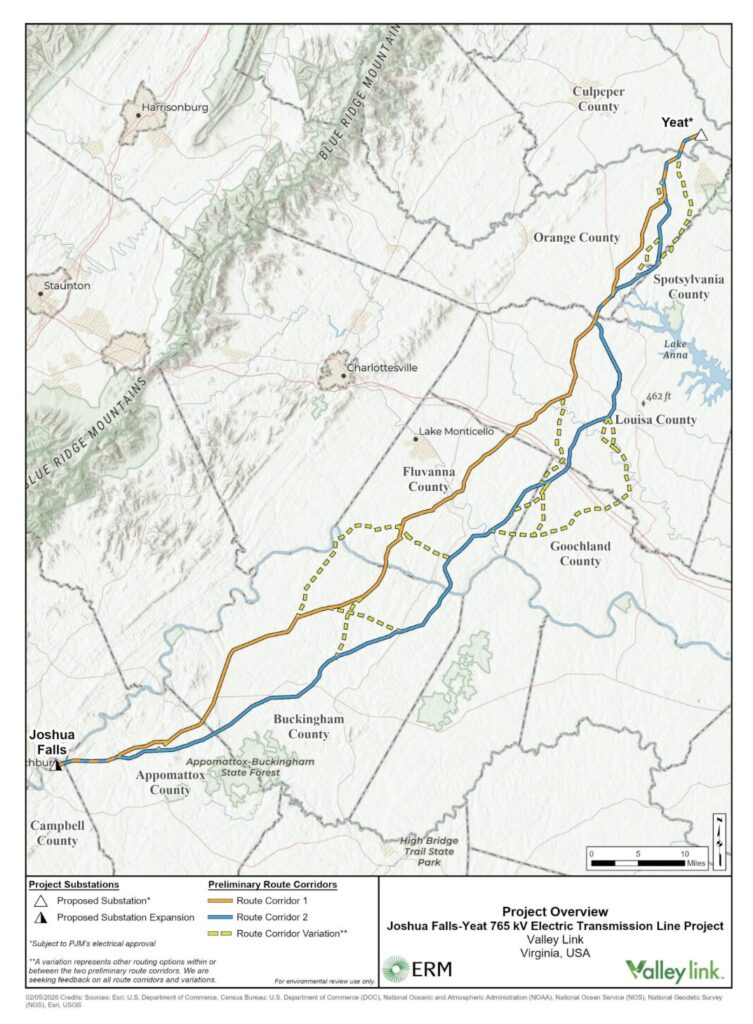
The path: The project would begin at the Joshua Falls substation in Campbell County, a few miles outside Lynchburg. From there it would head north-east and require a cleared, 200-foot-wide corridor through Virginia’s Piedmont, all the way to heavily forested area near Richardsville in Culpeper County where a large new substation, named Yeat by Dominion, would be needed. In between it would cut through Appomattox, Buckingham, Fluvanna, Louisa and Orange counties, and possibly Goochland and Spotsylvania. From Yeat, we anticipate existing lines or a new corridor to be connected to Morrisville in Fauquier County, since the objective is to deliver power to data centers in Northern Virginia.
Valley Link plans to file with the State Corporation Commission (SCC) for route approval by the summer of 2026 and install and energize the line by the end of 2029.
View the Project Routes Here →
Why This Matters
A 765 kV line is the highest-voltage transmission line we have in the United States. They can move up to 3500 MW of power over long distances efficiently; about three times as much power over the same distance as the next-largest size, 500 kV. For context, 500 kV lines are currently the highest voltage Dominion Energy operates in Virginia. The tradeoff to moving all that power is size.
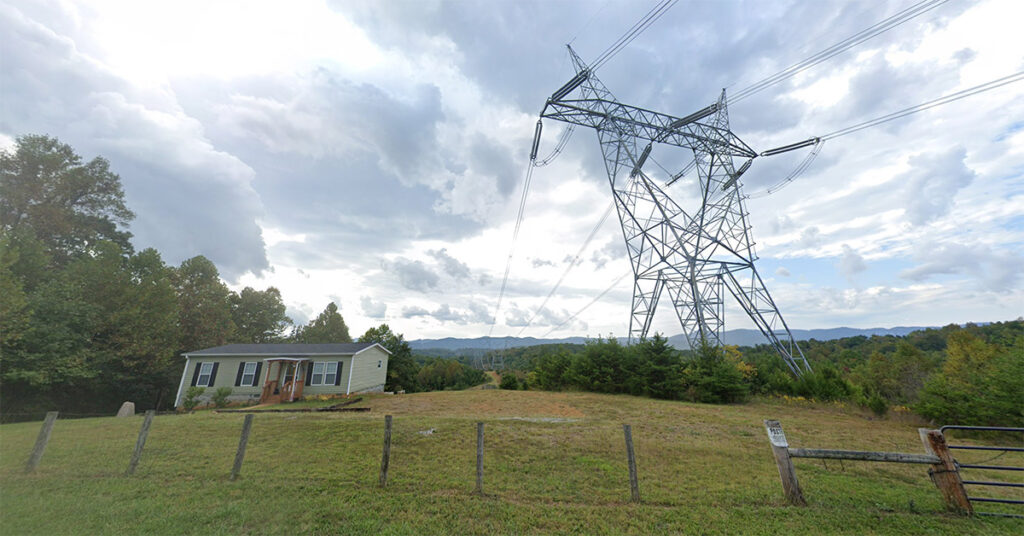
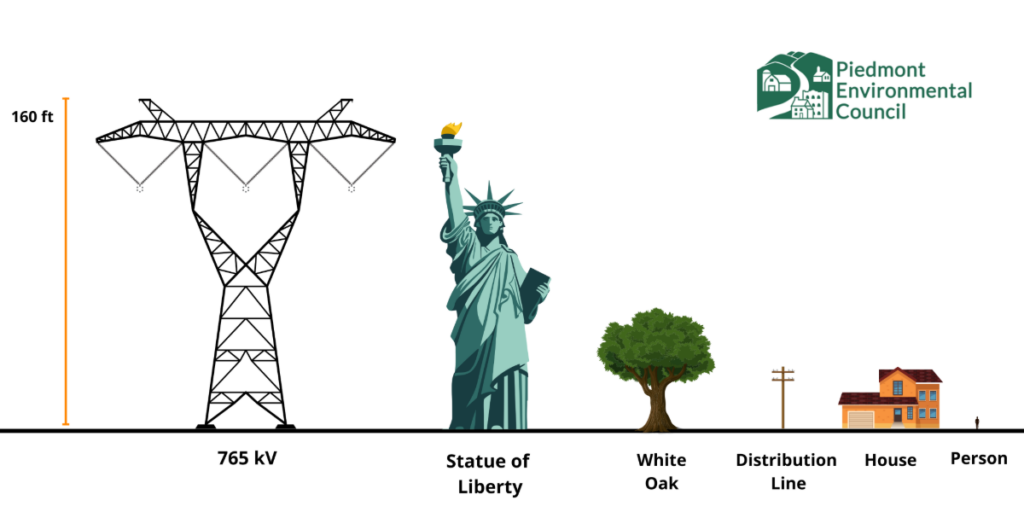
Valley Link expects a typical transmission tower to be 160 feet tall, about the height of a 12-14 story building. Over 400 of these towers, dotted every quarter-mile, for 115 miles would be required. The corridor requires a cleared right-of-way of 200 feet, impacting significant swaths of open space and active farmland where the towers would be visible for miles in the distance.
The proposed routes are primarily greenfield, meaning they don’t fall within existing utility corridors. If constructed, over 2,500 acres of land that is currently forested, farmed, providing valuable habitat and contributing to the rural economy and character of the region would be cleared and converted to utility right-of-way.
Despite this massive scale, Dominion Energy and their partners don’t expect that the project will require any substantive federal-level review for impacts to environmental, cultural, or historic resources. This is deeply concerning given what’s at stake. The nine counties Valley Link proposes to build through are home to some 450,000 Virginians. The utility sent their notification letters for the project to addresses within one mile of the line, roughly 120,000 businesses and residents.
Why Here and Why Now?
The electric grid operator for the mid-atlantic region, PJM, identifies areas where existing transmission lines might be inadequate or overloaded in the future based on where electric generation and demand are changing. The unconstrained growth of data centers has altered demand substantially in Virginia, and each new data center approved by localities adds more energy demand to the queue.eue.
The maximum power demand ever recorded on the electric grid in Dominion Energy’s territory is about 24 GW. When PJM selected the Joshua Falls-Yeat line in February 2025 as part of its Regional Transmission Expansion Plan (RTEP), they were expecting that to grow to around 33 GW by 2030, an increase of about 40% in five years. In the year since, data center requests for power have only grown. Dominion recently told the SCC they’ve received requests to serve over 70 GW of demand, almost three times the current peak load, and are receiving an additional 2-3 GW worth every month from this singular industry.
This demand growth, which has occurred almost entirely since the data center rush kicked off in 2022, flows directly into new transmission line project approvals across the region.
PJM’s 2021 Transmission Expansion Plan called for $920 million in baseline transmission projects, which are upgrades or new builds of high voltage lines deemed regionally important. The 2025 RTEP recommended almost $12 billion, an increase of nearly 1,300% in just four years. The Joshua Falls-Yeat line is just one piece of this uncontrolled buildout.
One of Valley Link Transmission’s partners, Transource, is itself a partnership involving American Electric Power (AEP). AEP operates the largest network of 765 kV lines in the country, stretching from the Great Lakes down to Virginia and ultimately ending at Joshua Falls near Lynchburg, Va. The Joshua Falls-Yeat line would plunge this 765 kV network further into Virginia, providing a new route for power to reach Dominion’s growing queue of data centers.
Next Steps
1. Community Meetings: March 2026
Valley Link will be holding in-person community meetings to discuss the project with each of the counties impacted by a proposed route. We strongly encourage you to attend and ask questions.
Find more info on your meeting →
- Thurs., March 5: Culpeper County
- Mon., March 9: Spotsylvania County
- Mon., March 9: Orange County
- Tues., March 10: Fluvanna County
- Tues., March 10: Appomattox County
- Tues., March 12: Louisa County
- Mon., March 23: Campbell County
- Mon., March 23: Goochland County
- Tues., March 24 AM: Buckingham County
- Tues., March 24 PM: Buckingham County
There will also be virtual meetings, held from 12-1 p.m. on:
- Thurs., March 5
- Mon., March 16
2. Follow-up Community Meetings: June 2026
Valley Link will hold follow-up meetings to discuss any route adjustments made in response to feedback received from the public — a reason to attend the community meetings! Meeting dates are to be determined, but set for June 2026.
3. Filing with the SCC: Summer 2026
Valley Link plans to file an application with the Virginia SCC to obtain a certificate of public convenience and necessity (CPCN) for the project in the summer, following their public engagement timeline. Under state law, a transmission line of this size cannot be constructed without this certificate. There will be an opportunity for public comments during this process, so you can expect to hear from PEC in advance.
Take Action
1. Attend a Community Meeting: If you’re able, attend your community meetings. Share your concerns with Valley Link, and learn what you can about what the impacts could be to places and resources that are important to you. Above all else, make your voice heard — that’s what the public comment process is about.
2. Leave a comment with GeoVoice: The Joshua Falls-Yeat project map features a commenting system, GeoVoice, that lets you submit concerns with the project routes directly to Valley Link.
- Sign up for a GeoVoice account
- Navigate the map
- Use the green “+” comment box in the bottom right-hand corner to comment
- If you’re having difficulty submitting a comment on the map, email me at [email protected]
765 kV transmission lines are massive affairs and this one is no exception. Expect to hear from PEC as these community meetings continue next month and the SCC process moves into the summer. Feel free to share this with friends, neighbors and interested parties and make sure they’re signed up for alerts from us at pecva.org/signup.
Sincerely,
Michael Barber
Senior Energy Infrastructure Policy Analyst
[email protected]
(540) 347-2334 x7036