Nominated to Preservation Virginia’s Annual List by Ten Conservation and Preservation Organizations
Credit: Hugh Kenny, PEC.
Warrenton, VA. (May 19, 2026) – This morning, Preservation Virginia has named the nine-county corridor targeted for Valley Link’s proposed 765 kilovolt transmission line project (aka Joshua Falls-Yeat) to its list of Virginia’s Most Endangered Historic Places for 2026. The Piedmont Environmental Council (PEC) and American Battlefield Trust made the nomination with eight other partners across the Commonwealth: Central Virginia Battlefields Trust, Central Virginia Land Conservancy, Fluvanna Historical Society, Friends of Buckingham, Friends of Wilderness Battlefield, Historic Germanna, Preservation Piedmont and Scenic Virginia. The partners convened a press conference at Historic Germanna this morning to share the news of designation and to outline the many historic resources at risk.
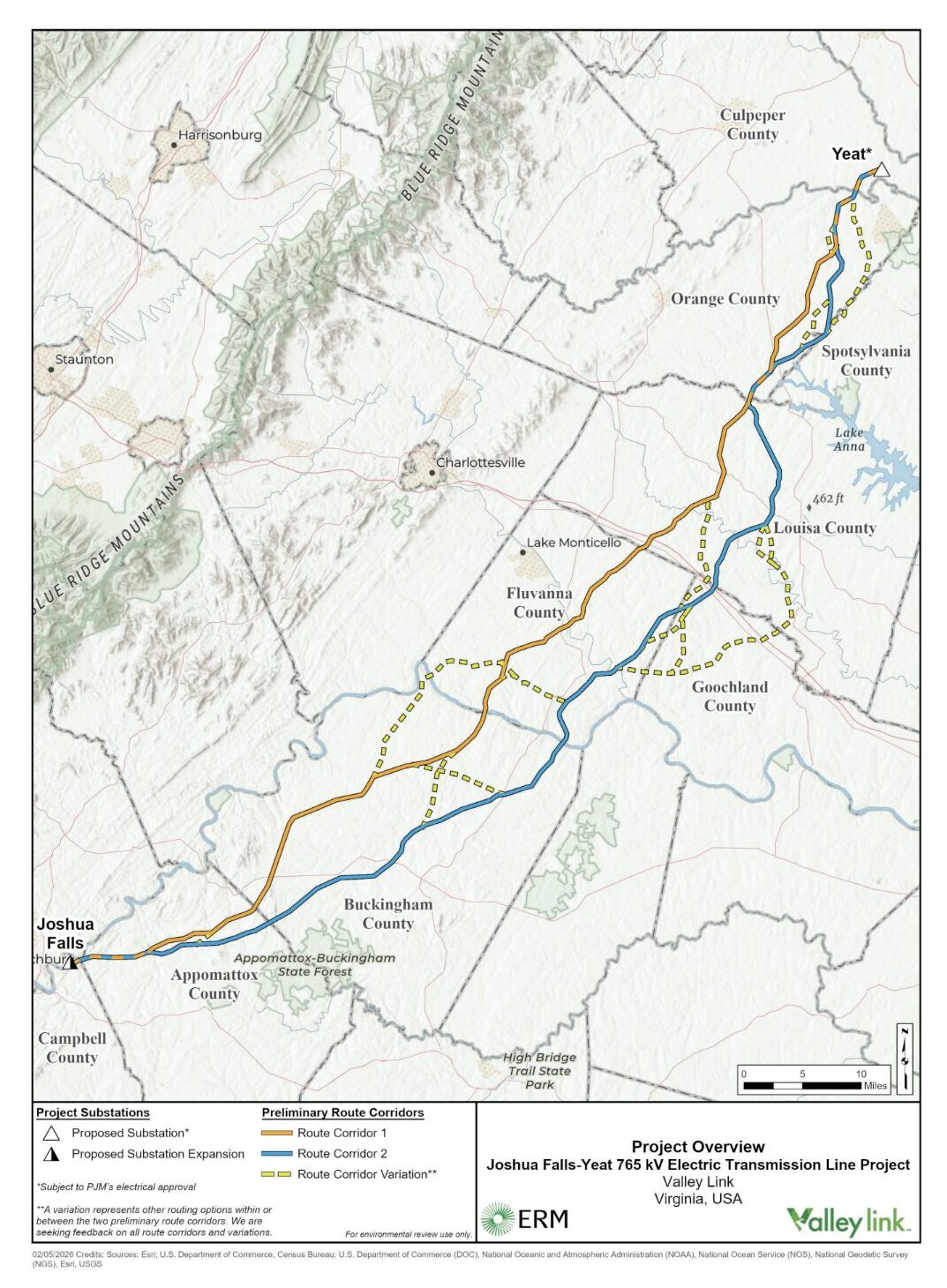
Valley Link Transmission, a joint venture of Dominion Energy, Transource, and FirstEnergy Transmission, is proposing the largest transmission line ever seen in Dominion territory. The 115-mile-long transmission line would begin at the Joshua Falls substation in Campbell County, a few miles outside Lynchburg. From there it would head north-east and require a cleared, 200-foot-wide corridor through Virginia’s Piedmont, all the way to heavily forested area near Richardsville in Culpeper County where a large new substation, named Yeat by Dominion, would be needed. In between, it would cut through Appomattox, Buckingham, Fluvanna, Louisa and Orange counties, and possibly Goochland and Spotsylvania. From Yeat, we anticipate existing lines or a new corridor to be connected to Morrisville in Fauquier County, in order to deliver power to data centers in Northern Virginia. If approved by the Virginia State Corporation Commission, the project’s massive transmission towers and lines will stretch across mostly greenfield sites (previously undeveloped land) rich in historical and cultural resources, sensitive environmental resources, and treasured scenic viewsheds.
“Naming the lands and waters affected by the Valley Link project as one of Virginia’s Most Endangered Historic Places comes at a pivotal moment when nine of our counties are facing unprecedented challenges posed by this project, said PEC President Chris Miller. “This region is full of environmental, cultural, and historical treasures that will be irreversibly changed and damaged by this proposed transmission line, which is only necessitated by the unchecked and unregulated growth of the data center industry in Virginia.”
“Battlefields like Mine Run and Trevilian Station cannot be fully understood or appreciated if a project like this is allowed to dominate the viewshed,” said David Duncan, president of the American Battlefield Trust. “Today’s announcement marks an important moment in recognizing the threat of this project to our nation’s hallowed ground.”
The impacts to the landscape are enormous. Over 2,500 acres of land that is currently forested, farmed, providing critical wildlife habitat and contributing to the rural economy and character of the region would be cleared and converted to utility right-of-way. At least nine historic districts, and numerous other historic resources (both listed and eligible) within the path and/or the viewshed of the proposed project, are likely to be impacted. Nonetheless, despite the immense scale, Valley Link claims the Joshua Fall-Yeat line will not require any substantive federal-level review for impacts to environmental, cultural or historic resources. This is deeply concerning given what’s at stake.
“At Scenic Virginia, we believe preservation begins with discovery,” said Scenic Virginia President Julie Summs. “When we take the time to identify and understand the landscapes that shape our communities, we create the opportunity to protect them for generations to come.”
The project would begin at the Joshua Falls substation in Campbell County, a few miles outside Lynchburg. From there it would head north-east and require a cleared, 200-foot-wide corridor through Virginia’s Piedmont, all the way to heavily forested area near Richardsville in Culpeper County where a large new substation, named Yeat by Dominion, would be needed. In between it would cut through Appomattox, Buckingham, Fluvanna, Louisa and Orange counties, and possibly Goochland and Spotsylvania. From Yeat, we anticipate existing lines or a new corridor to be connected to Morrisville in Fauquier County, since the objective is to deliver power to data centers in Northern Virginia.
Every year in May, which is National Historic Preservation Month, Preservation Virginia releases a list of historic places across the Commonwealth facing imminent or sustained threats. The list, which has brought attention to over 200 sites in Virginia, encourages individuals, organizations and local governments to advocate for their preservation and find solutions that will save these unique locations for future generations.
“We all know our world is progressing in ways we would never have imagined, said Tom Van Winkle, President, Central Virginia Battlefields Trust. “Technology requires data and data needs to be powered. This does not mean providing this power should come at the cost of our nation’s history. Those who fell on the battlefields affected by this massive transmission line project would have expected those hallowed grounds to be respected. This is not the way to accomplish that expectation.”
This designation as one of Virginia’s Most Endangered Historic Places is timely and underscores the urgency of the moment. This project is scheduled to come before the Virginia State Corporation Commission for approval of a final route in September 2026. Residents of the affected counties and other members of the public should submit comments ASAP in Valley Link’s online GeoVoice portal about specific impacts of the proposed routes. Detailed maps are available here. Valley Link will hold another round of community meetings after June, and the community will be able to submit comments to the SCC on the proposed route in the fall.
“The people of Fluvanna have spoken and acted time and time again to preserve our rural character and the diversity of special places throughout the County. In the spirit of honesty,” said the Historical Society’s President Kathleen S. Kilpatrick, “let me say that never before has the work and vision of generations of Fluvannians been threatened as today. We are a small rural county, and yet Fluvanna is told to bear some 31 miles of Valley Link on its 115 mile march to Culpepper. This will adversely affect every aspect of the historic and cultural identity that people have worked to preserve as living parts of our lives and landscape — from proud and strong descendant communities, to the beauty and productivity of open spaces and working lands, to landmarks that hold and share the stories of Fluvanna. As we stand on the eve of the 250th anniversary of our struggle for independence, that defining American right to use, enjoy and protect the sanctity and value of our very homes is threatened.”
“The Valley Link transmission project threatens not only Buckingham County’s forests, farms, scenic landscapes, and private property rights,” said Dr. Scott Flood, President Friends of Buckingham,“ but also the county’s historic rural landscape, including the Buckingham Court House Historic District and the Buckingham Female Collegiate Institute Historic District — the site of Virginia’s first chartered college for women. Whether transmission structures directly cross these historic districts or are constructed nearby, industrial-scale corridors, tower visibility, forest clearing, and landscape fragmentation could permanently damage their historic integrity, scenic character, and cultural significance. The project risks undermining the very rural and historic sense of place that defines Buckingham County’s identity and heritage.”
“The explosive growth of data centers in our beloved Piedmont region and central and northern Virginia is driving the development of Valley Link’s Joshua Falls to Yeat 765kV transmission line project, a 200-foot-wide right-of-way running for 115 miles through central Virginia’s significant and iconic farmland, forests, and rural communities, said Preservation Piedmont President Genevieve Keller. “This massive industrial project will adversely affect our region’s cultural and natural resources, and the rural qualities that support our local heritage tourism economy.”
The nomination highlighted many potential viewshed or other indirect impacts:
- Galts Mill Village Historic District
- Buckingham Court House Historic District
- Buckingham Female Collegiate Institute Historic District
- Bremo Historic District
- Fluvanna County Courthouse Historic District
- Green Springs Rural Historic District
- Mineral Historic District
- Fredericksburg and Gordonsville Railroad (Historic), Fredericksburg, Orange and Charlottesville Railroad (Historic), Potomac, Fredericksburg & Piedmont Railroad (Historic), Unfinished Railroad (Historic), Virginia Central Railway Historic District (Historic/Current)
- Trevilian Station Battlefield, determined potentially National Register-eligible
- Mine Run Battlefield, determined potentially National Register-eligible
- Journey Through Hallowed Ground National Heritage Area
- Historic Village at Lee Wayside
It also listed several even more direct impacts:
- Orange Springs, National Register of Historic Places Listing, VLR Listing, DHR ID: 068-0066
- Louisa County cemetery off Chopping Road with 16 burials, DHR ID: 054-5044
- Rivanna Canal Navigation Historic District
Potential direct impacts to designated scenic resources along the proposed corridors include:
- Virginia Byways 613 and 6
- Designated Virginia Scenic Rivers: Rivanna, James
- Qualified Virginia Scenic River – the Slate
- Potential Virginia Scenic Rivers: Saint Anna, sections of the James, theHardware
- Views from the The National Byway – The Journey Through Hallowed Ground
[See ConserveVirginia Scenic Layer for more information.]
Downloadable images from today’s press conference (Please credit all photos: Hugh Kenny, PEC):
- Will Glasco, Chief Executive Officer of Preservation Virginia announcing the Joshua Falls-Yeat transmission line corridor one of Virginia’s Top Endangered Historic Places.
- Jennifer Hurst-Wender, Executive Director of Historic Germanna, welcomes attendees.
- Piedmont Environmental Council President Chris Miller addressing press conference attendees and a television station.
- Thomas Van Winkle, President, Central Virginia Battlefield Trust, with visualizations of a 765 kV transmission line behind him.
- Jill Grant, Program Director of Scenic Virginia, at the podium.
- Kathleen Kilpatrick, President of Historical Society of Fluvanna, and former director of the Virginia Department of Historic Resources.
- Irene Leech, board member of Friends of Buckingham, speaks about cultural heritage resources in Buckingham County.
- Piedmont Environmental Council Senior Energy Infrastructure Policy Analyst Michael Barber addressing press conference attendees, with a television station in the background and a reporter in the foreground.
Downloadable high-resolution visuals on display during the press conference:
- 3 Graphics illustrating the scale of a 765kV transmission tower and line. Credit: Marco Sanchez, PEC.
- A detailed map of the proposed Joshua Falls-Yeat transmission line corridor. Credit: PEC
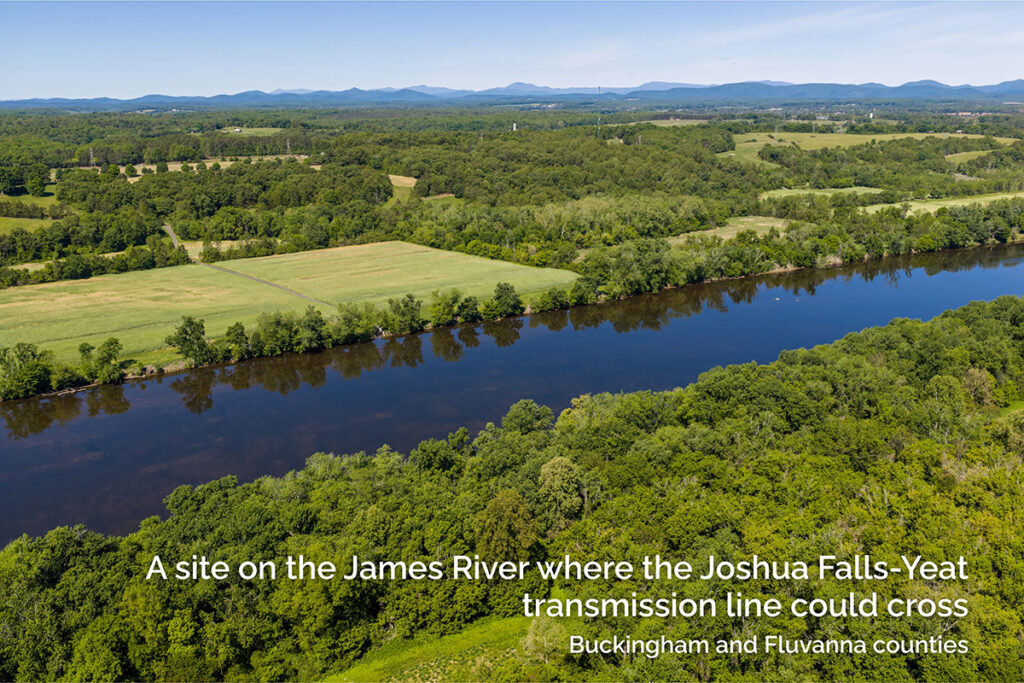
- Photo of the James River where the proposed Joshua Falls-Yeat transmission line could cross. Credit Hugh Kenny, PEC
- Second photo of the James River where the proposed Joshua Falls-Yeat transmission line could cross. Credit Hugh Kenny, PEC
Contact: Elizabeth Ransom, Media & PR Specialist, [email protected], 540-347-2334 x7029
###
The American Battlefield Trust works to preserve and restore America’s hallowed battlegrounds and educates the public about what happened there and why it matters.
Central Virginia Battlefields Trust is dedicated to preserving historic land from four pivotal Civil War campaigns: Fredericksburg, Chancellorsville, Mine Run, and the Overland Campaign, including key battlefields like the Wilderness and Spotsylvania Court House. Our mission ensures these vital landmarks are protected for future generations to explore and learn from.
The mission of the Lynchburg-based Central Virginia Land Conservancy is to help landowners conserve their property through voluntary land preservation agreements known as conservation easements.
Since its formal organization in 1964 the mission of the Fluvanna Historical Society has been to protect, preserve, and promote Fluvanna County’s historic and cultural heritage for public benefit. Today, the Society is recognized as a dynamic nonprofit educational and service organization dedicated to engaging the community with accuracy, inclusivity, and honesty.
The mission of the Friends of Buckingham is to protect the natural environment and cultural heritage of Buckingham County.
The mission of the Friends of Wilderness Battlefield is to assist the American Battlefield Trust and the Central Virginia Battlefields Trust in their efforts to preserve the battlefields in Spotsylvania and Orange Counties. The Friends provide advocacy, educational programs, and service projects for the battlefield.
Historic Germanna connects communities with Virginia’s past and present through its historic, natural, and cultural resources.
Preservation Piedmont is a nonprofit organization dedicated to the preservation and appreciation of the historic, natural, and cultural resources of the region. Preservation Piedmont focuses on the City of Charlottesville, the County of Albemarle, and adjacent localities by promoting greater public awareness of and advocating for historic preservation in the region; safeguarding historic resources; sponsoring educational tours and programs; promoting heritage tourism; supporting local projects, partnerships, and initiatives that help to identify and protect community resources; and monitoring and raising awareness of local and state government actions on issues affecting preservation of historical, cultural, and natural resources.
Scenic Virginia, a 28-year-old nonprofit organization, is dedicated to preserving, protecting, and enhancing the scenic beauty and community character of the Commonwealth. Through its award-winning Treasured Views program, Scenic Virginia empowers communities to identify and conserve the landscapes and viewsheds that define Virginia’s unique visual heritage.
The Piedmont Environmental Council (PEC) works to protect and restore the lands and waters of the Virginia Piedmont, while building stronger, more sustainable communities. Founded in 1972, PEC is a locally based, community-supported 501(c)3 nonprofit and accredited land trust. At the core of PEC’s approach is a focus on educating, engaging and empowering people to effect positive change in their communities.