Part 1 of 2: Updates on critical data center issues impacting the Piedmont
Dear Supporter,
As the end of the year approaches and the holiday chaos falls upon us, the demands of everyday life make it hard to find time for one more thing. But we hope you will take a few minutes to voice your concerns about a critically important change that the Virginia Department of Environmental Quality (DEQ) is proposing around the increased use of emergency diesel generators on data center campuses that would affect pollution and air quality levels in our region.
This email is part 1 of 2 updates we’re providing this week about critical data center issues impacting the Piedmont. Keep an eye out for our second update later this week about additional transmission lines proposed by PJM to serve data centers in our region, and how you can weigh in.
DEQ Wants to Allow Data Center Emergency Diesel Generators to Run More Often
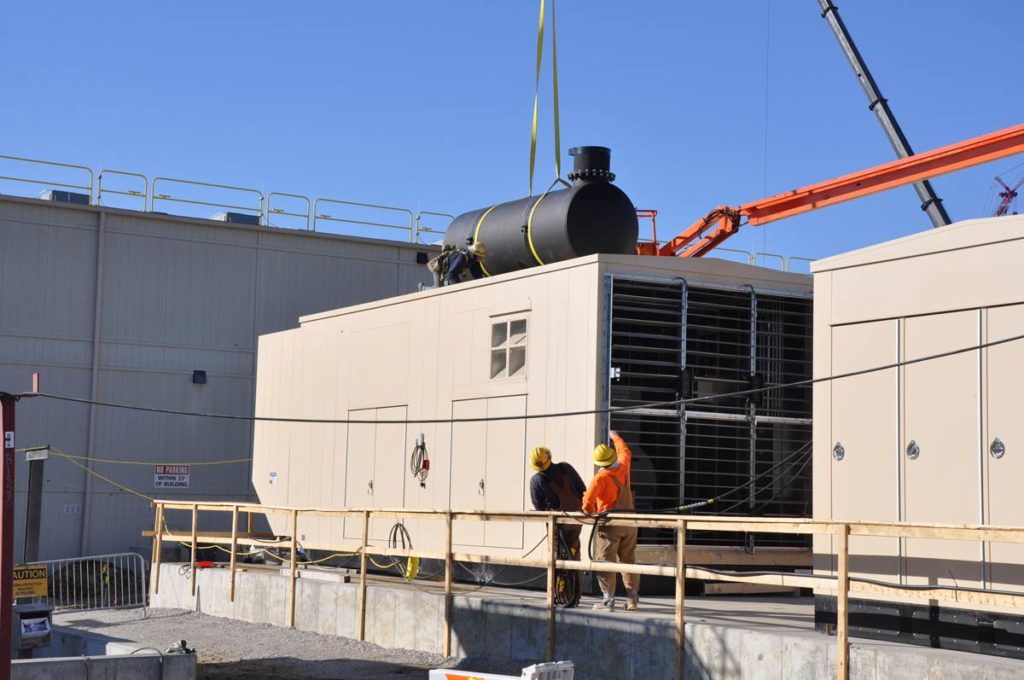
The Virginia Department of Environmental Quality (DEQ) is currently accepting comments on a proposed change that would allow data centers to run backup diesel generators during planned outage events. Until now, these generators could only be used in the case of “sudden and reasonably unforeseeable events” or maintenance. In other words, these diesel generators–one of the most polluting forms of energy generation–were only ever meant to serve as backup power in emergency situations.
Why is this being proposed? Utilities want the flexibility for the data centers to be able to run their existing backup diesel generators during planned outage events. This is driven by a desire to expedite timelines and avoid paying for more expensive options better equipped to protect public health.
Planned outages, such as while transmission lines are built or worked on, are considered foreseeable, meaning data center operators have sufficient time — and are expected to — seek alternative options. Options typically used include: a) renting mobile Tier IV gas generators with higher pollution controls, or b) retrofitting Tier II generators with SCRs (selective catalytic reduction systems) to protect the public from pollution. (Type II and Type IV generators explained below.)
But DEQ’s proposal would allow data centers to potentially turn on hundreds to thousands of diesel generators, putting public health at greater risk. We believe this change should not be allowed or, at the very least, should be strictly limited and regulated.
Take Action!
Tell DEQ that you oppose this change. Submit your comments by clicking the link below and filling in your contact information, comment subject/title and comments (limited to 3,000 words) by Wednesday, Dec. 3. See below for guidance for submitting effective comments.
Pollutants from Tier II vs. Tier IV Generators
Generators release emissions that can be harmful to public health and contribute to the formation of ground level ozone, including fine particulate matter (PM10 and PM2.5), carbon monoxide (CO), nitrogen oxides (NOx), sulfur dioxide (SO2), and volatile organic compounds (VOC) which are all regulated by the DEQ.
Different types of generators have different impacts and rules associated with them. The difference between Tier IV and Tier II generators is that Tier II generators are typically only used for short periods of time and have weak emission standards, whereas Tier IV generators can be used for much longer periods of time, even as the primary power source of a facility, and have significantly stricter hourly emissions standards.
And here’s why this matters: Emergency generators only have to meet Tier II emission standards because of the limited amount of time that they are expected to be used. Read more →
Cumulative Impacts of Diesel Generators
We are also concerned that DEQ’s proposed change could be easily expanded to allow the data centers to run these generators during periods of grid stress, as was proposed back in January 2023. If emergency diesel generators are allowed to be used for “demand response” — a program that pays customers (in this case, data centers) to reduce their electricity usage from the grid during peak times — this could lead to significantly more pollution during the hottest days of the summer, which are often also the poorest air quality days in our region.
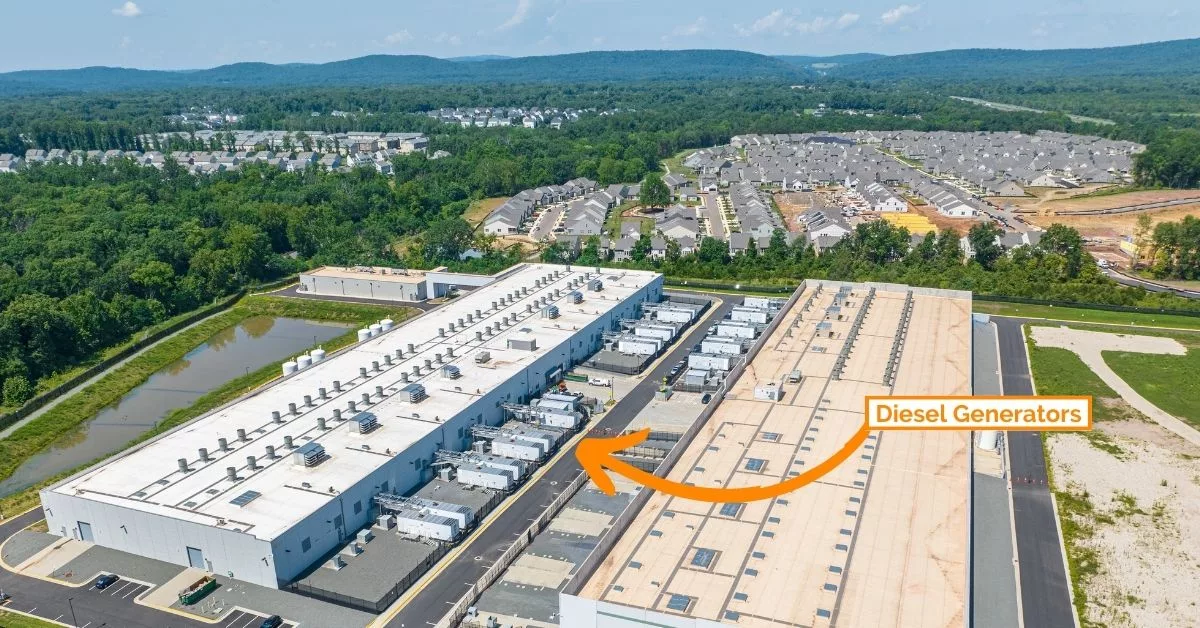
Putting this into perspective, just about every data center has emergency back-up power, mostly in the form of Tier II diesel generators, which each produce 2-4 megawatts (MW) of energy and are about the size of a train car, or more than 50 times the size of a typical whole-home generator. Virginia has permitted nearly 9,000 such diesel generators for use as emergency back-up power at data centers.
Where there are large clusters of data centers, there are large clusters of generators. In eastern Loudoun alone, 4,700 diesel generators are permitted (see map), with a total capacity of 12 gigawatts (12,000MW). That is the equivalent of 12 large gas plants or 12 nuclear reactors. The proposed change would limit the usage to the emission standards approved under their minor air permits; however, according to the study done last year by the Joint Legislative Audit and Review Commission (JLARC) for the General Assembly, data centers are currently only using 7% of their permitted capacity, on average, which means they have room to increase their emissions an additional 93% during planned outage events. Furthermore, DEQ has not made any estimate of the potential cumulative impact of these generators operating for an extended period.
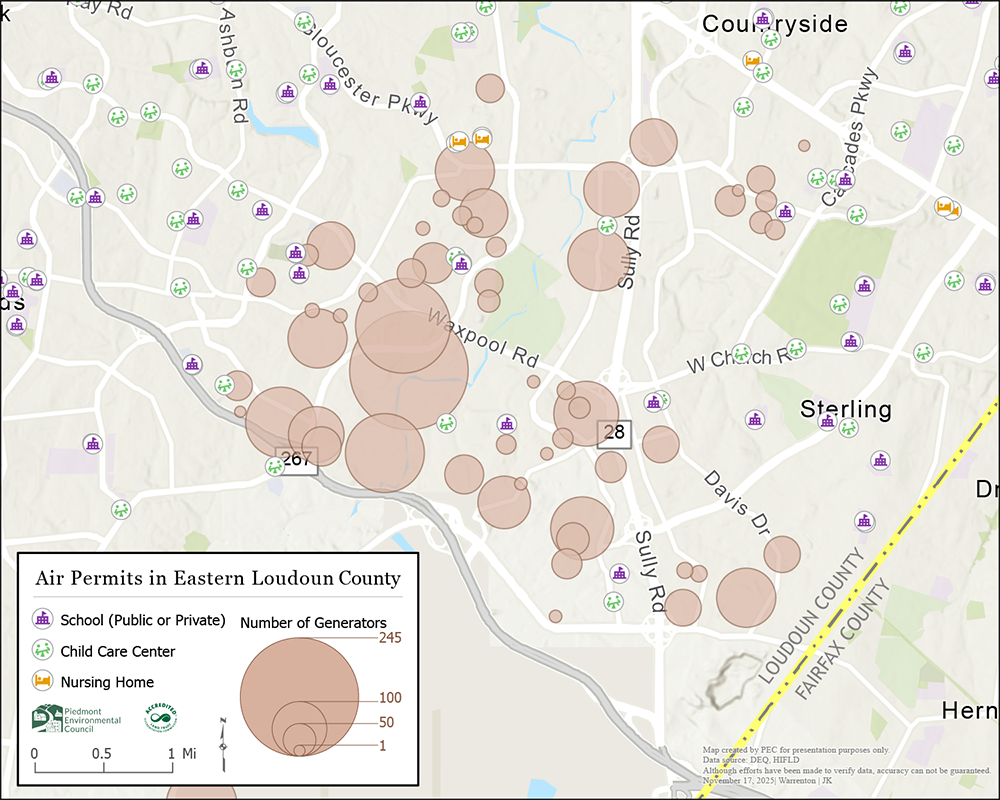
We also have an interactive map where you can explore your own neighborhood.
The mission of the Virginia DEQ is to, “protect and enhance the environment of Virginia in order to promote the health and well-being of the Commonwealth’s citizens, residents, and visitors in accordance with applicable laws and regulations.” It is time for the DEQ to prioritize protecting public health instead of accommodating expedited development timeframes and lower costs for developers.
PEC Position: We believe this change should not be made at all. And if it is, it should be severely limited to data centers that are not within at least half a mile of “sensitive receptors,” meaning people and places that are particularly vulnerable to the harmful effects of air pollution, such as schools, hospitals, parks, trails and residential areas.
Furthermore, just as DEQ is proposed to be given notice when these generators will be running for planned outage events, the public should also be given notice about where and when these generators will be running and for how long. And finally, each site where emergency generators are running should be inspected daily by DEQ staff or a third-party contractor to monitor fuel usage and have air quality monitoring installed to track the pollution levels when inspectors are not onsite for the duration of their usage to ensure problems are identified early and the burden of enforcement is not on the public to submit complaints.
Guidance for submitting effective comments
It is best for your comments to be unique and not repetitive of other comments, so we encourage you to use these bullet points as a starting point and add your own thoughts.
- DEQ must put protecting public health first as their primary mission above all else.
- The emergency generator allowance should not be broadened to include planned outage events.
- This will contribute to more unnecessary pollution and put us on a slippery slope that could lead to these generators being used for demand response during periods of grid stress, which is not their intended use.
- If DEQ chooses to make this change, it should incorporate strict limitations and regulations including:
- Not allowing Tier II generators to be run for planned outages near “sensitive receptors” (e.g., schools, hospitals, parks, trails and residential areas)
- The public should be given notice about where and when these generators will be running and for how long.
- Each site where emergency generators are running should be inspected daily to monitor fuel usage and should be equipped with air quality monitoring for the duration of their usage.
In the meantime, please forward this alert to your legislators, so they know how these issues are threatening the quality of life and public health of Virginians.
Lastly, if you haven’t done so, check out our press release on the Three Things Everyone Needs to Know About Data Centers in Virginia, Right Now.
Thank you for taking the time to take action on these important topics and we look forward to engaging with you on these issues and more – including more proposed transmission lines in our region. Please don’t hesitate to reach out if you have any questions.
Sincerely,
Julie Bolthouse
Director of Land Use
[email protected]
(540) 347-2334 x7042

P.S. Don’t forget to support the continued work of PEC in your end-of-year giving, if you are able!