It’s the data centers driving energy demand and costs; and Virginians want to know who’s accountable?
Warrenton, VA (November 14, 2025) – Data centers and rising energy costs were a top issue for voters in the election. But who’s really in charge? And, who’s responsible for ensuring there’s a transparent, sustainable, achievable energy plan for our state?
Very few of our elected leaders, let alone the average Virginian, understand the energy infrastructure planning process and the lack of transparency around it. There’s no public plan. Instead, for-profit companies — Dominion Energy, Google, Amazon and Meta — are entering into binding, exorbitantly expensive contracts that, under current rate structures and cost allocations, obligate all ratepayers to subsidize billions in infrastructure investments to power data centers alone.
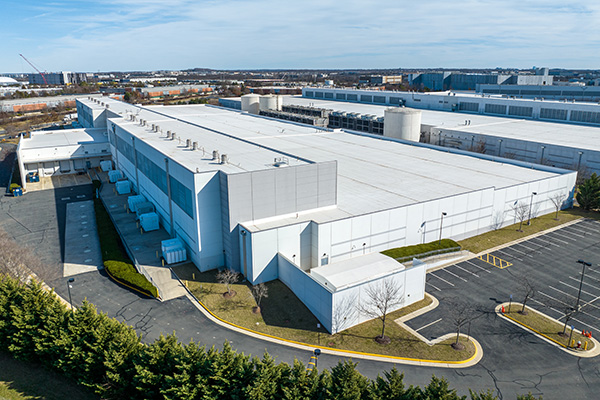
Every Virginian should be alarmed not only about the number of data center projects underway but also about the growing size and scale of each project. In 2013, a data center proposal required “only” about 16 megawatts (MW) of power.
Today, most data center campus proposals in Virginia will require at least 300 MW, approximately the same amount of energy needed to power Loudoun County, or 150,000 households. Multiple proposals, such as the proposed Digital Gateway in Prince William County, need energy in the 2.4 gigawatt (GW) to 7 GW range. That’s three-to-four times the power produced by Lake Anna nuclear power plant, Virginia’s largest power station.
Energy demand is only one side of the equation. The generation and transmission needs for Virginia’s data centers are beyond anything this country has seen, let alone our state. In Loudoun County, Dominion is proposing a 500-kilovolt, 22-mile-long transmission line, with hundreds of towers rising 215 feet — taller than the Statue of Liberty — winding through neighborhoods. The line will deliver power to about 40 new electric substations, each one designed to provide 100-300 MW of power. This is just one of six new transmission lines being routed through Loudoun County currently, according to Dominion Energy’s website.
As Gov. Spanberger and new state legislators set their priorities for 2026, every Virginia policymaker and citizen should be paying attention to the following three things:
1. Dominion Energy’s 2025 Integrated Resource Plan projects drastic increases in residential energy bills and 17% growth in data-fueled energy demand since 2024.
Dominion’s 2025 IRP projects that if data centers don’t pay for their fair share, monthly residential bills will rise from an average of $159 today to between $255 and $308 by 2035 and up to $381 by 2045 — more than double our current electric bills, not counting inflation. Every Virginia household will be paying more than $2,600 per year to subsidize the data center industry and the richest corporations in the world.
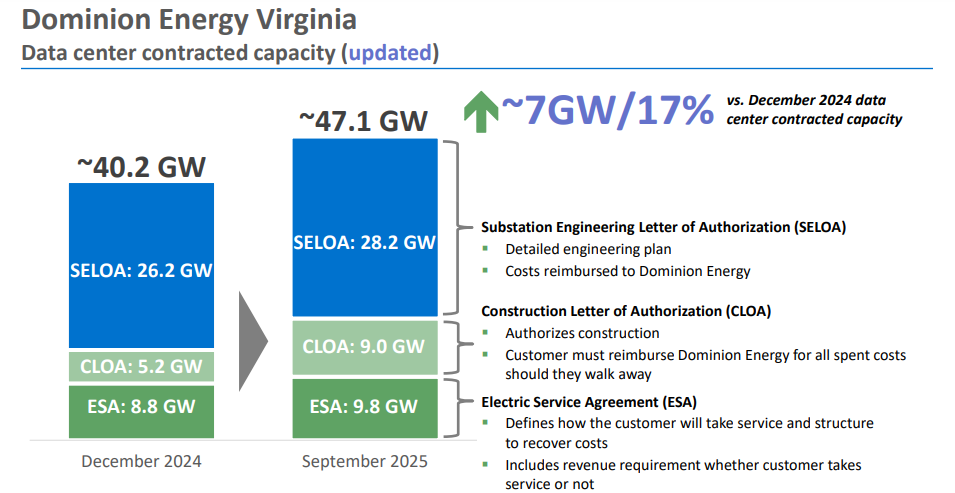
Since Dominion filed its last IRP in December 2024, the utility has increased the data center energy demand forecast by 17%, adding another 7 GW, or about the same as seven nuclear power plants. In total, Dominion Energy says it has contracts for 47.2 GW of additional data center demand beyond what’s currently needed (see chart below). The updated IRP does not account for additional energy generation, escalating fuel costs, or the ever increasing pipeline of data centers yet to be built.
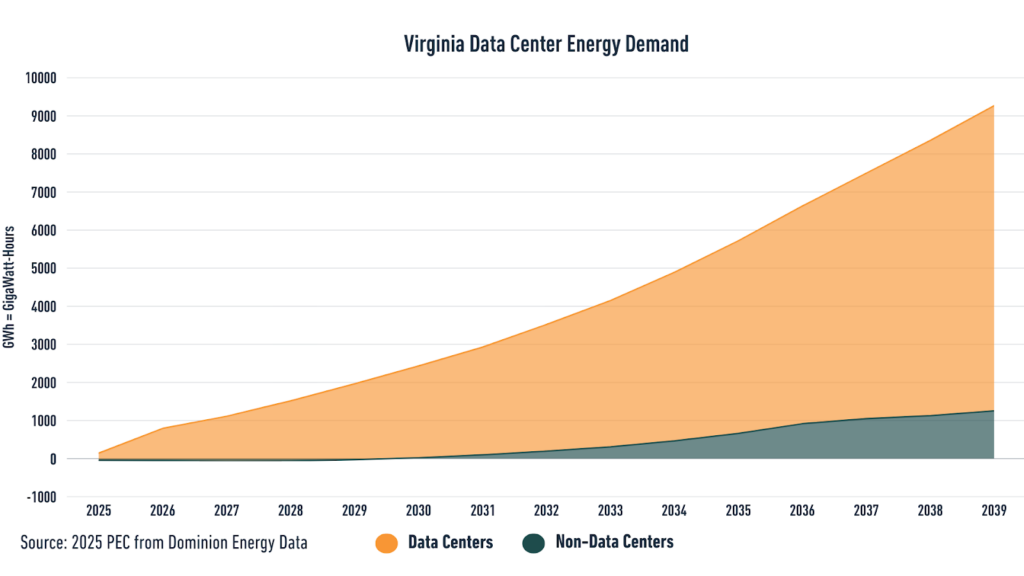
Despite what some headlines and utility reps want us to believe, virtually all new energy demand in Virginia over the next 20 years will be a result of data center usage, as Dominion Energy’s own data illustrates below.
2. The generation and transmission infrastructure needed to power data centers is not only massive, it is disruptive to our communities and natural resources, and will cost Virginia ratepayers billions.
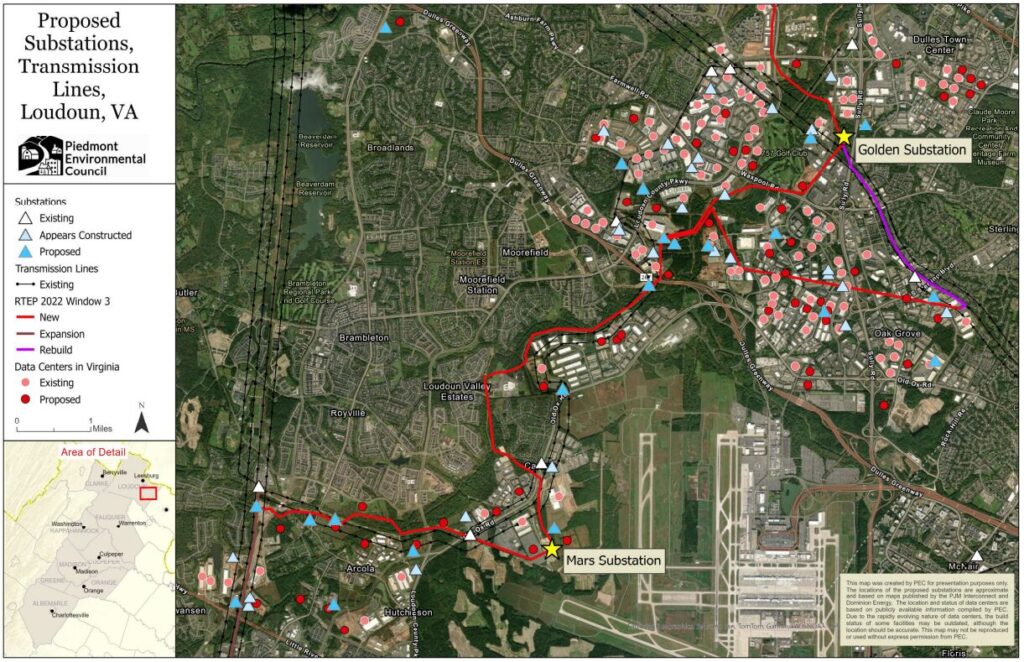
The Virginia State Corporation Commission (SCC) is currently considering one of the largest transmission projects in a suburban area in state history: the Golden-to-Mars 500-kiloVolt loop around Loudoun County. It is ultimately only needed to serve data centers with more than 40 substations along the way, each one comprising 10-20 acres of industrial use. The Golden-to-Mars line would follow a route threaded through neighborhoods, schools, natural areas and commercial businesses, as seen in the map below.
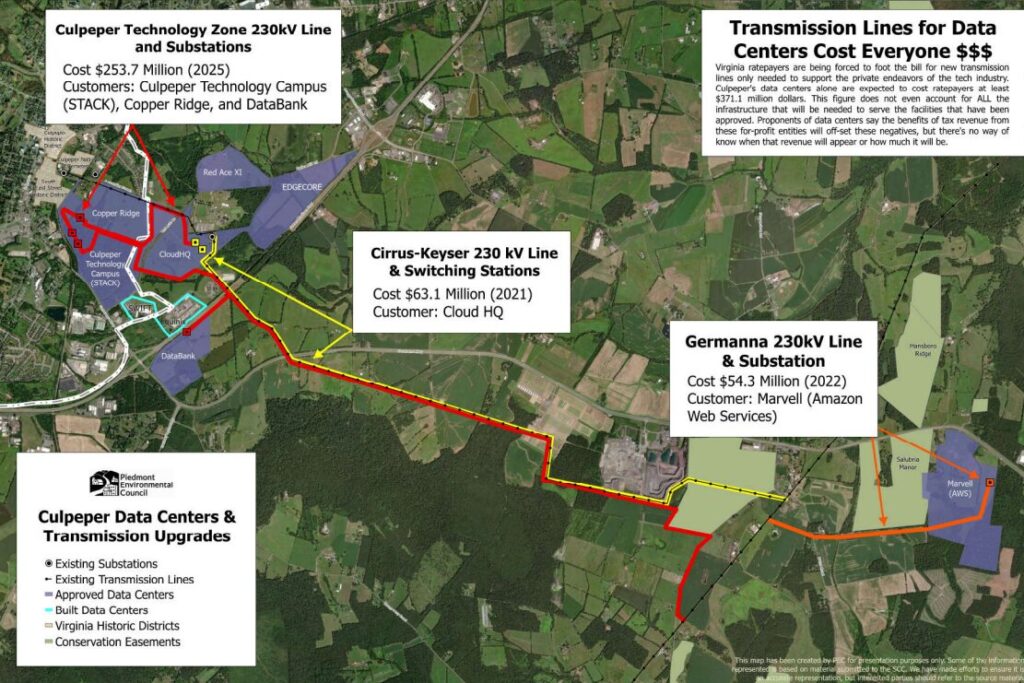
The SCC is also considering a massive transmission project in Culpeper to serve just three of the six new data centers in the Culpeper Technology Zone. The 1.2 GW capacity of this proposed line is about five times the peak power demand of all of Culpeper County, and the capital costs associated with this project exceed $250 million.
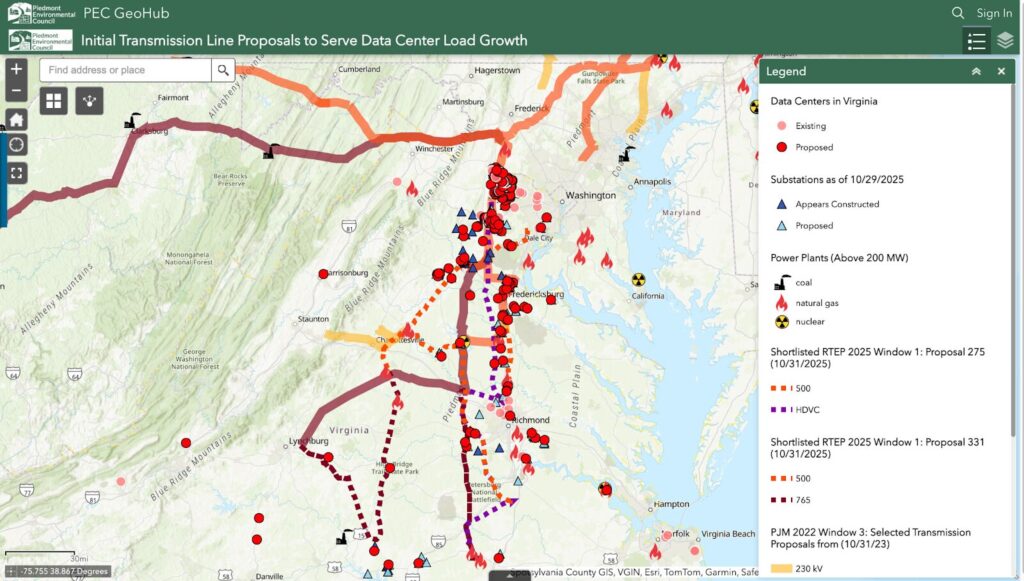
These two projects are just the tip of the iceberg. As of now, there are as many as a dozen similar transmission proposals needed to power data center demand (see map below). On top of the costs to average ratepayers, no mitigation plan is in place to lessen the adverse impacts of the transmission lines to our environment and communities. Data centers should pay the costs of such mitigation, and the SCC should consider undergrounding portions of the transmission lines and approving alternate routes.
In total, the impact of transmission alone on Virginia ratepayers is estimated at $28.3 billion in capital expense, according to Dominion’s 2025 IRP filing. The total capital expense, depending on the type of generation, ranges from $91.8 billion to $270 billion. For perspective, Virginia’s entire operating budget was $83.3 billion in 2024, and the 2025 budget for the Virginia Department of Transportation (VDOT) is $8.87 billion, $2.5 billion of which is allocated to capital projects.
3. At the end of November, the SCC will issue its ruling in the historic rate-setting case.
The SCC, an unelected board of three commissioners appointed by the General Assembly, holds the fate of Virginia’s energy future in its hands when it determines who’s responsible for paying for the billions of dollars of infrastructure needed to meet data center energy demand. This case is one of the biggest decisions the SCC will ever make — and one that will have lasting impacts on all Virginians for generations to come.
Beyond its rate setting authority, the SCC reviews and issues final approval of generation, transmission and substations. It will consider dozens of transmission proposals in the coming months and years, and it must ensure that data centers, not Virginian families, farms and small businesses, pay for the billions of dollars of infrastructure needed to power data center campuses. The SCC must also ensure that high-volume users — data centers — are contributing to the mitigation costs needed to preserve our environment and the value of our communities.
The SCC, along with the Governor and General Assembly, has a lawful obligation to prioritize Virginia’s citizens. There is currently no definitive public plan for managing energy demand and supply in Virginia. Instead, we are allowing for-profit tech companies to determine the future of energy infrastructure.
The system is broken, and we know what’s causing it. We can control our energy and economic future if we take the tough, necessary steps now to implement oversight and mitigation. Virginians need accountability, transparency and answers. We need to build a smarter digital future.