SCC Hearings:
When: September 18 & 29, 6:30 p.m.
Where: Rock Ridge High School, 43460 Loudoun Reserve Drive
Community Page: Visit NoPowerLines.org for more information and notices.
Download PDF of Talking Points →
Background
What is the Golden to Mars Transmission Line Project?
Golden to Mars is the last segment of a three-part loop to serve Data Center Alley, which connects with the Aspen to Golden line (currently under litigation) and the Wishing Star to Mars line. It also includes two offshoot 230 kV loops (Lockridge and Sojourner).
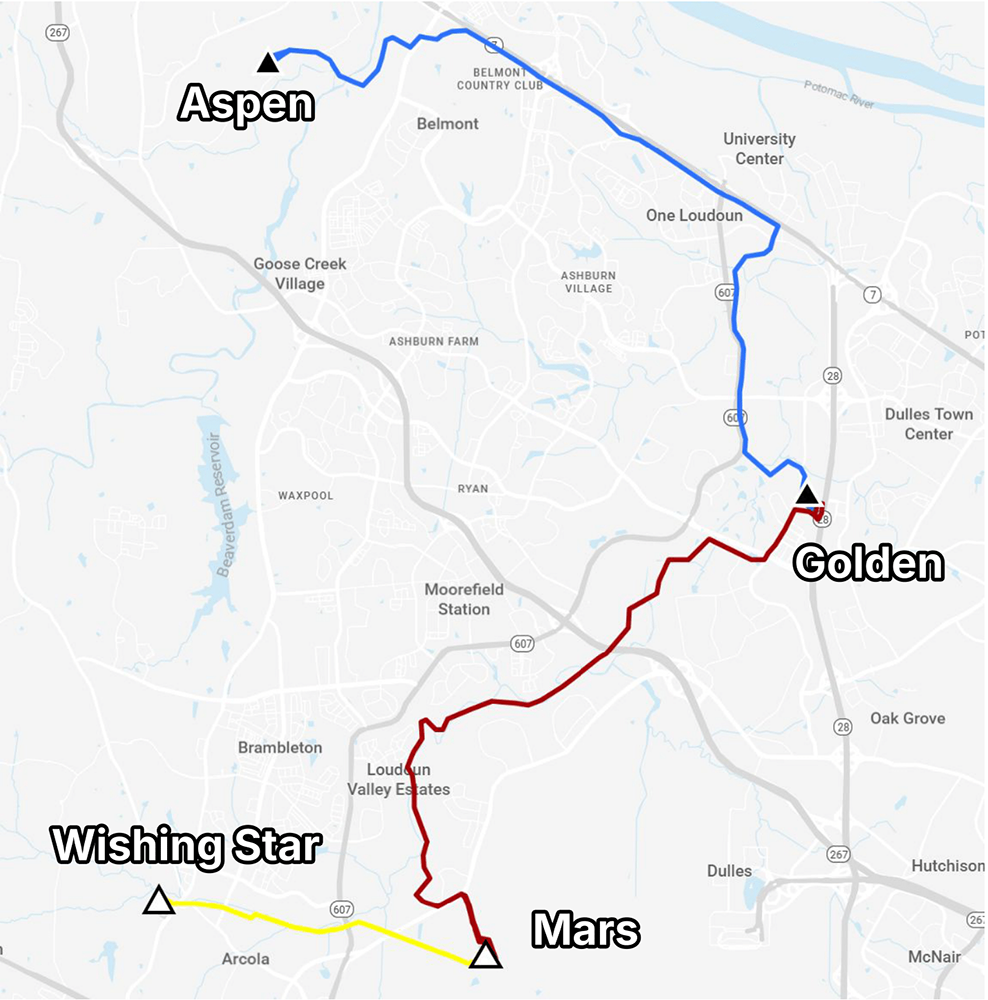
Dominion Energy plans to build eight to nine miles of new transmission infrastructure in the Ashburn and Dulles area to carry 500 kV and 230 kV powerlines to Data Center Alley.
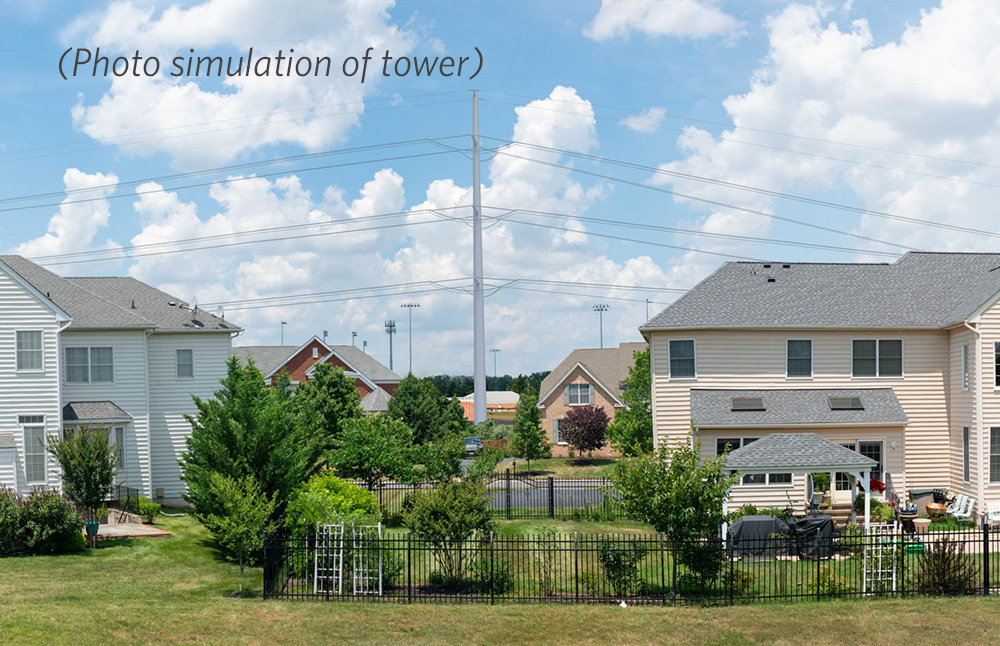
Monopoles, 185-feet-tall, will connect the Golden substation (just west of Route 28, near the Dulles Wegmans) to the Mars substation (just west of Dulles International Airport, near the Old Ox Road data centers).
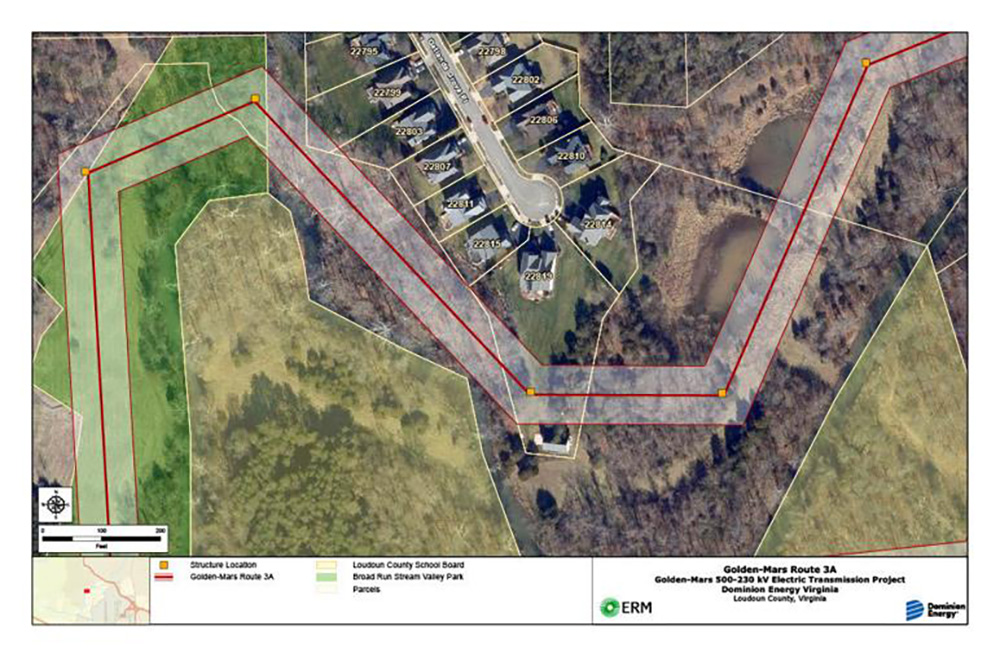
Dominion’s six proposals would require right-of-way through privately-owned land and will run alongside homes in Loudoun Valley Estates. For example, Route 3A even goes through backyards, with a total of 182 homes falling within 500 feet of the proposed high-voltage line.
In response to strong community concerns, the State Corporation Commission (SCC) will hold two public hearings to receive testimony from residents and local groups. This is a testament to the tremendous level of both public engagement and potential impact of this project. It is crucial that residents show support at both meetings.
Timeline of the Golden to Mars project →
Read more about the SCC hearings in our email alert →
Who is the SCC?
The SCC is a regulatory body that makes decisions based on strict standards and factors for consideration. It is important to craft your testimony to address these factors or they will be ignored. Your personal perspective is also important to stress.
Talking Points for the SCC Hearings
The SCC hearings will transform Rock Ridge High School into the Commission’s courtroom, following applicable laws and procedural rules. But don’t be intimidated! Anyone is welcome to attend, and we encourage you to testify on the personal impacts or precedent of this project.
→ Instructions for attending or testifying are available on the SCC website. Individual testimony will be limited to no more than five minutes. If you plan to speak, please arrive early. Signs are not permitted.
In order to have the most impact, it is important to tailor your comments to the SCC’s priorities and objectives, as their decision-making is guided by strict standards. PEC has put together the following talking points to help you craft your comment.
Key factors that the regulators will consider relevant to the Golden to Mars case:
1. There are economic benefits from requiring underground placement.
Loudoun County has requested undergrounding for its economic benefit to the county and feels that undergrounding can be done in a feasible and timely manner. Undergrounding transmission lines that derive from data center electrical consumption is critical for Loudoun County’s long-term success to maintain property values and keep Loudoun a desirable place to live. It also helps data center companies mitigate their impact on neighbors.
Many prospective homebuyers avoid purchasing homes near transmission lines for real and perceived reasons, including health concerns. The affected neighborhoods were completed long before transmission line routes were proposed and now, if an aboveground route is chosen, those closest will be unfairly penalized. In the southern section of the Golden to Mars line, each of the alternate above ground routes would have direct impacts on the residential communities, industrializing portions of neighborhoods and lowering property values. This will lead to social and economic inequities as well as a reduced quality of life.
2. Undergrounding will not have much impact to the local environment.
We believe it is possible to underground the line without significant impact to the Broad Run watershed. Expanding the existing right of way which is outside the Broad Run floodplain would require limited additional tree cutting at the stream crossings. The undergrounded portion would not be in or cross the Broad Run floodplain.
3. The cost of a partial undergrounding is necessary mitigation that should be paid by the data center industry.
A hybrid route, partially underground, is more expensive than a fully above-ground option. However, undergrounding only a segment of the route lessens capital cost. Further, while transmission related costs account for about 4 to 10 percent of the typical consumer’s electricity bill, Dominion could pass on the mitigation costs of transmission line projects (including undergrounding) through its proposed new rate structure for large energy users to address data center demand. (Source: JLARC-2006 study)
It is not typical for a 500kV transmission line to go through a dense suburban community. This mitigation through undergrounding demonstrates a level of fairness and is appropriate for the long term value of the community. The cost of undergrounding should be considered an investment in our community.
4. It’s a crisis by contract; magnitude & timing of the need can be managed.
Dominion has created an artificial crisis in grid stability through its lack of transparency in transmission planning and energy generation that unfairly burdens residential neighborhoods for the benefit of nearby data center facilities. Dominion failed to communicate the transmission needs associated with approved data centers in the County and has expressed unwillingness to adjust timing for unreasonable in-service dates. This has prevented the opportunity for mitigation through an undergrounding solution.
5. Undergrounding demonstrates fair treatment to ratepayers.
Dominion has already informed the public that all ratepayer costs will increase to accommodate built and future data center facilities, itself a burden on residents. But in the face of unprecedented data center energy demand, the SCC will also encounter a growing number of ratepayers, like this, who are doubly burdened. Historically, the SCC has acted narrowly on its statutory obligation to protect all ratepayers, tolerating greater local impacts on subsets to protect economic interests of the whole. But this second class of ratepayer, bearing both the physical and financial burden of industrialization, will become more common. The SCC must find alternatives that don’t penalize unsuspecting ratepayers for a single industry’s benefit, but instead work with end-customers (notably missing from this discussion) to protect those not driving demand.
6. Undergrounding 500kV transmission lines should be promoted as pilot program.
Only one 500kV transmission line has been buried in the US (Chino Hills, CA). The lead contractor for the Chino Hills project was Black & Veatch. Black & Veatch is a contractor of Dominion’s. Northern Virginia is the Data Center capital of the world. These transmission lines are coming in at a rapid pace industrializing our residential and sensitive areas. Dominion must have in its toolset the ability to underground these lines in the appropriate areas. A pilot program will allow our utilities to learn from and construct future underground projects where it makes sense. The Mars to Golden site has already been studied and a viable underground solution has been identified by the County and community’s engineering experts and the SCC has the broad authority to implement such a program.
It’s best if you take these ideas and put them in your own words, relying on your personal perspective and the impact on your life. Below are a couple of ways that you could do this. Don’t forget to limit your comment to five minutes!
An example talking point in practice
Pick one of the bulleted items from the key factors list above – for example:
There are economic benefits from requiring underground placement.
You could say something like this:
“Loudoun County may have lower taxes because of data centers, but these companies are lowering the value of the county as a desirable place to live; particularly because of the industrialization that transmission lines and substations are creating…”
Then add your own perspective and concerns, like this:
“… The powerline will reduce my property value because the routes are (within x ft of my home/within my community/etc), lowering the overall attractiveness of this area and making homes less desirable. Transmission lines through residential areas were not in the County’s or my community’s master plan so I did not know about this possibility when I purchased my home (x) years ago. It creates second class residents and lowers the overall attractiveness of our community…”
Then have a wrap-up statement supporting a hybrid approach for a short segment, like this:
“… An investment in a pilot program to underground part of this line will provide a new approach to minimizing and mitigating impacts on residential communities who will be increasingly impacted by transmission lines that are not intended to serve their needs.”