50 Year Old Methodologies No Longer Work for Virginia; PEC urges State Corporation Commission to Adopt Modern Cost Allocation Methodologies and Commonsense Consumer Protections
Warrenton, VA , July 17, 2025 – The Piedmont Environmental Council submitted expert witness testimony to the State Corporation Commission (SCC) regarding the commission’s biennial review of Dominion Energy’s rates for generation, transmission, and distribution services. (Read full written submission here).
This SCC review is the first opportunity to address the electricity rate structure for the largest concentration of data centers in the world. The current rate structure spreads infrastructure costs over Dominion’s entire customer base. This means that all ratepayers must pay for the infrastructure data centers require, a financial burden that should not be placed on residents and other businesses.
In the last decade, the energy demand of data centers has expanded eightfold from 462 megawatts in 2013 to 5.8 gigawatts in 2024. Today, individual data center projects, which often comprise several massive data center buildings, can demand between 300 MW to 7,000 MW of power, just for a single campus. Dominion Energy recently reported that it has over 40,000 MW of data center capacity in various stages of contracting. That’s the equivalent of powering 10 million homes; Virginia currently has approximately 3.4 million households.
Many states are taking action. Ohio,Texas, Minnesota, Georgia, Utah, California and Oregon are pursuing ratepayer protections, and other states have legislation pending. Virginia should be leading this list, as Virginia ratepayers are most at risk of providing massive subsidies to the data center industry, which includes the wealthiest companies in the world.
Northern Virginia has witnessed the rapid and dramatic expansion of data centers over a relatively short period, especially in the past five years. First, they were small enough to fit in one room. Next they expanded to cloud computing and storage.Today, they support the explosive growth of AI, with hundreds of data center buildings larger than Walmart supercenters approved or under review across the state. As much as the number of square feet of data centers has increased, the demand for more energy has grown even faster. The projected demand is more than our electrical grid is capable of providing.
The cost of the transmission lines, generation facilities, and substations needed to support approved and projected data centers has been growing dramatically. When the SCC directed Dominion Energy to examine the costs attributable to data centers as part of its 2024 IRP, Dominion’s filing showed that data centers are the main reason energy demand is projected to skyrocket in the years ahead (see graph below).
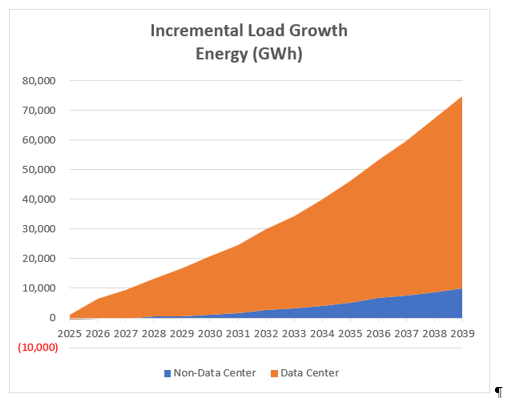
Dominion Energy’s 2024 IRP forecasted a cost of approximately $100 billion to accommodate projected demand increases by 2039. This estimate was based on a projected data center peak load increase of 8 gigawatts by 2039. On a recent investor earnings call, however, Dominion Energy told shareholders that it had 40 gigawatts of data center capacity in various stages of contracting as of December 2024.
“A new approach to assigning costs is in order to replace a rate-setting methodology that Dominion has used for 50 years, in which costs are spread across the entire customer base. The size and scope of data centers and their need for power and energy infrastructure is unprecedented, and the current structure for sharing cost no longer works,” said Chris Miller, president of The Piedmont Environmental Council. “The SCC must create a rate structure that more fairly assigns the infrastructure costs to those entities that create the costs. Residents and other businesses should never be saddled with the business expenses of the richest companies in the world.”
As part of its biennial review filing, Dominion Energy proposed a new rate class for high load customers, defined as those requiring 25 MW or more. This would apply to the majority of existing and planned data centers. PEC agrees it is appropriate for Dominion to place its largest customers in a separate rate class, but demonstrates that the utility’s proposal does not go far enough to protect consumers and does not address fundamental flaws with the current allocation of costs.
In direct testimony filed on July 16, PEC’s expert witness argued that Dominion’s current methodologies for allocating costs are no longer appropriate in light of the massive changes to Virginia’s energy system. PEC recommends several changes to Dominion’s rate structure to ensure that data center customers pay their fair share for the infrastructure they require.
- Fairness: PEC urges the SCC to require transmission and distribution infrastructure costs to be more fairly allocated to data center customers that are driving much of the new infrastructure needed through their excessively high requests for service. Under current regulations, much of these costs are paid for by customers whose electric usage is flat. Everyone pays even when a transmission line is only needed to serve a data center customer.
- Methodology: PEC also recommends that the SCC modify the way electric generation expenses are recovered from customers. The current methodology, which Dominion has used for over 50 years, shifts too much of the burden to residential and small commercial customers. Continuing this practice is unfair because the unprecedented increase in peak demand projected by Dominion is almost entirely due to high-load factor data center customers – not small energy users.
- Consumer Protections: PEC also urges the SCC to adopt more stringent consumer protections than suggested by Dominion, including requiring data centers to make minimum financial commitments and agree to longer contract terms before receiving electric service. This is critical to protect all ratepayers from the risk of being left paying for transmission and power generation infrastructure if the data center growth doesn’t build out as expected.
“It is not clear what the next 10 years will bring. What we do know is that there will be capital expenses and other unknown factors that should be factored into the rate structure. The SCC has the obligation to create a system that protects residential and small business ratepayers and does not subsidize global companies. Virginia citizens and businesses are depending on the SCC to do the right thing,” said Miller.
#####
Media Contact: Michael F. Doble, APR, CFCP
Piedmont Environmental Council Communications
[email protected]; (703) 579-7963